Never-Before-Seen Ancient Roman House Of The Griffins Buried Underground Opens To The Public

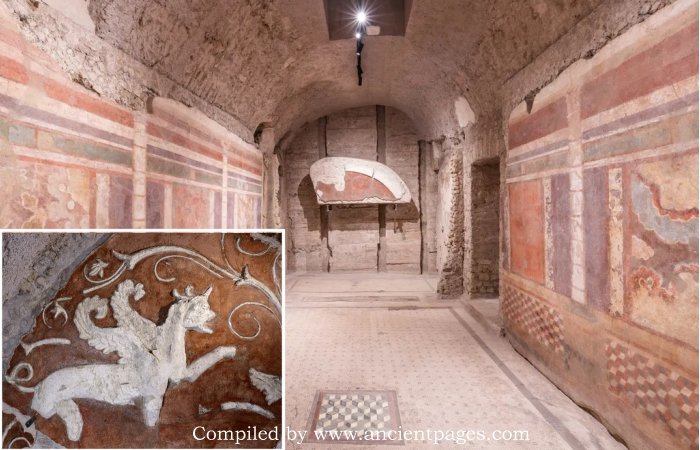
Jan Bartek – AncientPages.com – The House of the Griffins (Casa dei Grifi), one of the best-preserved ancient Roman homes, is now accessible to the public for the first time. The name “Casa dei Grifi” originates from a decorative motif featuring griffins—mythological creatures depicted with the body of a lion and the wings and head of an eagle. This distinctive decoration can be seen in one of the main underground rooms, giving the site its unique name.

Credit: Simona Murrone, Colosseum Archaeological Park
This 2,000-year-old subterranean residence is situated on Rome’s Palatine Hill, close to the Colosseum. The area was historically significant, serving as the location for temples and the homes of prominent citizens during Rome’s Republican era, which spanned from 509 B.C. to 27 B.C. With the advent of the Roman Empire, Palatine Hill became an aristocratic district as new palaces were constructed over earlier residences.
The House of the Griffins became concealed underground when Emperor Domitian constructed his palace above it in the first century A.D. As a result, this ancient site remained hidden from view for centuries
The underground house was discovered in the 19th century by Italian archaeologist Giacomo Boni. Remarkably well-preserved, its murals remained concealed beneath layers of dirt accumulated over centuries.
You don’t need to travel to Rome to visit the House of the Griffins; experience it—virtual tours are available.

Credit: Simona Murrone, Colosseum Archaeological Park
Following over two millennia and a comprehensive restoration effort led by the Colosseum Archaeological Park in 2024, visitors can now explore this historic site starting March 3. The restoration project focused on reinforcing structural stability and conserving wall paintings by cleaning surfaces and reviving their original colors and details.
Additionally, new lighting and audiovisual systems have been installed to enhance guided tours both onsite and virtually.
“The restoration and consolidation involved an integrated intervention, including 3D photogrammetric surveys and restoration of the painted surfaces. Thanks to the allocated funds, it was possible to launch a scientific study and conservation project for the monument, both for its painted surfaces and its structure, given the evident signs of movement in the masonry that occurred in ancient times, resulting in gaps in the walls, plaster loss, and differences in level in the mosaic floor.
In the following months, the lighting enhancement and audiovisual system for the real-time live tour, designed by Federica Rinaldi with technical supervision from Stefano Borghini, were completed, thanks to the sponsorship of Comoli Ferrari, allowing the site to remain permanently open,” the Colosseum Archaeological Park’s director, Simone Quilici, said in a press release.

Credit: Parco Colosseo
Visitors will not physically enter the home’s private rooms, as these are located underground and accessible only by a steep staircase. Instead, guests above ground will observe a tour guide wearing a head-mounted smartphone as they descend into the domus and explore its rooms, providing live narration of the experience.
This live virtual tour offers several advantages. It enables visitors to view areas of the domus that would otherwise remain inaccessible due to their subterranean location. Additionally, by restricting physical access, the livestream helps preserve the fragile frescoes from excessive humidity and carbon dioxide.
See also: More Archaeology News
“Its location at the highest point of the hill, its distribution over several levels that take advantage of the slopes of the Palatine Hill itself, and its preservation make it today an almost textbook reference,” she told Euro News.
“It was certainly a domus of the highest standard.”
Beginning March 3, livestreamed tours will take place every Tuesday, with sessions offered in both Italian and English. Additional languages may be added in the future. Each group is limited to twelve participants and requires advance reservation. Please note that an extra ticket is needed for these tours, in addition to the standard Colosseum-Palatine Hill entrance fee.
Written by Jan Bartek – AncientPages.com Staff Writer