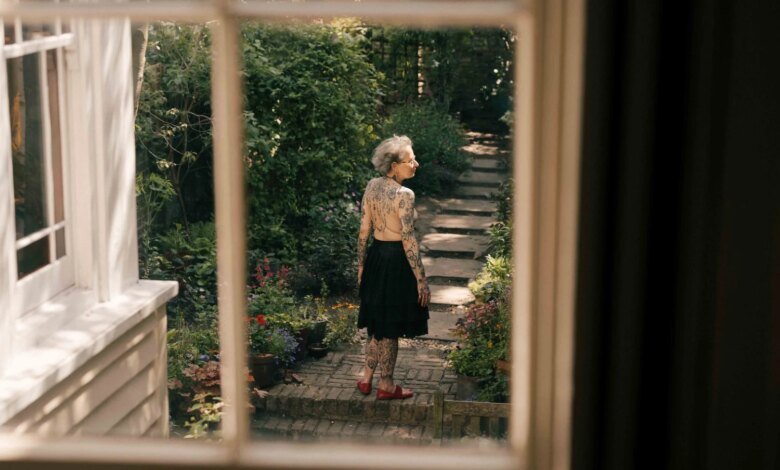
To coincide with the release of a new book that portrays the lives of mother-daughter artists Lois and Carey, we speak to Rona Bar and Ofek Avshalom, the Israeli photographers behind the project
“This one encounter opened us up to a whole new world,” says Rona Bar, one half of the photography duo Fotómetro. “[After seeing] their relationship, the house and the way they relate to their Jewish heritage, we knew we had to come back.” She’s speaking about artists Lois Ward-Marvin and Carey Marvin, the daughter and mother whom she and her partner Ofek Avshalom spent over a year photographing. The results can be seen in their new book, Lois & Carey, which documents the idiosyncratic everyday lives of these two women.
The pair stumbled across Lois’s Instagram profile when they were researching participants for their previous project, Proof of Existence. Something about her art and performative personality hooked them, says Rona. “We were also very intrigued by the way she embraces her Jewish identity,” adds Ofek.
Lois in tefillin
They arranged to meet at Lois’s eclectic family home in central London, where she introduced them to her mother, Carey, and it wasn’t long before a friendship blossomed. “We started to show up even without the camera,” says Ofek. “They showed us a world we didn’t know existed. They introduced us to the Jewish art and queer communities in London. We thought we knew what being Jewish meant, but [with them] we found a completely different identity.”
For Lois, her expression of Judaism in art is clearer, whether that’s in her latex bra emblazoned with a Star of David on each breast, or wrapping her body in tefillin (ritualistic straps and boxes containing passages from the Torah, typically worn by Orthodox males). Carey’s art, on the other hand, can be seen in bits of embroidery (on a yarmulke, for example) and across her body in tattoos inked by Lois, such as the word HOPE splayed across her chest, interlaced with the letters of the word in Hebrew: TIKVAH. These evocative snapshots captured sympathetically by Rona and Ofek are contrasted alongside shots of everyday activities such as watering plants and preparing for Shabbat, and suggest both a quiet modesty and fierce confidence.
Rona and Ofek, aka Fotómetro
Originally from Tel Aviv, Rona and Ofek are now based in north London. They met over social media when Ofek responded to a call out by Rona for collaborators, and they worked together for a year before getting together romantically. “We started a creative project that ended up being our first book, Us, which was about couples,” says Ofek. “It was inspired by our own relationship, which started during the pandemic.”
Published in 2022, Us provides an intimate glimpse into the homes of 28 couples who live on the fringes of what is deemed the societal norm. Dispelling ‘otherness’ is a theme that runs through much of the artists’ work. “The taboo,” as Ofek calls it. “Diane Arbus is one of our favourite photographers,” he continues. “She explored this, but in a different time. She did it in a documentary way, but we are also inspired by artists like [the American film director] Tim Burton and [the British fashion photographer] Tim Walker, who do it in a more staged, fantasy way.”
Lois using hand poke tattoo on Carey
Since founding Fotómetro in 2019, Rona and Ofek have had work exhibited in numerous galleries, including the Saatchi and National Portrait Gallery in London, Jewish Museum Vienna and the Eretz Israel Museum in Tel Aviv. They’ve been featured in Vogue Italia, i-D, Dazed, The Guardian, The Times and more, and they’ve won a number of accolades, including the Eve Arnold Photography Prize at the 2025 Women in Art Prize, an Independent Photographer Award (2023) and a European Photography Award (2022).
Their projects have explored topics from queer theatre, with the British collective Sweet Beef (Notes on ‘Camp’, 2024), to teenagers in Tel Aviv (Youth, 2021) and journeys in self-discovery (Tell Me Where Your Freedom Lies, 2022-24). But until now the pair hadn’t artistically delved into their Jewishness. “We find it fascinating to express our ideas through other people,” says Ofek, “but we never felt the need to explore our heritage until we found ourselves abroad during a hard time [in the wake of the 7 October attacks]. Then it felt like the natural thing to do. We’re still examining the same things we did before, but this time through a Jewish eye.”
Lois’s childhood bedroom
Of the collection of images of Lois and Carey featured in the book, one of Ofek’s favourites is of Lois tattooing Carey. “It’s in Lois’s room,” he says, “which is her home studio, and she’s using a hand poke technique [done manually with a single needle, rather than a tattoo machine]. It reminded me of a daughter doing a drawing for a mother, but she’s using her mother as the canvas. It represents a transformation from childhood playfulness to the complexities of adulthood. Some people might find it odd having a daughter tattooing a mother, but in their relationship it’s very natural.” Rona’s, meanwhile, is a shot of Lois’s childhood bedroom, which is currently used for storage, but still has its lurid pink mantelpiece, “like a portal to the past”, says Rona. “It carries traces of life experienced, but also the way we evolve, [showing how] memory shapes us in subtle, unexpected ways.”
Each of the photographs holds a variety of ideas and beliefs, Ofek explains. “We want the viewer to be provoked and have an authentic response.” These images are not there to be analysed but, as Rona puts it, to invite the viewers to feel.
By Danielle Goldstein
Photos by Rona Bar and Ofek Avshalom
Lois & Carey (89books, 2025, £48) is out now. thefotometro.com/books
This article appears in the Winter 2026 issue of JR