

As generative AI tools become more widely used, a key issue is the technology’s impact on labor demand. Where might we find evidence of that impact? In this post, we examine whether early evidence of AI’s effect on the labor market appears in firms’ job postings. We combine an occupational measure of AI exposure with detailed U.S. job-posting data from Lightcast, which aggregates listings from company career pages, national and local job boards, and job-listing aggregators. Using this data, we test whether postings for AI-exposed occupations declined disproportionately since the release of ChatGPT in late 2022. We find that, while overall hiring has slowed since then, the evidence from job postings provides little indication of a distinct AI-driven decline in labor demand.
Measuring a Job’s Exposure to AI
To measure how exposed different jobs are to AI, we use a task-level AI exposure metric developed by Anthropic that combines detailed task descriptions from O*NET with observed AI usage. O*NET breaks each occupation into a set of specific activities that workers regularly perform. For example, a copywriter may edit or rewrite marketing text, while a web developer may write supporting code for websites and web applications. The Anthropic measure evaluates each task and assigns it an AI exposure score based on three factors: whether the task could theoretically be mostly completed by AI; whether the task actually appears in a sample of AI usage data; and whether AI is used to automate the task rather than augment it.
Tasks receive a higher AI exposure score if most of the observed usage is used to automate, rather than augment, work. These task-level scores are then aggregated to the occupation level using information on how much time workers spend on each task, producing an occupation-level measure of exposure to AI on a scale from 0 to 1.
This measure should be interpreted as the potential AI exposure of an occupation based on observed usage. A job being exposed to AI may not translate into reduced hiring or increased layoffs for the occupation as a whole; in the New York Fed’s Second District, significantly more firms report retraining workers in AI-exposed occupations than reducing hiring. In practice, even if many tasks within an occupation are highly exposed to AI, a single task may limit the extent to which the occupation as a whole can be automated.
Using this measure of an occupation’s exposure to AI, the chart below compares the distribution of AI exposure across occupations in employment (blue) and in job postings (gold). Each bar shows the share of workers or vacancies in occupations within a given range of AI exposure. Moving right along the x-axis corresponds to occupations with higher exposure, while the y-axis reports the share of employment or postings in those exposure bins.
AI Exposure Remains Limited in Both Employment and Vacancies
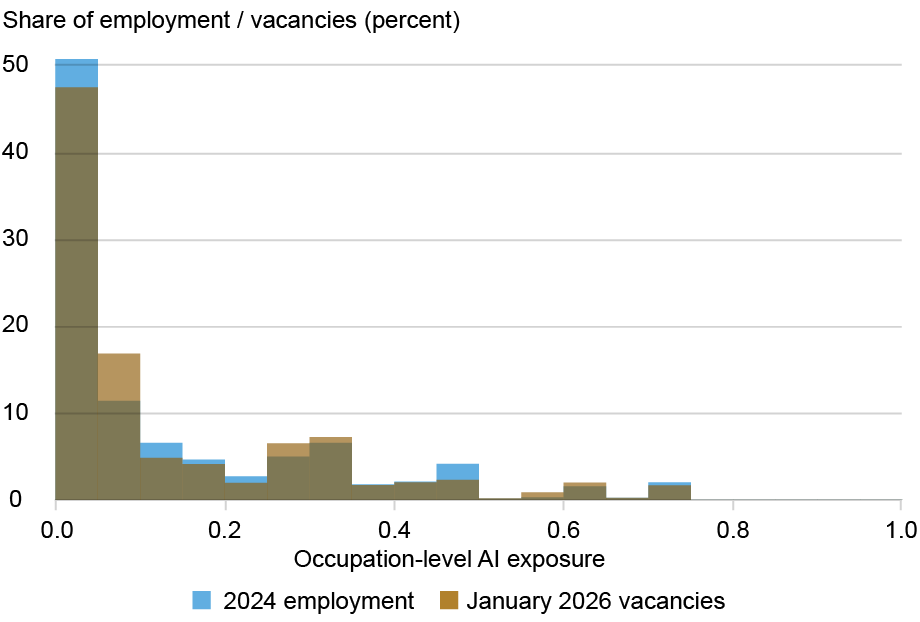
Notes: Bars show the share of total employment in 2024 (blue) and vacancies from January 2026 (gold) across occupations grouped by ranges of AI exposure. (The dark green is where the two overlap.) The x-axis reports bins of AI exposure, and the y-axis reports the share of employment or vacancies within each bin.
The chart highlights that AI exposure remains relatively limited. Only a small share of employment or vacancies is concentrated in occupations with high AI exposure—less than 10 percent of workers and vacancies are in occupations with an AI exposure of at least 0.4—and 40 percent of workers are in jobs with zero measured AI exposure. Given this limited exposure, do we see any impact of AI when we look at the change in job postings over time?
To examine whether AI is affecting labor demand, we conduct an event study that compares how job postings evolve for occupations with relatively high versus low AI exposure around the release of ChatGPT in late 2022. Here, we define high-exposure occupations as those with an AI exposure of at least 0.2; the results are similar under alternative cutoff values.
The chart below plots the estimated difference in job postings between these high-exposure occupations and less-exposed occupations for each quarter relative to the last period prior to the release of ChatGPT (the difference in 2022:Q3 is zero by construction). The blue line in the chart shows how much more (or less) hiring occurred in high-exposure occupations compared with low-exposure occupations at each point in time, relative to the quarter before ChatGPT was released. The shaded area depicts statistical uncertainty around those estimates. This event study also accounts for persistent differences across occupations (since some jobs consistently have more postings than others) and economy-wide changes in hiring over time, allowing us to focus on differences in hiring by AI exposure.
Declines in Vacancies for AI-Exposed Occupations Began Before the Release of ChatGPT in Late 2022
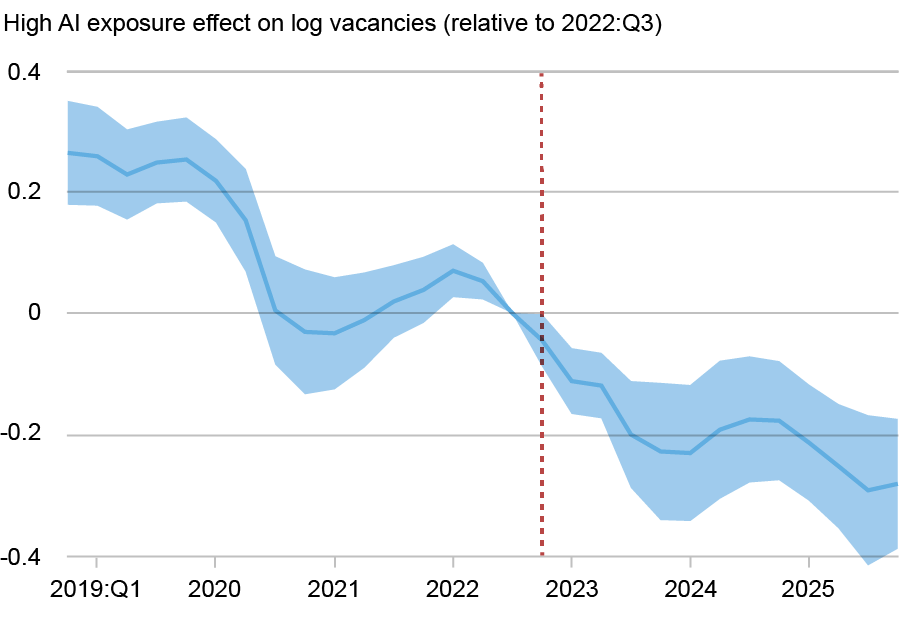
Notes: Occupations are classified as “high exposure” if they have a job-level exposure of at least 0.2. Occupation weights are derived from the number of vacancies for that occupation in 2019. The vertical red line indicates the quarter of ChatGPT’s first public release. Shaded regions indicate 95 percent confidence intervals.
If AI had had a significant causal effect on employment, we would expect the employment difference between exposed and less exposed occupations to behave in the following two ways. First, prior to ChatGPT’s release, hiring trends in high- and low-exposure occupations would move similarly. This would suggest that, in the absence of AI, the two groups would have continued evolving similarly. In the chart, this would correspond to estimates being statistically indistinguishable from zero in all quarters prior to 2022:Q3. Second, a sustained divergence between high- and low-exposure occupations should emerge at some point after ChatGPT’s release. A gap that opens up—and especially one that grows over time—would be consistent with AI affecting labor demand.
While the chart shows a relative decline in postings for occupations with higher AI exposure, the event study indicates that this trend predates the release of ChatGPT. The divergence between high- and low-exposure occupations began before 2022 and does not show a clear additional break in trajectory after 2022. Besides, the gap in labor demand between high- and low-exposure jobs stabilizes after 2023, at odds with AI gradually displacing exposed occupations. This makes it difficult to interpret the relative decline in hiring in AI-exposed occupations as a direct consequence of AI adoption.
Is AI Reducing Demand for Entry-Level Jobs?
Much of the early discussion about AI’s labor-market effects has focused on younger and entry-level workers. Research on the employment impact of AI has found a larger decline in the number of younger workers in occupations with high AI exposure after the release of ChatGPT. At the same time, related work using job postings finds that demand for junior and senior roles in these occupations declined at roughly the same time and by similar magnitudes beginning in 2022.
We conduct another event study to measure the difference in postings between junior and senior roles within occupations with high AI exposure, relative to late 2022 (shown in the chart below). Values above zero indicate that postings for junior roles increased relative to those for senior roles within the same high-AI-exposure occupation, while values below zero indicate the opposite. For example, if the line remained consistently above the horizontal axis after 2022, it would suggest that labor demand for junior positions in high-AI-exposure occupations had grown relative to hiring for senior roles in those same occupations.
No Clear Divergence in Labor Demand Between Junior and Senior Positions in Occupations with High AI Exposure
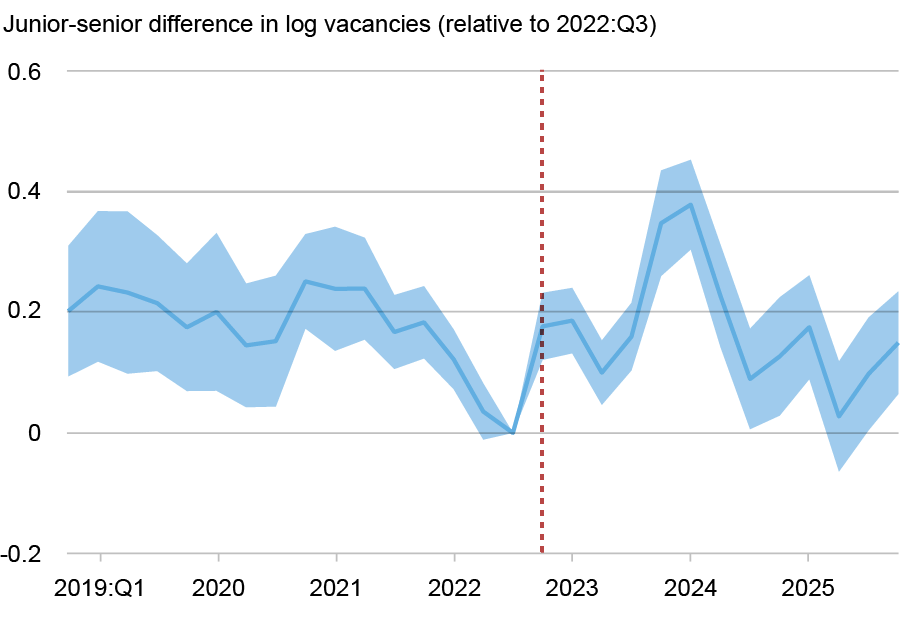
Notes: Occupations are classified as “high exposure” if they have a job-level exposure of at least 0.2. Job postings are categorized as either “junior” or “senior” level by Lightcast based on information in the posting. Occupation weights are derived from the number of vacancies for that occupation in 2019. The vertical red line indicates the quarter of ChatGPT’s first public release. Shaded regions indicate 95 percent confidence intervals.
If AI were disproportionately reducing demand for entry-level work, we would expect the line to move downward after 2022, indicating a relative decline in postings for junior roles. Instead, the line fluctuates, without a clear upward or downward trend. This suggests that labor demand for junior and senior roles within highly exposed occupations is moving broadly in parallel, and that the slowdown in postings is not concentrated specifically in entry-level highly exposed jobs.
Conclusion
Overall hiring has slowed since 2022, and unemployment has increased among young workers and recent college graduates. The evidence from job postings suggests that while AI may be contributing to recent labor market developments, it is not the main driver of the slowdown in hiring. In line with this interpretation, the New York Fed’s business surveys indicate that, so far, firms intend to incorporate AI mainly via retraining, with limited effects on hiring. While job postings show a relative decline in vacancies in occupations with greater exposure to AI, that divergence began before the release of ChatGPT in late 2022. Moreover, we do not observe a divergence in labor demand between junior and senior positions within highly exposed occupations. These patterns make it difficult to attribute the recent slowdown in entry-level hiring to AI alone.

Richard Audoly is a research economist in the Federal Reserve Bank of New York’s Research and Statistics Group.

Miles Guerin is a research analyst in the Federal Reserve Bank of New York’s Research and Statistics Group.

Giorgio Topa is an economic research advisor in the Federal Reserve Bank of New York’s Research and Statistics Group.
How to cite this post:
Richard Audoly, Miles Guerin, and Giorgio Topa, “Do Job Postings Show Early Labor‑Market Effects of AI?,” Federal Reserve Bank of New York Liberty Street Economics, May 14, 2026, https://doi.org/10.59576/lse.20260514
BibTeX: View |
Disclaimer
The views expressed in this post are those of the author(s) and do not necessarily reflect the position of the Federal Reserve Bank of New York or the Federal Reserve System. Any errors or omissions are the responsibility of the author(s).