Google looks to ease publisher concerns over the impact of AI Overviews on referral traffic

As Google continues to integrate more artificial intelligence-powered features into its Search tools, referral traffic trends are changing, and SEO, as it’s long been known, is transforming.
But Google is aware of the impacts of its AI evolution, and it’s now working to add in new tools and options to keep Search referrals flowing through to websites. Meanwhile, the company is also providing new guidance on how website managers can optimize their content approach to align with this shift.
First, in terms of Google Search display. Google said that it’s increased the number of inline links directly within responses, and added website previews to encourage more click-through responses within Search results.
Google also added Preferred Sources to its AI overviews to help users define their own experience. In addition, the platform is experimenting with a range of new link designs in its AI elements to make them more useful.
In combination, these tools provide more ways to drive referral traffic and address concerns about AI summaries diluting traffic.
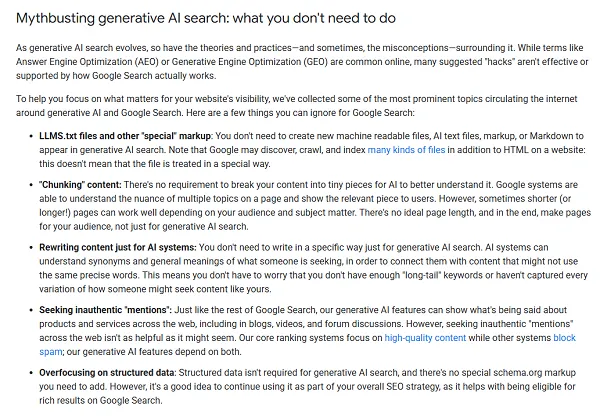
Google also provided an overview of optimization tips for its AI elements. This explainer also looks at how traditional SEO practices align with the AI shift.
Google also added new controls that will enable website owners to essentially opt out of its AI search features, and have their content withheld from AI overviews.
This update comes in response to a ruling from the U.K.’s Competition and Markets Authority, which dictates that, in the U.K. at least, website owners must have the ability to control how their content is used within AI features.
As per the CMA: “In a world first, publishers will now have effective tools to prevent their content being used to power AI features in search, such as AI Overviews. This will put publishers, like news organisations, in a stronger position to negotiate content deals with Google.”
Google said that sites that opt out of AI search will not receive traffic or impressions from its generative AI features. Google also said these controls will not be used as a ranking signal for search results outside of these generative AI Search features.
The additional control ensures that website owners maintain control over their data. This also means website owners can restrict Google’s capacity to reduce referral traffic by providing in-search summaries of their content.
Yet, at the same time, the final outcome might not be so positive for those who choose to restrict their content, because opting out will likely reduce overall referrals even further, based on the prominence and popularity of Google’s AI overviews.
In addition, U.K. authorities will also require Google to ensure that publisher content is properly attributed, using clear links, in AI‑generated search results.
Finally, Google is rolling out new insights for website owners in Search Console, which will provide data on the appearance of their pages in generative AI Search features.
“These insights include impressions metrics and information about which pages appear in AI responses and in what countries,” Google said. “We’re continuing to work with website owners to understand what insights will be most helpful to inform their strategies, and we’ll introduce additional metrics over time.”
In combination, these additions will provide more ways for web publishers to keep driving traffic from Google Search, while also giving publishers more capacity to manage their listings, and avoid having their own content used to limit click-throughs.
The impact, however, will depend on participation, and ensuring that a lot of publishers do move to control their data. Otherwise the changes will potentially restrict the exposure potential of those that do limit it.
But then again, Google has previously claimed that the impact of AI overviews has been blown out of proportion anyway, with actual click-throughs and referral trends not seeing any massive declines as a result of its AI summaries.
In August, Google reported that it hadn’t seen a significant decline in total referral links being sent from Google Search results as a result of its AI overviews.
Google said that, overall, total organic click volume from Google Search to websites had been relatively stable year over year, while click quality had increased.
That’s despite external results showing significant traffic declines for some websites, with news publishers, in particular, seeing big drops in Google referrals. Earlier this year, Search Engine Land reported that Google referrals for news publishers were down 33% globally from November 2024 to November 2025, and down 38% in the U.S. over the same period.
It seems, then, that the true impact lies somewhere in between, with some websites seeing more traffic, and others seeing big declines, depending on the type of query and the way that Google highlights certain elements.
Still, Google said that people are “more satisfied” with its AI search features, and that they’re also searching more often. “AI Overviews now has over 2.5 billion monthly active users, while AI Mode has surpassed one billion monthly users,” Google said.
Google added that people are asking entirely new questions, which could be where it’s seeing search gains for some sites.
Either way, with usage figures like these, Google is definitely not getting rid of its AI elements anytime soon, which means that SEO is evolving, and fast.