For Searcy, that constraint was also a liberation. Without inherited systems or legacy assets, the team could stop asking how to update Gears and start asking what Gears actually needs to be in 2026.
“We took advantage of UE5 to bring Gears up to speed with where modern gaming is, without losing what makes it authentic,” Searcy says. “You’re playing a sweaty Gears game — but it’s entirely built from scratch to capture the emotional core of those older games.”
The technical gains are concrete. Hanbeck points to MegaLights – a groundbreaking UE5 lighting system that E-Day is amongst the first games to ship with – as one example of how the new engine serves tone, not just graphic fidelity. We’ll learn more about MegaLights implementation from The Coalition when Rayner takes the stage as part of the State of Unreal keynote at Unreal Fest in Chicago next Wednesday.
“We wanted to lean into the horror-adjacent elements Gears always had,” Hanbeck says. “Light and dark, getting into scarier spaces, dynamic shadows. This tech lets us do that in a way we couldn’t before.”
But the point was never the spec sheet. It was that the technology finally matched the scale of the story. “You really don’t want to tell that story if you can’t deliver on the visual gravitas of what has to go with it. It deserves a certain amount of weight.”
Fawcette puts it simply: “Literally everything you see in E-Day did not exist before we made it for this game.”
One City, Three Days
The Coalition is based in downtown Vancouver, at the intersection of the stadium district and Yaletown — and every Gears game since 2015 has been built there. The studio looks out over BC Place, the working waterfront, and the mountains beyond. When it came time to build Kalona, the city where all of E-Day takes place, Studio Art Director Aryan Hanbeck says the team drew on what was right outside the windows: the ocean, the landmarks, the geography of a city they know by heart.
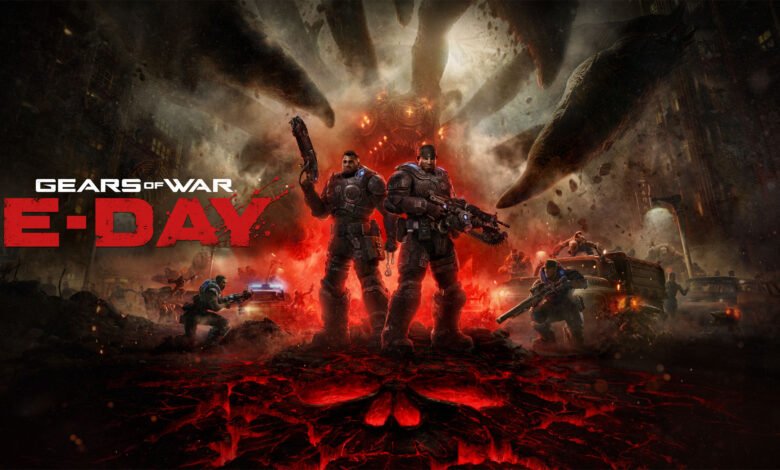
You can feel it. The sports stadium, the industrial waterfront, the airfield at the city’s edge, the dense residential neighborhoods stacked around the refineries that sustain them — Kalona is fictional, but it was built by people who know what it feels like to live in a city like this. That matters, because E-Day is not a story about soldiers traveling to a distant battlefield. It is a story about home being destroyed.
Emergence Day is a global catastrophe — the entire surface of Sera breaks open. But Searcy and the team made an early decision: at that scale, the human impact gets lost. To feel it, you must bring it closer — one city, over three days, as it falls apart around the people who live there.
“We wanted Kalona to feel like another character in the story,” says Hanbeck. “A place with its own history, its own texture.”
“We’re not an open-world game, but this technology has allowed us to build an entire city that feels alive,” Searcy says. “In previous games, you see linear levels that are often disconnected — you load from one to another, they have different vistas, and don’t feel super cohesive. When we look at Kalona in the [UE5] editor, we can literally lift up the camera and look at this entire, integrated city.
That continuity is what makes the destruction land. In E-Day, you watch a living city torn apart—homes still lit, meals half-finished—while people abandon their cars and run for cover. Small details—a child’s toy, an uneaten dinner—make the loss real as everyday places collapse under the Locust assault.
“The environment gets to tell a story, whereas before, you’re just walking through the ruins of cities in the aftermath of war,” Fawcette says. “You’re going to see it through Marcus and Dom’s perspective, but you’re also going to open up the lens of what else is happening in the world, and what other people are going through. That’s pretty unique to E-Day.”
And Kalona is not empty. Marcus and Dom — played again by John DiMaggio and Carlos Ferro, who have voiced the pair since the original Gears of War — are not deployed here. They are recently back from the now ended Pendulum Wars, attending an armistice memorial in the city when the ground opens. The people around them react, adapt, and break down in real time.
“At the beginning, people don’t know what the hell is going on,” Hanbeck says. “Then they’re being slaughtered by monsters. Later, you might encounter groups that are trying to fight back. The evolution of how our civilians act, and how we act towards them, has been one of the most interesting things to explore.”