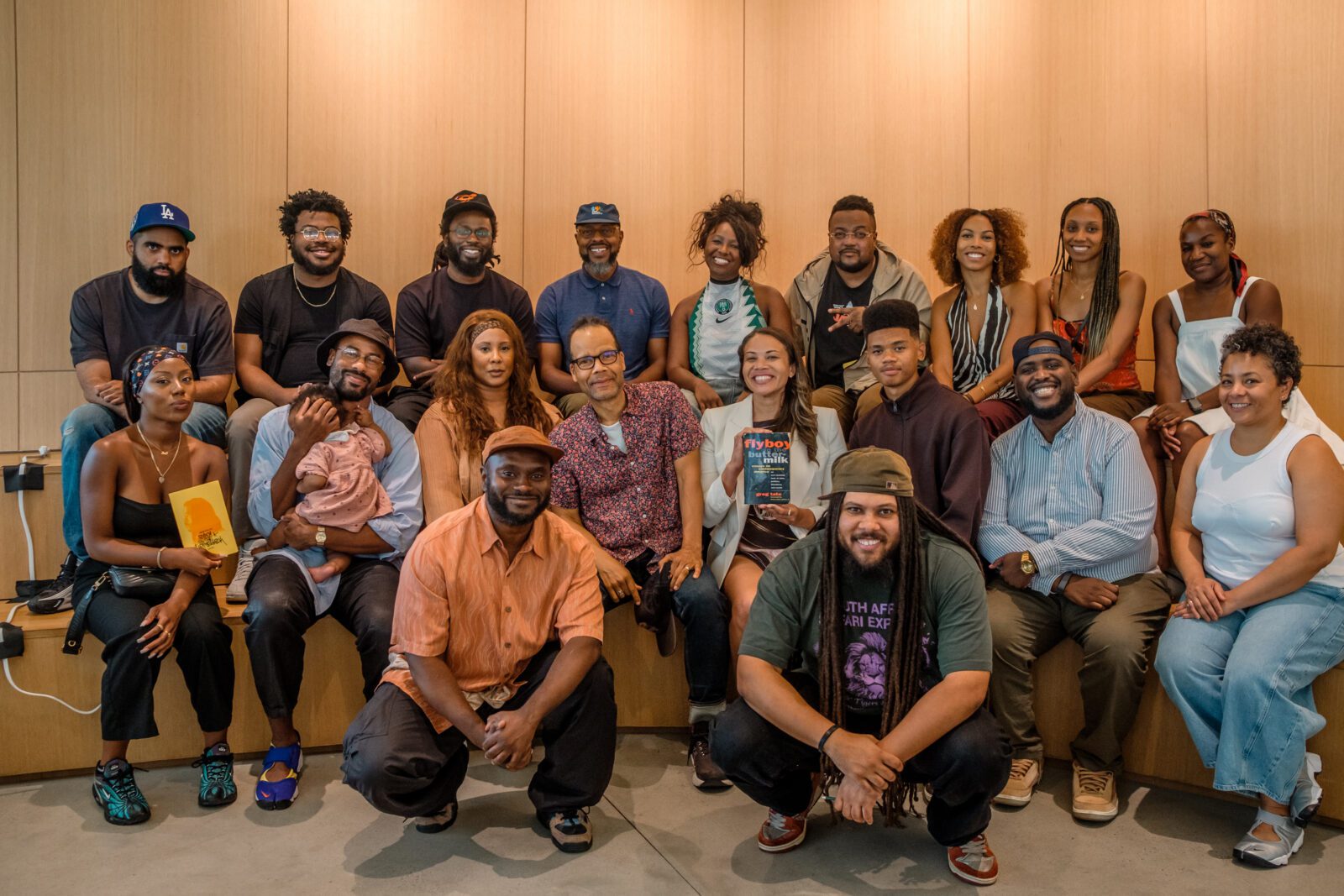
“I’m glad we’re starting with style, to be honest. The man had styles on top of styles,” Elena Bergeron says, addressing a packed house at the Museum of Contemporary African Diasporan Art on a recent Saturday. Bergeron is a writer and editor with The New York Times. “One of the things about looking at criticisms of art is, so much of it takes the form of these nerd-ass essays. Sometimes I need to look at Tate to be like, ‘No, there’s other stuff possible; there’s other ways of thinking about this.’” The crowd responds with knowing laughter.
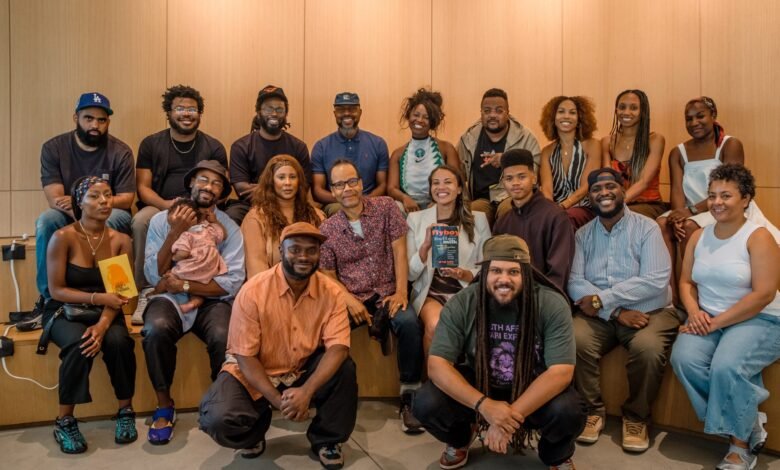
I am, of course, a middle-aged Jewish dork who dresses like one, and I stand out in this intergenerational crowd draped in what I will call “museum couture”: European club and African national soccer kits, tastefully curated rap tees, flowing white linen maxi dresses, geometric earrings and wood-bead necklaces, locs swept up in a pile or hanging to shoulder or small of back, bucket hats, cadet caps, canvas tote bags from art exhibits or independent bookstores, pierced septums and heavily tattooed forearms cradling copies of the recently, finally reprinted classic Flyboy in the Buttermilk. Greg Tate was a writer who wrote for other writers, so, appropriately, there appear to be many here, disciples taking copious notes during panels dedicated to his aforementioned style and his substance.
My point is this is an audience of intelligentsia hungry for culture, for discourse about culture, for language. So hungry they have dedicated four hours of a beautiful mid-summer Saturday to a symposium focused on the work of Tate—a totemic (posthumously honored) Pulitzer Prize-winning Black culture writer and critic, primarily for The Village Voice—who passed away five years ago. As writers, we have been told over and over again this audience no longer exists. Yet here they are. The question remains: How to locate enough of them, to foster a community that will continue to produce this good work?
As opportunities dry up in a market that, as has always been the case in America, disproportionately affects Black labor, in the age of Substack and atomized soloists building individual brands in a vacuum, a long-considered and recently launched project calling itself New Eyes Collective believes it has found a solution in marshaling their forces, pooling their followings and energies to form a kind of super-friends for Black culture writers and editors who have bylines at every major institution of culture journalism left standing.
For now, they are Timmhotep Aku, Ivie Ani, Melvin Backman, Elena Bergeron, Peter Berry, Lawrence Burney, Mankaprr Conteh, Andre Gee, Dylan Green, Clover Hope, Shamira Ibrahim, William Ketchum, Jessica Mckinney, Natalie Meade, Marcus J. Moore, Alphonse Pierre, and Dimas Sanfiorenzo, and their mission is to come together to create a space and opportunities for its members to make and promote work that honors the Black Radical tradition.
If the Tate symposium is any indication, the collective is headed in the right direction. It was praxis, an afternoon dedicated to nerding out over memorable ledes, to poetry embedded in prose, to cascading references, to Jùjú music, to the traditions of Black storytelling Tate honored and pushed forward in his writing.
A few days after the event, I got on a Zoom call with New Eyes Collective founders Timmhotep, Shamira, Andre, Ivie, and Mankaprr to talk about their mission, and how Tate’s legacy continues to influence their work.
(This conversation has been edited and condensed.)
I wanted to start with Tate. For readers who couldn’t make the symposium, how did he inspire the collective, and how did you all decide to make him the focus of the inaugural event?
Timm: When the idea to assemble a group of Black writers occurred to me, I was reading Tate’s “Cult-Nats Meet Freaky-Deke.” Specifically: “There’s no periodical on black cultural phenomena equivalent to The Village Voice or Artforum… Though there are certainly black editors, journalists, and academics capable of producing such a journal, the disintegration of the black cultural nationalist movement and the braindrain of black intellectuals to white institutions have destroyed the vociferous public dialogue that used to exist between them. Consider this my little shot at opening it up again.”
In circles of cultural criticism, especially contemporary cultural criticism, Greg Tate is seen as a North Star. He’s seen as someone who set a standard to aspire to in terms of rigor and style. But Tate, to some extent, became a mythological figure. People would talk about Greg Tate, but they wouldn’t necessarily engage with the work, from my experience.
When I found out that they were reissuing Flyboy in the Buttermilk, I thought that this would be a great opportunity to delve deeply into his work, so he wouldn’t just be a person you name-drop for some of our followers but a person whose stuff they could really engage with. So doing the first event was us saying, all right, let’s share Greg Tate’s actual work.
Shamira: Until this reissue, Flyboy was pretty hard to get in print unless you had it for a while. It came out in 1992. Sometime last year, you could buy used copies for, like, $90. So we wanted to reintroduce this to people who might not even know that this is a major reference that influences some of their favorite writers.
Andre: Rereading the book, on my latest rounds in preparation for the event, was really inspiring in a way that’s timely for me, as I’m trying to figure out how to grow as a writer. Part of the work we’re doing as a collective is future-minded. We’re trying to enlighten people on who the greats are, and why they’re great. Somebody hit the website after the event and they were like, “Thank you for putting me on to who Tate was. Now I have somebody to read.” So that was really cool.
View this post on Instagram
Andre: I feel like every time I read him, I understand him better, just processing it all, because it’s so dense and layered in reference. Overarching, it’s just a reminder that you can be experimental and have more fun with your writing, which is timely with me having a newsletter.
Ivie: I think Greg Tate really did have his finger on the pulse of what matters, as far as culture, as far as music, as far as art, as far as any form of Black authenticity and Black cultural production. He thought deeply and critically. And I always make that distinction because thinking deep is not the same as thinking critically. But I think Tate’s writing showed that he was able to do both.
Timm: Tate was so prescient. He called so much shit. He could see and understand shit so clearly. It was decades ago in some cases, but the stuff that he’s talking about is extremely relevant to right now as it pertains to culture, how Blackness is perceived, and the political economy. It’s valuable to go back to our ancestors’ and elders’ past work and see the connections they made while we live in these realities that they predicted.
Shamira and I were talking before the event Saturday, along the lines that the opportunity that you all have created is not “just” to have this platform to write another tired, critical thinkpiece. It’s an opportunity to shine a light on things that you are passionate about, events you can educate with and express some hope through, and I really felt that in the Tate event. So what possibilities does this collective have you excited about?
Mankaprr: I love the real-life connections between ourselves and the people these events can bring together. A woman came up to me at the end of the event Saturday; she was on her way out and her name is Kathleen and she was a photographer that worked with Tate. She was telling me a story about how they got stuck in Greece while he was covering a music festival. Things like that. Tate’s family was at the event with us. That meant so much.
Shamira: In my opening remarks on Saturday, the core question I asked was: What are we willing to build for ourselves? And I asked that for a couple of reasons. One is our current digital reality as writers is naturally very isolating. I think many of us can attest to the feeling of, it’s you, your laptop, and your co-work space, or your desk or whatever. And between juggling assignments, begging people to read your pitches, it can create this sense of malaise and defeatism. Sometimes it feels like I’m screaming into the void. No one’s listening. I make this joke all the time, but I just assume only 15 people ever read anything I’ve ever written, because people don’t read anymore. So it can be very easy to get caught up in that feeling of defeat and overwhelm, like no one knows what this feels like.
View this post on Instagram
These feel like unprecedented times, and part of the criticality of someone like Greg Tate is reminding us these aren’t unprecedented times. These issues by no stretch of the imagination are unprecedented. The extraction of labor, of capital from cultural workers who survive on the goodwill of patrons—we’ve exchanged individual patrons for private-equity billionaires, but it’s the same function, ultimately. But in that space, the writers who came before us were able to still build something.
So, for me, it’s like we can sit online every few weeks and argue about how writing is dead and done with and AI is taking over all of our resources and nobody cares. And if we keep saying it, then sure, nobody will care, because we don’t care, either. Or we can corral our resources, especially those of us in this collective who have years of experience at every level of editorial publishing, and think about how we can build something that’s greater than the sum of its individual parts and set a foundation that hopefully can help people to avoid feeling like their experiences are unprecedented 20 years from now.
Ivie: The epitome of what we’re doing is linking and building with a purpose. I think New Eyes is our opportunity to build a better ecosystem—for Black culture workers and for media in general—in which we don’t replicate the same systems that have oppressed us, that have pushed us out of the industry, or pushed us to the margins of the industry.
I hope that our work can no longer just exist as a product for media companies but as something that can inspire people in the way that the event did. There were so many people that came up to each of us and told us how much they appreciated the event. And this was our first announcement of anything. So to get that type of reception shows that this is something that people want.
We can sit online every few weeks and argue about how writing is dead and done with and AI is taking over all of our resources and nobody cares. Or we can corral our resources and think about how we can build something that’s greater than the sum of its individual parts. —Shamira Ibrahim
Let’s talk about the industry. I was wondering if you could all speak to the punishing and unpleasant institutional and structural experiences that made starting this collective necessary.
Timm: It has always behooved Black people to collectively organize on behalf of themselves as workers, and I think that’s something that’s overdue for the world of culture journalism. When I started having private conversations with folks, DMing folks, emailing folks about doing this, it was because I saw a need. We started New Eyes to figure this out, because, god damn, nobody is going to figure it out for us. The institutions have never decided to figure it out for us. I’ve been laid off countless times and places. There is no safety net for the Black media worker. The Black media worker is usually last hired, first out, and I’ve literally been in that situation.
Shamira: To Timm’s point, Black editorial labor is viewed from a point of extraction, not a point of contribution. Just look at this decade. In 2020, 2021, there was a huge explosion of Black criticism. I saw someone call it the identity thinkpiece boom, where all of a sudden, every editor needed to have a Black History Month issue, every editor needed to care about the right organizations, every editor was invested in rappers that were doing community work. All of a sudden, all of us—I think I could say, all of us on this call—were getting swarmed with commissions, swarmed with asks, so on and so forth.
Now, you see the headwinds changing. Fascism on the rise. All of a sudden, it’s not convenient to care about Black shit anymore. It’s not convenient for that to be a priority, both on the page as well as with respect to politics. And I think for many of us who have spent time at all different levels of the corporate media world, it just feels like you’re banging your head against the wall. That at any point, you are put back at zero. They can decide, actually, we don’t care about Black things anymore. Our readership isn’t Black. We are not invested in actually trying to do the progressive thing here. Or, actually, the private-equity companies that own all of our archives of hip hop media, as you know, Abe, actually are not invested in making sure that any of that is available. At some point it feels like a self-defeating effort: to continuously beg corporate management to offer us respect.
So, then, what can we do? We can demand our respect.
Timm mentioned being laid off many times. I was wondering if there were specific experiences you all have had that made you decide, “Fuck this. We have to take action and do something.”
Ivie: I definitely have a story, but I would have to tell you off the record.
Andre: When I was at Rolling Stone, I felt like I was doing good work, and they just threw me away. It made me feel disposable. We’ve been saying it’s a fact of life to be laid off, but I never experienced anything like it.
It’s like the 2020 racial justice initiative, when you could have players wear “I Can’t Breathe” shirts on NBA 2K. And I was like, damn, I kind of feel like that’s Complex hiring me. It’s not that far off from that. It kind of elucidated how companies and corporations were trying to do anything to seem woke and progressive, like Shamira was saying. I realized I kind of got swept up in that myself. I realized how in so many ways, I was used and extracted and manipulated, which was scarring. And for me, if I were to put myself back in that position, on staff somewhere else, it would be like, fool me twice. Why would I do that?
Ivie: I think many of us have felt what it feels like to be fawned over in the industry, and we’ve also felt the fangs of the industry. That is a very singular experience for Black writers. You get put on this pedestal when it is beneficial to the industry to have you there. And you’re the first to be collateral damage when mergers happen, when the budgets close, when the ad dollars dry up or when an executive decision is made arbitrarily. We are the first to experience that tokenization. It’s hypervisibility and invisibility simultaneously. That’s what it feels like to be a successful Black writer in the industry, not even an unknown Black writer.
One of my old editors at The Village Voice told me about 10 years ago: “Well, if it’s any consolation, the industry has always been volatile.” So showing up and doing this work is a choice. It’s an active choice to continue to do this, but it’s a different type of choice to do it in community. Because when you do it in community, you’re doing something about it. And I think that’s what we’re all trying to do. Regardless of where we end up working. Regardless if we’re staffed anywhere or not. We’re trying to do work amongst one another, with one another, for one another, that can allow us to just exist in media.
Showing up and doing this work is a choice. It’s an active choice to continue to do this, but it’s a different type of choice to do it in community. —Ivie Ani
On the subject of community, you had a tremendous turnout for your first event, but I wonder if there are other potential solutions and remedies, like grants, that you’re exploring outside of a user- or subscription-funded model to provide a financial foundation for New Eyes to continue putting on events like the Tate symposium.
Timm: For right now, New Eyes is a grassroots organization. We are extremely grateful to Critical Minded for the support they gave us for the event, but we are bootstrapping it based on our combined resources. If there are potential supporters who really fuck with the idea of what we’re trying to do and want to support, we’re down to have them support us as benefactors—without strings attached and with us being able to maintain the integrity of our mission and be principled about it.
What did you learn from your first event, and what do you think the future of the collective looks like? Do you want an independent website where writing can live, an organization programming regular events, a social media platform where you guys can promote each other’s work, some combination of the three?
Shamira: No matter what we do, we’ll do it with care. And we definitely want it to be multidisciplinary. So that will be editorial, that will be in person, that will be digital. We want to make sure that we keep accessibility in mind when it comes to programming as well. We did this first event in Brooklyn and New York because Greg Tate is very specific to New York media in that way. But by no means is everything going to be New York centric. I think you can expect more offerings, and also as we get more feedback, more adjustments to make sure that we’re meeting the needs of the community that we’re trying to serve. Our hope is not to impose our will upon our community. We do want to impose a set of principles, but this is supposed to be an ongoing dialogue as to what best meets the needs of critics now, as well as the community that we feel accountable to.
I also think the event helped shake this feeling we get stuck in, this repetitive dialogue of “Black criticism is dead. There’s no good places left to celebrate Black criticism.”
Timm: I think we learned people are here for what we’re about. People are invested in our mission without us even having to state the mission. I think there’s been such a void for this type of collective in cultural criticism from Black folks that people have been waiting around for something like this to happen. People want to see unfiltered and un-bought, un-bossed Black voices talking about what is the world right now. And I think what you can expect from us is more IRL events and programming, more workshops that are educational, more discussions and talks that are hopefully edifying for folks. Programs that equip people to navigate this profession.
People want to see unfiltered and un-bought, un-bossed Black voices talking about what is the world right now. —Timmhotep Aku
We want to provide, not only a service to our membership, but a service to other Black cultural workers like us, and then broader than that, a service to our community in general. That means programming around media literacy. Programming in which we’re getting to talk about the brass tax of how you navigate the industry as a Black cultural worker. I mentioned how I’ve been laid off a bunch of times, and one thing that came to mind for me is a lot of us have been the only chocolate chip in the cookie at whatever fucking place we worked. We don’t know what to do when we get laid off and somebody gives you a piece of paper and says, “Sign this and this is what your severance is going to be.” So a future for us looks like doing workshops in which we equip people to navigate these industries.
I didn’t really have a mentor who showed me how you navigate being Black in all these white spaces, how you navigate being Black in corporate America, how you navigate being Black from a working class background among people who are not like that and don’t have the same interests. People who teach you how to fiscally navigate all this stuff. And it would be a shame for all of us who are in the collective, who have amassed all this knowledge and wisdom from our experiences, to hoard those things and not share amongst each other and then not share it amongst a larger community.
I’d also say you should expect us to publish something, be it in a digital format, be it a zine, be it whatever. It’s fun to be writers who take commissions and work at institutions, but I think it is maybe even more important to have a foundation where you’re publishing independently and you’re pooling resources.
The post Greg Tate and the Future of Black Journalism: a Group Chat With New Eyes Collective appeared first on BKMAG.