While Meta is clearly very excited about its artificial intelligence-powered Muse agents, it’s interesting to note that the company is using the exact same playbook it used in previously failed AI rollouts.
As reported by 404 Media, Meta’s Chief AI Officer Alexandr Wang announced last week that the company had expanded its outbound calling capacity for Muse agents, which enables Muse to make phone calls to businesses on a user’s behalf for pricing queries, bookings and the like.
However, not all of these calls are AI-generated. Meta is reportedly augmenting this process with human staff.
According to leaked insights from Meta employees, the company is testing a process which hands off some AI calls and certain requests to trained human agents.
In some ways, this makes sense, especially since Muse is in its early roll-out stage. Meta wants to make its AI agents as functional as possible, and as such, using humans to handle potential issues, while also training the system, could be a simple means to keep the ball rolling, with fewer hiccups.
But it is also worth noting that this is exactly what Meta did with its previous M AI agent experiment.
In 2015, Meta launched M within Messenger, which the company pitched as an AI-powered agent that could answer questions and even undertake tasks for users.
Tasks like calling a restaurant to make a booking:
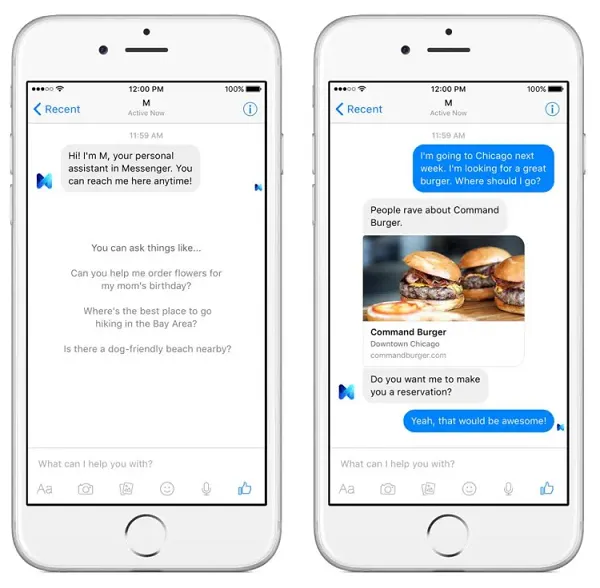
M was powered by both AI and human trainers, with the human staff prompted to assist the bot if it ever got stuck. Users wouldn’t know which parts of their requests were completed by a human or by AI. But they didn’t have to because all they needed was the end result, which was essentially an automated process for getting things done.
Except it didn’t work.
Although M was functional, the use of human staff made it difficult to scale, due to the inherent costs associated with having a hybrid system. The offering also saw limited user interest. As Casey Newton reported for The Verge in 2018 when Meta announced the shutdown of the M project, he personally had found little use for the tool.
Newton shared his personal experience with the bot with Meta CEO Mark Zuckerberg, and Zuckerberg said that Newton’s experience was similar to many.
So Meta has tried this same approach before, over a decade ago.
It didn’t work then, but maybe, with advances in AI, now is the time.
Either way, Meta remains dedicated to the idea that AI agents will improve users’ lives. Whether they like it or not.
According to reporting from Reuters, Meta did test what it called a “human concierge” approach to supplement Meta AI responses with real human staff, but has since shelved the concept due to concerns that it could expose private data to human contractors.