We’re usually not supposed to look directly at the sun except during the glorious totality of a solar eclipse. But NASA’s PUNCH mission has been staring unblinkingly at our star since June 2025. PUNCH, short for Polarimeter to Unify the Corona and Heliosphere, avoids frying its optics via a sunlight-blocking coronagraph that creates a permanent personal eclipse for its Narrow Field Imager. Now, in a video revealing PUNCH’s newly processed data, you can see a year of the sun’s dancing corona, too—without risking your retinas.
The solar corona is the topmost layer of the sun’s atmosphere. Curiously, it’s much hotter than the layers beneath it by millions of degrees Fahrenheit. And it’s suffused with protons and electrons streaming away from the sun; these atomic building blocks can’t coalesce into atoms because of all that heat, but that leaves them free to become almost perfect electrical conductors, according to PUNCH principal investigator Craig DeForest.
On supporting science journalism
If you’re enjoying this article, consider supporting our award-winning journalism by subscribing. By purchasing a subscription you are helping to ensure the future of impactful stories about the discoveries and ideas shaping our world today.
Electricity and magnetism are linked, so that near-perfect electrical conductivity means the outflowing protons and electrons spiral along the sun’s magnetic field lines as they traverse the corona. Sunlight shimmering off the electrons makes magnetic field lines visible in the video as bright golden rays interspersed with explosive coronal mass ejections (huge bursts of magnetized plasma erupting from the sun). The overall visual effect is like a cosmic variant of the wacky inflatable tube people outside used car dealerships.
The sunlit electrons tell us about “the amount of particles in the corona and the shape of the magnetic field,” says Alfred de Wijn, a research engineer who studies the sun at the National Science Foundation’s High Altitude Observatory and is unaffiliated with the PUNCH mission. “We can see that the corona is constantly changing as a result of the solar wind—a stream of charged particles—and coronal mass ejections.”
Behind the sun’s glowing corona, background stars slide from left to right, including several familiar constellations: Leo passes behind the sun in August (around three to four minutes into the video) and part of Sagittarius is visible in November (around 6:20 to 7:20). Venus and Mercury also make several appearances as large, bright white dots crossing from either side.
Several comets also pass through PUNCH’s field of view. The comet C/2025 R3 (PanSTARRS), a far-flung traveler from the outskirts of the solar system, passed very close to the sun on April 19, 2026, and makes a spectacular appearance in the video at 11:09.
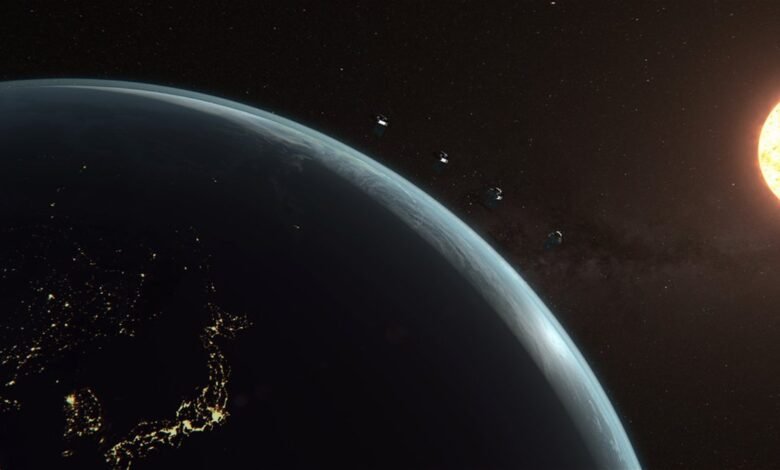
PUNCH is composed of four separate spacecraft precisely aligned and calibrated as they orbit Earth over the poles, staying in constant view of the sun. The video is “a triumph,” DeForest says, because it shows how the mission’s instrument responsible for imaging the corona, the Narrow Field Imager, overcame an unexpected problem. When PUNCH initially opened its eyes, Earthshine (sunlight reflecting off Earth) bounced into its sensors and overwhelmed the delicate signal from the corona. At first, “you couldn’t see a darn thing,” DeForest says, but thanks to some clever image processing that treated each image as a four-million-dimensional vector, the research team was able to remove the bright, flickering Earthshine and recover the entire year’s worth of coronal data, creating the new video.
“This is not some distant, abstract system we’re looking at,” DeForest adds, pointing out that PUNCH’s spacecraft pass over us every sunset no matter where we are on the globe. “We live on the Earth, but our neighborhood is the inner solar system. Being able to see this invisible part of our environment is profound.”
Subscribe to Support Independent Journalism
Great science journalism requires human expertise, time, effort and creativity. And it costs money. That’s why I and the journalists here at Scientific American hope you’ll join our community.
When you subscribe, you are supporting staff and freelance journalists who are passionate about telling science stories that are true, important and compelling. Our editors and reporters are often experts in their fields, which means they understand the nuances of big discoveries and can untangle the breakthroughs from the hype. With a subscription, you are also supporting rigorous fact-checking to ensure the words we publish are precise and accurate. And you’re supporting original illustrations, graphics and photos that bring you closer to an advanced laboratory, an ice sheet in Antarctica or a space mission in orbit. You’re helping us craft other types of high-quality journalism as well: Our newsletters are carefully written, edited and curated by staffers you have or will come to know and love. Our Science Quickly podcast is based on original reporting, collaboration with editors and scientists and exacting production.
Subscriptions keep this engine running so we can continue to deliver thoughtful, rigorous and independent science journalism to you. In an era of viral misinformation, this work is crucial. If you value what we do, I hope you’ll consider joining us as a subscriber