Conny Waters – AncientPages.com – A burial pit discovered on the outskirts of Cambridge offers significant insight into a turbulent period in English history, possibly dating to when the region served as a “frontier zone” amid conflict between the Saxon kingdom of Mercia and East Anglia, which fell to Viking control around 870 AD (CE).
The site was uncovered by Cambridge University archaeologists and students during a training excavation for undergraduate archaeology students.

The mass grave contained remains from at least ten individuals, as indicated by the number of skulls found. Among these were signs of violence: at least one decapitation and an exceptionally tall man with evidence of trepanation—a surgical intervention involving drilling into the skull. The grave’s contents were unusual, comprising both complete skeletons and dismembered body parts. Archaeologists noted clusters of skulls without corresponding bodies, a “stack of legs,” and four intact skeletons—some positioned as if they had been bound.
Violence And Brutality – A Grumesome Sight
This grim discovery highlights the brutality associated with historical conflicts. All those interred appear to have been young men who were hastily disposed of in the pit, suggesting they may have died in battle or skirmish, or possibly through mass execution. The findings are featured in an episode of BBC’s ‘Digging for Britain,’ providing viewers with further context about this remarkable archaeological site.

Credit: Cambridge Archaeological Unit/David Matzliach
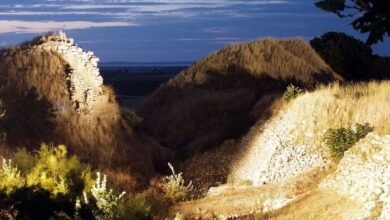
The excavation at Wandlebury Country Park, led by Dr. Oscar Aldred from the Cambridge Archaeological Unit (CAU), focused on the site’s notable “ringwork”—a series of banks and ditches that outline an Iron Age hillfort built around a thousand years before the Viking era.
Archaeologists explain that these Iron Age features would have made Wandlebury a prominent gathering place in early medieval times, much as it remains today. Located just three miles south of Cambridge, Wandlebury is a popular spot for school visits and family outings.
The University’s Department of Archaeology and CAU have partnered with local charity Cambridge Past, Present and Future—owners of Wandlebury—to conduct student training excavations at the site over several years. This recent discovery marks their most significant and dramatic find to date.
“Before we uncovered the first remains, our best find was a 1960s Smarties lid,” said Olivia Courtney, an archaeology undergraduate from Bath, now in her third year at Cambridge University.
“I had never encountered human remains on a dig, and I was struck by how close yet distant these people felt. We were separated by only a few years in age, but over a thousand years in time.”
An Unusually Tall Warrior
These are the first human remains discovered at Wandlebury since 1976, when a storm uprooted a tree near the current excavation site and revealed five skeletons from the same period. The most notable aspect of this recent find is the complete skeleton of a man aged between 17 and 24, who was buried face down in a pit. Remarkably, he would have stood about 6 feet 5 inches tall—significantly taller than the average male height of around 5 feet 6 inches during that era. Archaeologists suggest his exceptional height may have resulted from a growth condition.

Credit: Cambridge Archaeological Unit/David Matzliach
Initial radiocarbon dating places this individual’s death between AD 772 and AD 891 with an estimated probability of 85%. Further analysis is planned to refine this date range.
A particularly intriguing feature is a large oval hole, approximately three centimeters in diameter, located on the back left side of his skull. This suggests he underwent trepanation—an ancient surgical procedure where a hole is drilled or scraped into the skull while the person is still alive. Evidence of healing around the wound indicates he survived for some time after the operation.
Trepanned skulls have been found worldwide, including among ancient Greek and Roman remains. Historically, trepanation was believed to alleviate symptoms such as migraines and seizures, as well as psychological disorders recognized today.
“The individual may have had a tumour that affected their pituitary gland and caused an excess of growth hormones,” said Dr Trish Biers, curator of the Duckworth Collections at the University of Cambridge, where these remains have been taken for further analysis.
“We can see this in the unique characteristics in the long shafts of their limb bones and elsewhere on the skeleton.”
“Such a condition in the brain would have led to increased pressure in the skull, causing headaches that the trepanning may have been an attempt to alleviate. Not uncommon with head trauma today,” Biers said in a press release.
The discovery of dismembered remains alongside fully articulated bodies at the site is highly unusual, even for a mass grave, and has left archaeologists searching for answers. Evidence such as chop marks on one man’s jaw indicates he was beheaded, while a few others show trauma consistent with combat. However, archaeologists note that there is not enough evidence to conclude that those buried at Wandlebury were casualties of battle.

Credit: Cambridge Archaeological Unit/David Matzliach
What stands out is the presence of severed heads, limbs, and other body parts—including ribs and pelvises—discarded in the pit. In some instances, similar body parts were stacked together and placed atop four deceased men, one of whom appears to have been bound. According to Dr. Oscar Aldred from CAU, this arrangement suggests acts of severe violence and possibly execution rather than typical burial practices or battlefield deaths.
“Those buried could have been recipients of corporal punishment, and that may be connected to Wandlebury as a sacred or well-known meeting place.”
“It may be that some of the disarticulated body parts had previously been displayed as trophies, and were then gathered up and interred with the executed or otherwise slaughtered individuals,” Aldred said.
“We don’t see much evidence for the deliberate chopping up of some of these body parts, so they may have been in a state of decomposition and literally falling apart when they went into the pit.”
Saxons Or Vikings?
In the late 8th century, Cambridge was governed by Offa, the ruler of Mercia. However, around 874-875 AD, half of the Viking Great Army established a camp near Cambridge and subsequently sacked the town. Following this event, Cambridgeshire became part of the Viking kingdom of East Anglia and remained under Viking control into the early 10th century as part of the Danelaw agreement. Initial radiocarbon dating suggests that some unearthed bones date back to this period. However, since no grave goods have been found with these remains, further research is necessary to determine whether they belonged to Saxons or Vikings.
“Cambridgeshire was a frontier zone between Mercia and East Anglia, and the continual wars between Saxons and Vikings as they clashed over territory across many decades,” said Aldred. “We suspect the pit may relate to these conflicts.”
Historic England, an organization responsible for overseeing and managing archaeology on protected Scheduled Monuments like Wandlebury, is supporting the excavation efforts at the site. They have commissioned a new geophysical survey of the area, which archaeologists anticipate will provide further insights into the surroundings of the burial pit.

Credit: Cambridge Archaeological Unit/David Matzliach
“Wandlebury is an important natural and historic resource for the people of Cambridgeshire. The extraordinary discovery there speaks to the story of our nation and the lives of ordinary people living during turbulent times,” Tony Calladine, East of England Regional Director, Historic England, said.
The Cambridge team’s future research will involve bone analysis, including ancient DNA and isotopic studies, to examine health, kinship, and ancestral connections. These methods aim to determine whether the remains are of Viking origin. Additionally, archaeologists plan to conduct “refitting” of dismembered bones in an effort to reconstruct individuals and estimate the number of people deposited in the pit.
See also: More Archaeology News
“I would never have expected to find something like this on a student training dig. It was a shocking contrast to the peaceful site of Wandlebury,” added Grace Grandfield, a Cambridge undergraduate from York who took part in the dig.
“Several of the individuals we uncovered were a similar age to me, and it was a sobering experience to identify ever more disarticulated bones and realise the extent of the suffering that had taken place.”
Written by Conny Waters – AncientPages.com Staff Writer