Rabbi Shoshana Cohen explains how the broken matzah teaches us to work toward redemption – United Hebrew Congregation Terre Haute


Happy Adar! We have entered the Jewish calendar month of Adar and, on my last visit, we celebrated Shabbat Zachor together, the Shabbat before Purim.
Although we have much to be happy about as Spring approaches and the natural world is coming back to life, the news about a new war between the U.S. (and Israel) and Iran is alarming.
We have much to unpack when it comes to teachings in the Torah around issues of war and peace and decision-making, as Scott Skillman details in his message this month.
Last year, we included in our UHC community seder an optional reading from Rabbi Shoshana Cohen of the Shalom Hartman Center in Jerusalem. She wrote the following passage about how the broken matzah that we eat during the Passover seder teaches us to work toward redemption in real time.
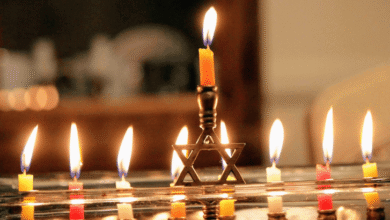
I share it with you in the hope that even in the midst of war, we continue to seek meaning in doing mitzvahs and spreading the Eternal Flame that we spoke about last Shabbat, even at times of duress:
In stable times, yachatz reminds us that even if our lives feel whole, the world still holds brokenness. In times when we ourselves feel broken, yachatz forces us to confront the reality of despair and insists that we keep telling the story of redemption.
When we are whole, like the top and bottom matzot, we are responsible for repairing that which is broken; when we are broken, wholeness and hope remain, even if they may seem out of reach.
Once we break the matzah, we place it between the top and bottom matzot, creating a “sandwich” that offers us a model for managing precarity. When we are whole, like the top and bottom matzot, we are responsible for repairing that which is broken; when we are broken, wholeness and hope remain, even if they may seem out of reach.
This ritual relies on a binary between brokenness, pain, and despair on one hand, and wholeness, hope, and redemption on the other. But perhaps the middle matzah can teach us something more nuanced: the difference between brokenness and wholeness is never complete. Pain and hope are not entirely separate.
Peace is often subject to binary thinking: peace and harmony necessarily preclude war and violence.
The metaphor of yachatz can also help us understand the Jewish view of peace. Peace is often subject to binary thinking: peace and harmony necessarily preclude war and violence. Yet we may be better served by thinking of these as dynamically intertwined, permitting us to strive for a broken peace and fragile vision of redemption.
Similarly, the most common Jewish prayer for peace articulates peace in binary terms, contrasting peaceful heavens with chaotic earth: “May the One who grants peace in the heavens grant peace for us and for all Israel.” Yet the original source of this line paints a more complicated picture of the heavens, not a scene of serenity but a battleground where God continuously restrains and dominates the forces of chaos.
“Dominion and dread are God’s, who makes peace (oseh shalom) on high… God stretches the divine abode over the chaos… He stilled the sea; He struck down Rahav; His hand pierced the elusive serpent” (Job 25:2, 26:7, 10, 12–13).
We break the matzah as a symbol of a broken, struggling peace, a delicate balance between order and chaos, and as a reminder to keep fighting for a fragile peace.
Peace is not an eternal, tranquil stability, but an act of constant struggle, a fragile boundary between order and chaos. Job reminds us that peace is not a utopian or perfect wholeness. Rather, it is the fraught and continual attempt to hold instability at bay.
With this in mind, we break the matzah as a symbol of a broken, struggling peace, a delicate balance between order and chaos, and as a reminder to keep fighting for a fragile peace. While this peace might not look messianic or utopian, it creates space for people to not only survive but to flourish.
This year when we break the middle matzah, let us be inspired to imitate God in holding back the forces of destruction, however precariously, and allowing life to thrive.
The Shalom Hartman Institute is a leading research and educational center serving Israel and world Jewry. It works to enrich the moral and spiritual life of Israel and the Jewish people, deepen the commitment to pluralism and Israel’s Jewish and democratic character, and rebuild the covenant between Israel and the Jewish world.
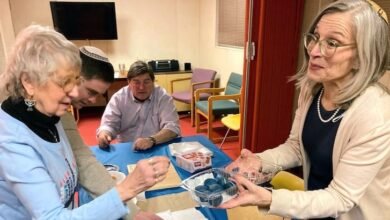
A big thanks to Karen Harris for bringing homemade hamantaschen to our pre-Purim oneg, and to everyone who helped with making that lovely nosh complete.
I look forward to seeing you next on the Shabbat of Passover and for the community seder on Saturday evening, April 4!
Rabbi Jennifer Lewis will serve UHC Terre Haute during the 2025-26 academic year.