
Youth unemployment has risen dramatically since the pandemic—as has the prevalence of remote work. Our analysis suggests that these trends are related, with remote work making it more difficult for managers to train and mentor new employees. Accordingly, companies may be reluctant to hire less-experienced workers in distributed work arrangements. We estimate that remote work can explain 64 percent of the recent increase in unemployment among young college graduates. Further, the timing of this surge suggests that remote work—not generative AI—explains the bulk of the rise in youth unemployment.
(Not) Working from Home
Unemployment among young college graduates has risen significantly since the pandemic, a topic much discussed by scholars and the popular press. While unemployment among those under 29 was 3.1 percent on average in 2017-19, it rose by 20 percent to 3.7 percent in 2022-25.
The unemployment dynamics for young graduates particularly stand out given that the unemployment rate for more experienced college graduates actually dipped from 1.9 percent in 2017-19 to 1.8 percent in 2022-25. The chart below shows how unemployment evolved for college-educated workers of varying ages.
Unemployment among Young College Graduates Surges Above That of Experienced Workers
Notes: Gray shading denotes the early pandemic period. Series show change in unemployment rates by age group relative to 2019 levels.
The high unemployment rates of young college graduates are particularly concerning because early-career experiences can have lasting consequences. For example, entering the labor market in a recession can scar a person’s career. Research finds that individuals who began looking for jobs in slacker labor markets tend to have lower earnings and slower career progression relative to comparable peers who began their job search in better market conditions.
Remote Job Prospects
We document that one factor contributing to youth unemployment is the four-fold rise in remote work since the pandemic. Employers may not want to hire fresh graduates onto distributed teams because it is more difficult to teach them the requisite skills from afar.
We compare unemployment rates among people working in “remotable” jobs—such as software engineering—to those in “non-remotable” jobs—such as mechanical engineering. To categorize an occupation as remotable or non-remotable, we use a commonly used index of how easily the tasks required for a given job can be done remotely. We then compare the unemployment rates of younger individuals in remotable and non-remotable jobs to those of more experienced workers.
The aggregate increase in the unemployment rate for young college graduates can be traced to remotable occupations, where young people’s unemployment rate increased by almost 1 percentage point between 2017-19 and 2022-24. By contrast, the unemployment rate of older workers in remotable sectors marginally declined over that period. As a result, the age gap in unemployment between younger and older workers significantly increased in remotable occupations. This relative increase in young people’s unemployment coincided with the pandemic and has remained elevated since then, as have rates of remote work.
By contrast, in non-remotable jobs, young graduates’ relative unemployment rate ticked up in 2020 but returned to baseline soon afterward. This divergence is illustrated in the chart below.
Unemployment Age Gap for College Graduates Driven by Job Remotability
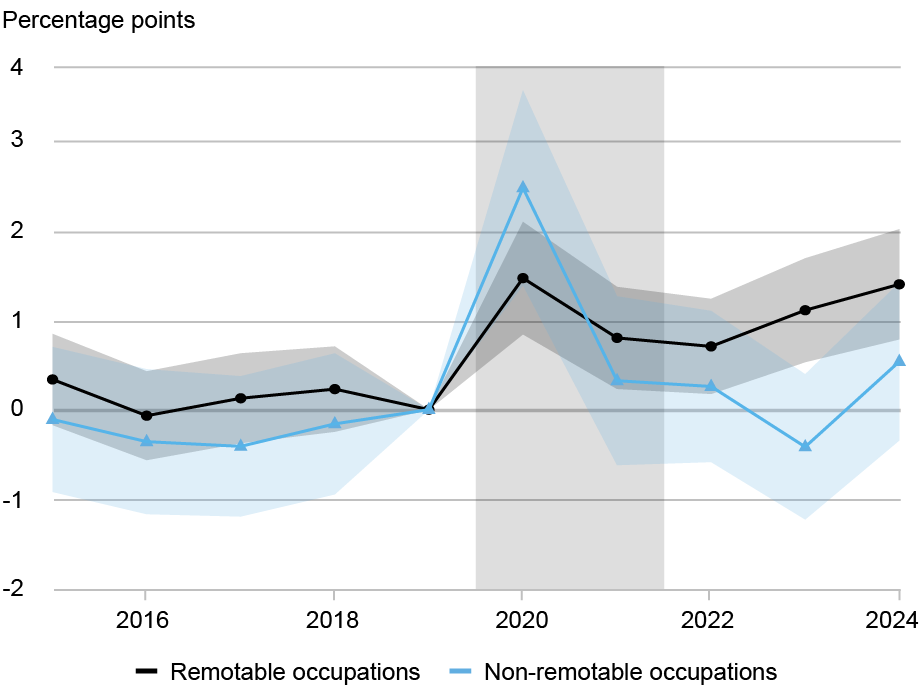
Notes: Gray shading denotes the early pandemic period. Series show the age gap (18-28 versus 29+) in unemployment rates by occupation category relative to 2019 levels.
Since so many young college graduates are in remotable occupations, our back-of-the-envelope calculation indicates that remote work can explain 64 percent of the increase in unemployment for all young college graduates between 2017−19 and 2022−24.
The AI Factor
Many analysts have attributed the recent labor market challenges of young college graduates to generative AI, among other factors. But the uptick in youth unemployment rates predates the rapid diffusion of AI. Moreover, even when we hold occupations’ exposure to AI constant, we find that the differences between younger and older workers persist in both remotable and non-remotable jobs.
Of course, generative AI and other factors may play a more primary role in determining the employment patterns of younger workers going forward. Nonetheless, the evidence to date suggests that the rise of remote work has meaningfully contributed to the recent challenges facing young college graduates.
Patterns at the Firm Level
Working with proprietary data from a Fortune 500 company, we are able to shed light on the underlying reasons for these labor market changes. We show that when people work next to their colleagues, they receive more feedback on their output and more mentorship. When they are separated even by a short distance, that feedback tapers off dramatically. The loss in feedback is more pronounced for younger workers, who miss out on constructive comments that spur their development.
The negative effects of operating remotely from one’s colleagues show up in work quality as well. When all employees functioned in isolation, those who had previously worked side-by-side with teammates, and consequently received more mentorship from their colleagues, produced better-quality output than those who had spent more time working at a distance from their teammates. Further, when we analyze the firm’s return-to-office (RTO) mandates, we find that workers on co-located teams, who experienced a more meaningful change in their proximity to colleagues, likewise showed greater improvements in their work quality.
The firm’s hiring patterns suggest that it understood the pitfalls of distance for worker development. When its offices were closed due to the pandemic, the firm hired fewer inexperienced workers and more experienced workers, who might need less mentorship to do their jobs well. Once its offices reopened, the company shifted back to hiring younger workers. However, there is a twist: for positions on distributed teams, the firm consistently hired more experienced workers, even after reopening. This divergence suggests that the firm’s hiring decisions were influenced by the complications of remote work rather than other macroeconomic trends. Overall, the firm’s hiring patterns suggest that it is willing to teach junior workers when proximity is feasible but shies away from employing inexperienced workers if distance creates barriers to training and development.
RTO and Job Opportunities
Consistent with our findings, many firms’ RTO mandates have cited the importance of colocation for mentorship and learning. The firm we study had a stricter RTO policy than other tech firms, which enabled it to mentor in-person and therefore hire young workers post-pandemic.
These dynamics suggest that remote work has weakened incentives to hire young workers by impeding on-the-job training. Ironically, when jobs are scarce, it becomes even harder for young workers to secure the training they need.

Natalia Emanuel is a research economist in the Federal Reserve Bank of New York’s Research and Statistics Group.
Emma Harrington is an assistant professor of economics at the University of Virginia.
Amanda Pallais is a professor of economics at Harvard University.
How to cite this post:
Natalia Emanuel, Emma Harrington, and Amanda Pallais, “Remote Work Leaves Younger Workers Sidelined,” Federal Reserve Bank of New York Liberty Street Economics, June 1, 2026, https://doi.org/10.59576/lse.20260601
BibTeX: View |
Disclaimer
The views expressed in this post are those of the author(s) and do not necessarily reflect the position of the Federal Reserve Bank of New York or the Federal Reserve System. Any errors or omissions are the responsibility of the author(s).