Mamdani moves to protect workers from extreme heat, but private-sector reach is unclear

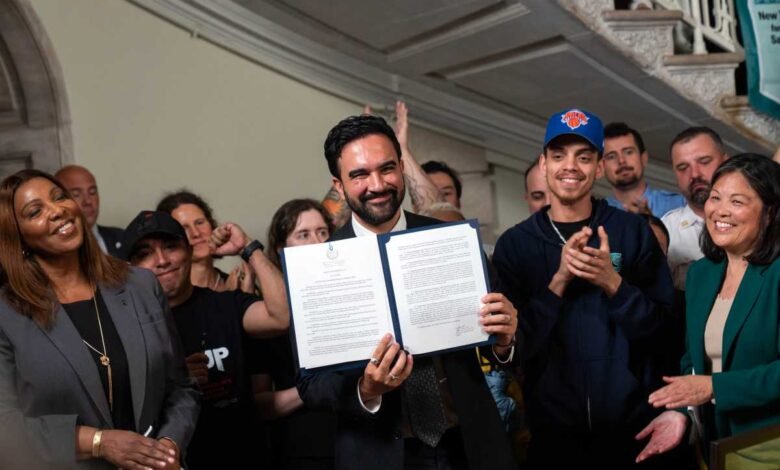
Mayor Zohran Mamdani signed an executive order Monday directing city agencies to expand protections for workers exposed to extreme heat, an effort City Hall described as the first initiative of its kind in New York City history.
The order calls for multilingual heat-safety guidance for outdoor and indoor workers, heat illness prevention plans for city employees and contractors, a review of construction-site safety rules and a Health Department review of heat-related workers’ compensation claims filed by city employees.
But the measure does not immediately create a broad, enforceable heat standard for private employers. Asked whether it would guarantee the likes of airport workers and others receive shade, water and breaks, Mamdani said the order would start a broader review of existing and possible protections.
“This is going to provide a full comprehensive review of actions both within the public sector and the private sector,” Mamdani said, adding that the city would look at “every single rule that’s enforced and implemented, as well as ones that need to perhaps be introduced.”
“No one should have to choose between their paycheck and their health,” Mamdani said earlier at City Hall, where he was joined by union leaders, worker advocates and city agency commissioners. “The workers building our skyline, delivering our packages, selling food on our street corners and keeping this city running deserve to come home safe at the end of every shift.”
Killer heat impacts workers in NYC
The announcement coincided with the release of the Health Department’s 2026 heat-related mortality report, which found that hot weather prematurely kills about 500 New Yorkers each summer. The report said the city averaged seven direct heat-stress deaths a year from 2016 to 2025 and about 490 heat-exacerbated deaths a year from 2014 to 2023, where heat worsened underlying illnesses. Among heat-stress deaths, 8% were work-related, the report found.
The report also pointed to a worsening climate risk. The city recorded 21 heat-stress deaths in 2025, including 19 linked to a four-day June heat wave, according to provisional data. The Health Department said the number of summer days in the hottest temperature range has more than doubled over five decades, a trend it attributed to climate change.

Mamdani’s Monday order directs the Department of Health and Mental Hygiene, NYC Emergency Management and the Department of Citywide Administrative Services to develop heat-safety guidance and educational materials for employers and workers, including employees, independent contractors, gig workers and day laborers. Outdoor-worker guidance is due as soon as practicable, while indoor-worker guidance is due by March 1, 2027.
It also requires mayoral agencies to develop heat illness prevention plans for city employees and contractors when the city’s Heat Emergency Plan is activated, directs the Department of Buildings to review construction-site heat safety requirements and instructs the Health Department to review workers’ compensation claims filed by city employees for patterns tied to hot weather
The order also directs the Health Department to study whether heat-related emergency room visits should become reportable public health conditions, including whether health care providers should report a patient’s work location and employer. If health officials determine the change would benefit public health, the department may propose amendments to the city health code.
City Hall billed the order as a new whole-of-government response to worker heat safety. The city, however, already had a detailed heat-stress prevention plan for municipal employees. That April 2025 plan, developed by DCAS’s Citywide Office of Occupational Safety and Health in consultation with the Health Department and NYC Emergency Management, requires city employers to provide measures including cool drinking water, shade, monitoring, training and rest breaks tied to the heat index.
Monday’s order appears to broaden that framework by putting more agencies under the mayor’s direction and focusing attention on workers beyond the municipal workforce, including people employed on construction sites, in delivery work and in other private-sector jobs.
Speaking at Mamdani’s press conference, John Mosquera, a ramp agent at LaGuardia Airport, described collapsing last summer while loading bags in the cargo hold of a plane during roughly 100-degree weather.
“I lost consciousness and just lay in the belly of the plane from how hot it was,” Mosquera said.
He said he was given water and a short break, then sent back to finish a 10-hour shift.
“No bag, no flight, and no company is worth a worker’s life,” Mosquera said.

Deputy Mayor for Economic Justice Julie Su, who previously served as acting U.S. labor secretary, said federal efforts to create a national heat standard have stalled, leaving cities and states to act on their own.
“Workers on the clock in the heat” have no clear legal right to “shade, rest, or water,” Su said. “The mayor isn’t waiting.”
Attorney General Letitia James, who joined Mamdani at the event, called the issue one of environmental justice, saying workers of color, immigrants and low-wage workers are disproportionately represented in jobs with dangerous heat exposure.
The order also tells agencies to reinforce existing protections, including rules that give food delivery workers access to bathrooms at restaurants where they are picking up orders.
Mamdani opened the news conference by warning New Yorkers about a separate weather threat: heavy rain and possible severe thunderstorms expected to move through the city Monday.
The National Weather Service issued a flood watch for much of the city from the afternoon through late Monday night, warning that rainfall rates could reach around 2 inches an hour in some areas.