Resonance: A Plague Tale Legacy – A New Chapter with Action and… a Minotaur? | Official XBOX Podcast

About this video
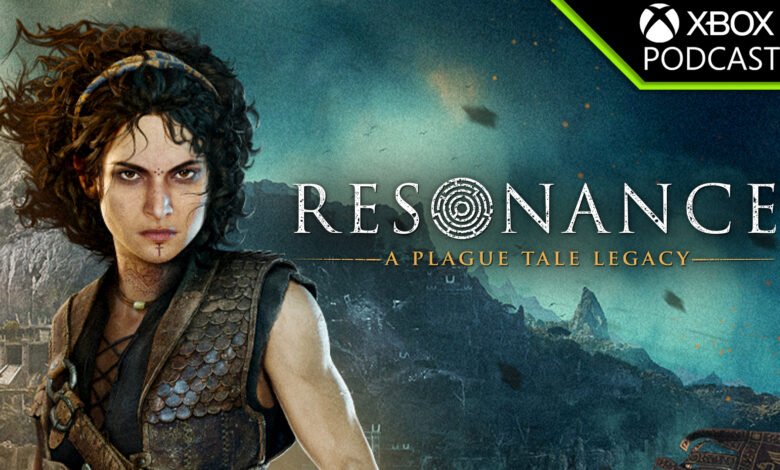
On this episode of the Official XBOX Podcast, we’re sitting down with the team behind the upcoming Resonance: A Plague Tale Legacy to discuss the setting, the story, the combat, and how the team was able to design a game that fits wonderfully into the Plague Tale series but is presented in a whole new way.
TRANSCRIPT
SPEAKER 1: Games in this podcast range from E to M. [ XBOX sound ]
JEFF RUBENSTEIN: Hello, and welcome to the official XBOX podcast, the only podcast coming to you from inside XBOX. I’m Jeff with an update on a game that’s been on my radar since its surprise reveal at XBOX Games Showcase 2025. Talking about Resonance, a Plague Tale legacy. It’s a game that reinvents the franchise by taking it back in time from previous Plague Tale titles. Less sneaking around, a lot more action, and at least from the parts that I’ve played so far, not a rodent in sight. It’s coming to XBOX Series X and S, XBOX on PC and Game Pass really soon, August 27th. So today we’re going to be showing a ton of gameplay from the opening hour or so of the game. I want to avoid some spoilers. And I captured this myself as real footage. Yes, I can parry, you know, most of the time. So to tell us a lot more about what to expect from the rest of the game, I’m pleased to welcome Eric Chort, the lead producer from Asobo Studio in Bordeaux, France. Bienvenue, Eric.
ERIC CHORT: Thank you. Thank you so much.
JEFF RUBENSTEIN: All right. Thanks so much for joining us here at the end of your day. Let’s get right into this because there’s a ton to cover. In a Plague Tale: Requiem back in 2022, we encounter Sophia as a supporting character. She helps Amicia and Hugo sail to an island that he had been dreaming about. A lot of crazy stuff happens over there. She manages to survive the events of that game, which is, you know, no small feat. When did you know that the next step for the team was to tell more of her story?
ERIC CHORT: So when we finished The Requiem, we were like, I would say pretty much exhausted because it was a quite a journey for us, not only for the players with all the emotions that there is in the game, but also for us as a team. It was like seven or eight years that we are working on a game with Hugo, with Amicia. And all this story was really hard to put in a game. It was really, really emotional for us. And so at the end, we were like, okay, it’s a chapter that is closed for us, but we still like Plague. So how do we continue to make a Plague game without Hugo and Amicia? And then the other part was what we want to challenge us as a studio. What would be our next game in terms of gameplay? And we wanted to be more dynamic. We wanted also to have combat. So we’re like, okay, do we have a character already present, or do we need to create a new one? And as soon as we think about not Hugo and Amicia again, but still Plague and more dynamic and combat, Sophia was a no brainer for us. It was pretty logical with all our background that we already wrote for Requiem. And all we wanted to do, Sophia was really, yeah, it was an evidence for us. So it was pretty at the beginning of the project when we stopped Requiem and think about the next step. Yeah, it was very easy and quick to choose Sophia.
JEFF RUBENSTEIN: So let’s go back to the reveal of the game. I keep thinking about it from XBOX Game Showcase 2025. There were a couple of things in terms of imagery that really stood out in then and in the trailers that you’ve released since that time. So there’s a minotaur. There’s a maze. The maze is right there in the logo of the game, a glowing rope. So for those not super up on Greek mythology, there was the famous minotaur lived in the center of the labyrinth. Sacrifices were sent into there. Eventually, Theseus slew it. And he had a lot of help with Ariadne and her golden thread. So, first of all, great timing tapping into Greek mythology. Not sure if you know, there’s a movie that’s got a lot of people — you may have heard of it. I don’t know. It’s got people very much into that. And something I personally find very appealing about these mythologies is like these places are real, like I can go to Crete right now. I mean, it might be like really expensive. So maybe not right now, but it exists. You can go. And I think people tend to wonder which part of the myth was real? And is that something you’re playing with here? Because obviously the events of this of Resonance take place in, I want to say, in the 1300s, a long time after the myth of the minotaur supposedly took place.
ERIC CHORT: So first of all, we didn’t think about the movie or the thing about that. I mean, we have the same appeal for the Greek mythology as other people that have now because of the movie. But I mean, because of God of War or these type of things, we already had this appeal in the team. So what we did is just, you know, for Plague, we use the dark plague that already happened in France in the 15th century. So it’s a base for us. And then we twist it with our own law. So what we did there is use the Greek mythology, which is more fantastic because we still have some historical sites, as you said, in Greece that exist and that you can visit. But all the other things, the characters, et cetera, they are more a myth, a story. We don’t know if it’s real or not. So we use that as a base. And then we twist it with our law. And we try to find ways to have something that feels real using all the things that already exist in Greece with the Roman, also the Egyptian — all the things that from this period can still be visited and seen today, all the historical things that we know. So have a real base as much as we can and then build on this to create our own universe and reinterpret the myth and the Greek mythology for our own story.
JEFF RUBENSTEIN: All right. So were there ideas that the team, as you were developing, like you said, you were working for eight years with Amici and Hugo on Plague Tale, in a sense, and Requiem. Were there ideas that the team had and they wanted to do, but it didn’t make sense for the type of game you were creating at the time. But now coming into Resonance, you’re like, oh, yeah, now we can do it.
ERIC CHORT: So, yeah, definitely. I think that combat is really the answer to that question. We were pretty lucky at the end of Innocence to be able to make Requiem. Because Requiem was like the game we wanted to do. But we didn’t add the time and the capacity during Innocence to make it. So with Requiem, we were able to make really the game we wanted in terms of rats, in terms of stealth, in terms of story, emotion and also in terms of graphics, et cetera. But we still were like, okay, in terms of action, can we do more? Can we? But Amicia was not the good character to use a sword and have melee combat. So definitely with Resonance, it was a good opportunity to make melee combat. And yeah, this is the thing that we are like, okay, let’s do that. Let’s go to combat.
JEFF RUBENSTEIN: Let’s get into that action, because I can tell you, like having played the first few chapters of the game, you do not shy away from action, which is awesome and such a contrast to previous games in the series. So Amicia from Innocence and from Requiem, she was all about avoiding combat. Although by the end of Requiem, she’s a pretty capable stealth killer. Sophia from the jump right into your face, she’s got a very direct style, dual blades. Let’s talk about what you built here in terms of a combat system, starting with the basics and then maybe layering in everything on top.
ERIC CHORT: So first of all, what we wanted is something very reactive. So this is the first thing we were like, okay, it has to be reactive. It has to be very smooth when you take it with your controller. All the moves, when you dodge, when you attack. This is the first thing we are thinking about. Second thing was be agile. Sophia needed to move very fast and very quick, but also because she will face a lot of enemies. So the idea of one against an army was really appealing for us. And then to have some challenge, we made it very little. So you can kill very fast, but you can also be killed very fast. So it’s another aspect that we added. And then we said, okay, but how Sophia can manage to be little and to face such a number of enemies. So then we added things like the grappling hook, things like the bottles that you can throw to enemies, the dagger also to be more lethal and more tricksy. This is a way that we made step by step. It was our first combat game. So we tested also a lot of other games. We looked at a lot of videos of GDCs or developers that worked on combat games to learn, to know what are the good things, the things we wanted in our game and the things that we didn’t want it. So in the best reference we have, probably Ghost of Tsushima is one of the best with the type of gameplay we wanted. So when we found this reference, then we try to adapt it to our character and to the combat we wanted. And yeah, that’s pretty much it.
JEFF RUBENSTEIN: So I think it’s really interesting. You mentioned that, you know, she cannot take a lot of hits. She’s not as big as the people that she is encountering at the beginning of the game, at least. We’ve got effectively three hits and you’re gone. But the thing I think is really interesting, you would think, oh, that makes you feel like, oh, I’ve got to be defensive. But you actually need to be more offensive because every time you kill somebody, you get that health block back. So the more hurt you are, the more aggressive you really need to be. So I thought that was a really interesting risk and reward. Maybe we can talk a little bit about the skill tree here as well. When I first got my first Resonance points where I was able to go through, we’re seeing that here. It was really hard to choose what I wanted, but I ended up going with this one that actually doubles down on that, where if you do the sort of longer charge critical hit, you effectively gain one invincibility frame effectively to allow yourself to take one hit. But that is a risk reward in itself. So I just would love to hear just a little bit more about how you thought about that. It makes it feel a lot different than other games that use parrying and other melee action games out there.
ERIC CHORT: Yes, so it was a way to really push the player not to just stay blocking. You can stay blocking as much as you want. There’s no endurance. But to push you attack, to push you to the dynamic and the agility that we wanted. The fact that you can get your health on enemies by killing them was a pretty quick idea we had. And we said, okay, it’s cool because it’s not useful to stay defensive. You can, but if you lose some health, you need to get back on the enemy and to kill him. So when we tried it, it was again by iterations. When I said that it was our first combat game, we needed to iterate a lot. So we get the references, we get what we wanted to do. But then to make it happen while it was our first game, we needed to iterate, iterate, iterate, have a lot of playtests. And the first time we tried this, I mean, getting back your health by killing an enemy, it was, okay, it’s immediately very good because it changed the way we were fighting. So we were always trying to get a kill. And it was really working well with the type of combat we wanted. So, I mean, it’s one of the many iterations that we had to find the good balance and the good rhythm we wanted for the combat. Again, it’s thanks to a lot of playtests, a lot of iteration inside the studio, outside the studio, thanks to Focus Entertainment, our publisher that helped us with the playtest. It’s definitely very satisfying.
JEFF RUBENSTEIN: Definitely, I think you found like a niche where it doesn’t feel like — lots of games have parries right now, lots of third person action games. But the sort of relentlessness you need to be with Sophia, that risk reward really stands out from my time playing so far. So plenty more there. Let’s talk a little bit more about just the world here, because one of the things that stood out to me, I love Plague Tale: Innocence. I love Requiem, but they’re very dark games, very oppressive. Like it’s what fresh hell is next? You know, things are bad. You’re just kind of hoping you can help these two kids survive. At least early on here in Resonance. I’m like, hey, we’re in Venice. This is beautiful. You know, I was, there were points of standing out on the rooftop and just like, wait, hold up a sec. I just want to look at the Grand Canal. I want to visit here. The Greek Isles clearly in the cards based on the mythology. So these are places that are sunny. So how do you create this like signature feeling of Plague Tale dread in these sun-drenched locales?
ERIC CHORT: In fact, it’s a matter of contrast. So what we like is to create a huge contrast. In Plague, it was a contrast between the crude, middle-age world of adults that were really hard and very arch for children. And on another side, our characters, Hugo and Amicia. So here the contrast is different. The contrast is more on, okay, this beautiful landscape, sunny Mediterranean, the water, the blue water, et cetera. But when you go deeper in the island, you see that it’s darker than you thought. And the more you go on in the adventure, in the journey of Sophia, the more you will go deeper in the island and you will discover that, oh, in fact it’s darker than you thought. And yeah, it’s always a matter of contrast. And we start very sunny, but it’s probably darker at the end. [ Laughter ]
JEFF RUBENSTEIN: Stay tuned. It’s going to get there.
ERIC CHORT: Yes.
JEFF RUBENSTEIN: No doubt. No doubt. All right. So I’ve got one last question for you. It’s about the title, actually. So like thinking back after having finished Requiem and Innocence, it’s clear what those names mean. So Resonance. So the word can mean something about sound, and it can mean like something that emotionally something resonates with you. I’m curious which meaning came first for the team.
ERIC CHORT: So, in fact, the name arrived pretty late in the production. So we already had both signification in head. And when the name proposition arrived, we were like, okay, it’s working with both. So it was just a perfect fit when it arrived. So it was not one or the other that started, just the name arrived. And we’re like, okay, it’s perfect. It fits with everything. So I can’t say why on the emotion side, it’s a real resonance because you will discover it in the story. But yeah, with the sound also, there are a lot of things that will happen with the dark part of the island. As I said, when you go really to the heart of the darkness of the island, you will discover that the sound resonance is really important, too.
JEFF RUBENSTEIN: All right. Well, this is something we’re going to have to find out for ourselves. But the good part is we don’t have to wait too long. Eric, this was sort of the end of your work today here. Anything else that we left out you want to tell us about Resonance, a Plague Tale legacy?
ERIC CHORT: I hope that people will enjoy it. I mean, for us, it was quite a journey after The Plague Games. And we are really happy to made a game with combat. And we hope that players will love it and feel the same emotions that they had with Hugo and Amicia. It will, of course, be different because it’s not a story about a brother and a sister. But yeah, Sophia has a lot to tell, and I hope people will enjoy it.
JEFF RUBENSTEIN: Thanks again for joining us today, Eric. Once again, Resonance: A Plague Tale Legacy arrives on XBOX Series X and S, XBOX on PC and Game Pass August 27th. That does it for this episode of the official XBOX podcast. We have a ton more in the works for you, and we will see you then. [ XBOX sound ]