Daniel Starks is the communications manager for Greenville, Texas, a city of about 35,000. He oversees nearly a dozen Facebook pages the city maintains. Recently, the page for the city’s library was notified it could no longer post more than two links a month.
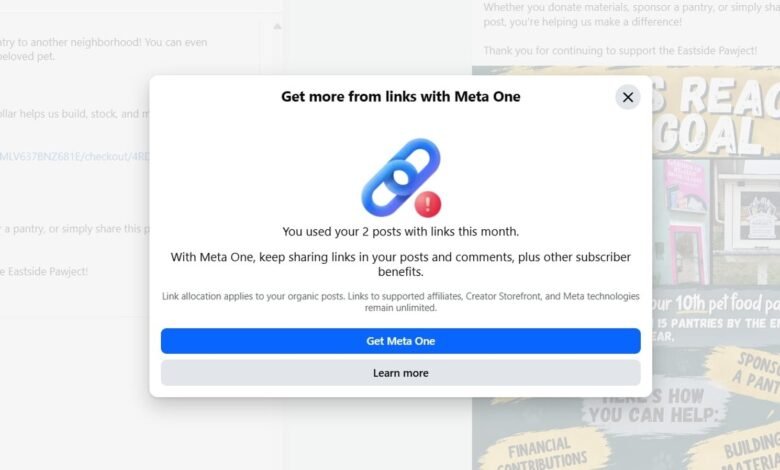
“You can add links to 2 posts per month, and you’ve used them all,” a message said. Sharing additional links would require signing up for a Meta One subscription that would cost $50 or more a month.
Starks is one of a growing number of people to encounter Meta’s ongoing experiment with charging creators, businesses and other professionals to post links on Facebook. Meta says the test, which is part of its push to sell more subscriptions, isn’t supposed to affect pages for nonprofits or government entities. But that’s not the case, according to nonprofit leaders who spoke with Engadget. All have pages that are identified as nonprofits and have been approved to use Meta’s fundraising tools, which requires a separate verification process. Many are now rethinking how they use the platform.
“More than half of what we do as a city, is linking back to information on our website,” Starks tells Engadget. ‘It’s scary because we don’t know how we’re going to pivot.” Worried the city’s other pages would soon be hit with similar restrictions, Starks instructed his staff to stop posting links in Facebook posts altogether. He made a graphic explaining to the city’s Facebook followers that relevant URLs would now appear in the page’s comments instead. He’s frustrated by the changes, which Meta claims are not supposed to affect government-run pages. The library’s page identifies it as a government building and the account was previously verified by the company.
“When you have an official governmental entity that is trying to get out in some instances very, very, important information, and we’re being paywalled by Facebook all because we’re trying to post a link, that’s a problem,” he said.
Nonprofit organizations are also scrambling after being caught up in the test. Bethany English is co-president of a small nonprofit that organizes pet food pantries in Indianapolis. Last week, she tried to create a Facebook post about an event the organization was participating in, only to find she was no longer able to post a link to her nonprofit’s website because she had used her allotted two links for the month.
Like Starks, the only alternative she was offered was to sign up for a Meta One subscription. An “expert” level plan, which would allow her up to 20 links each month, would cost $150 a month.
English says that social media has been “a huge deal” for her organization, the East Side Pawject, which she co-founded last year. The Facebook page, which has just under 1,000 followers, helps people find pet food pantries and learn where to drop off donations. Posts on Facebook also direct people who want to volunteer or contribute to fundraisers to the organization’s website. But paying $150 a month just to be able to regularly share links is difficult for English to justify. “We’re a very small nonprofit, and we want to do big things, but that makes it very hard when something just like having social media is going to cost that much,” English tells Engadget.
She’s already thinking of potential workarounds, like creating more dedicated Facebook events rather than organic posts. She’s also considered asking the nonprofit’s board members to add links in comments from their personal pages since personal profiles are exempt from Meta’s restrictions. “I don’t know what the fix is,” she says. “I know that the long term implications will be big if we’re not able to use it like we have before.”
In a statement, a Meta spokesperson didn’t address why nonprofits were seeing restrictions on link sharing. “We’ve been testing whether sharing links on Facebook should be part of the Meta One subscription,” the spokesperson said. “We will continue to evolve the experience based on the feedback we receive and what we learn.”
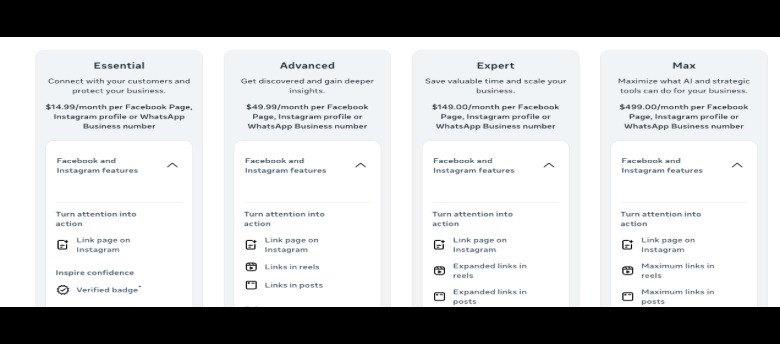
Meta has been testing paid linking for nearly a year. The company originally incorporated it into Meta Verified subscriptions, and it now promotes link-sharing as a prominent benefit of its new AI-centric Meta One plans. The cheapest $14.99/month plan comes with no additional link-sharing privileges on Facebook, though subscribers can add a dedicated link page to their Instagram bio. The $49.99/month plan comes with eight links a month on Facebook and the $149.99/month tier will buy 20 Facebook links. Only the $499.99/month tier comes with “unlimited” links on Facebook.
 Meta
“Fifty bucks for eight links a month is crazy,” says Jeff Bannister, marketing manager for a small North Carolina-based nonprofit called SparkPoint. “That’d be crazy for a corporation or a small business,” he told Engadget. “The ROI seems almost negative.”
SparkPoint, which advocates for public health and stronger social connections in Transylvania County, was recently hit with Facebook’s restriction on link sharing. Bannister is now looking at ways to work with other local nonprofits to mutually share information in the hopes of becoming less dependent on Facebook. “So much of the county is on Facebook still, there’s really not an easy solution to migrate us and the audience,” he says.
Nearly everyone who spoke with Engadget was confused about Meta’s new rules. Some people reported that they are still able to post links in comments on their posts, while others can’t. And Meta’s own descriptions of its plans and its help center information don’t indicate the restriction on links is a test. The company has said its Meta One plans are intended to “unlock more specialized capabilities” and AI features, but adding URLs to a Facebook post is one of the platform’s oldest features. It doesn’t require AI tokens. The fact that the company is now tying such a basic feature to its AI subscriptions feels like a cash grab for some.
“Having only two links per month for a nonprofit organization to spread awareness, raise support, ask for volunteers and more is really quite limiting,” says David Diskin, president of California Freethought Day, which hosts an annual event in Sacramento to promote civic engagement. Diskin was notified of the link-sharing limitation earlier this month, just days ahead of the event. He was offered slightly lower rates than others Engadget spoke with: $40/month for eight links, $119/month for 20 links or $399 for unlimited.
This week, the change was abruptly reversed. He was once again able to post links to California Freethought Day’s page. Like before, he was given no explanation for the change. He’s relieved, but remains frustrated with Meta. “It wasn’t until after our big fundraiser had passed that they fixed the problem.”
Update October 23, 2026, 3:26pm ET: After publication, a Meta spokesperson said that pages need to list “nonprofit” in the category section of their Facebook page in order for Meta’s systems to identify them as such. It’s not clear why the company can’t identify organizations that list their nonprofit status elsewhere on their pages or those that that use its fundraising tools.