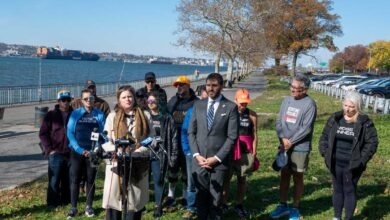
Cup of woe: Starbucks unionized baristas in Manhattan call for boycott as they seek contract with coffee chain

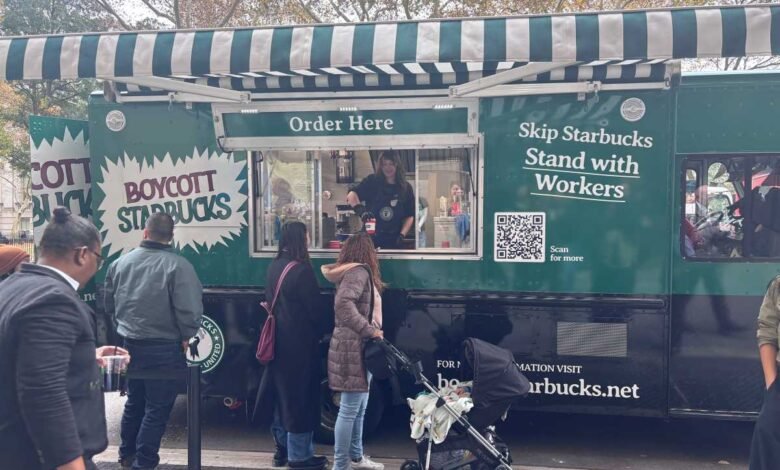
Saying “No contract, no coffee,” Starbucks baristas on Thursday handed out free coffee from a green food truck and encouraged passersby to “Boycott Starbucks” after five years with no agreement.
Members of Starbucks Workers United near City Hall sought to attract attention and apply pressure, offering cups of coffee and postcards, while seeking to get passersby to pledge online to boycott the brand.
About 700 stores in more than 40 states, including New York City, and 12,000 employees have unionized through Workers United, an affiliate of the Service Employees International Union.
They are seeking their first contract, including provisions such as at least three workers on the floor at all times, $17 starting wages for the lowest-paid baristas and 4% yearly raises.
“We’ve been fighting for a contract for five years,” Mina Leon, a Starbucks barista in the Financial District, said. “Now we’re calling for an institutional boycott of Starbucks in order to pressure them to finalize our contract.”

Skylar Colon, a Rhode Island barista, also believes the company should bargain and come to terms with a contract.
“We’re asking for a fair contract, for better pay, better staffing,” Colon said. “We’ve been fighting for about five years and they still have not written us a good, fair contract.”
While Starbucks touts a wide range of benefits if you work 20 hours a week, some baristas said due to sick time and other factors, it’s easy to end up below that.
“They choose your hours, so they’ll keep you at a minimum below 20 so that you miss out on healthcare,” Colon believes.
Leon said, although he typically works 25 hours a week, he hasn’t qualified for the benefits.
“They said I didn’t work enough hours over the past year,” Leon said. “If you have any callouts if you’re ever sick, then you dip below that and then you don’t qualify for benefits.”
State of the union

Starbucks, founded in 1971, has grown to a kind of coffee king, including 41,000 company-operated and licensed coffeehouses.
Although a relatively small portion of stores are unionized, local officials supported the right to join a union and obtain a contract.
Starbucks baristas across the country have been organizing for better wages, predictable schedules and decent working conditions,” Deputy Mayor for Economic Justice Julie Su said. “It’s a right that working people should have to choose to join a union and when they do so, they should be able to get to our first contract with their employer.”
New York City Council Speaker Julie Menin said five years is far too long to reach an agreement. “I want to make sure that the workers are really being protected,” Menin said. “I’m here in solidarity.”
Union leaders said rather than fighting the union, the company to work with the union for workers’ and everybody’s benefit.
“Despite all that support for the union, they have yet to get a contract and to get the things they’re fighting for,” SEIU Local 32BJ President Manny Pastreich said. “Fair wages. benefits and good scheduling rules.”
Pastreich said it’s important that workers “have a voice, so they can fight for the things they care about, and they can have a contract that guarantees those things.”
Bean there, done that

Although the union is urging a boycott, Starbucks workers last Nov. 13 went on a strike they called the “Red Cup Rebellion,” with similar slogans such as “No contract, no coffee,” “They make billions. We make beans” and “What’s outrageous? Starbucks wages.”
“Too many baristas still aren’t getting enough hours to pay the bills or meet the threshold for benefits,” the union said at the time. “Starbucks needs to invest in increasing our hours.”
CEO and Chairman Brian Nichol at that time said they “provided additional coverage hours in over 3,000 stores,” and doubled paid parental leave in the United States up to 18 weeks.
The company said they made “a $500 million investment in additional hours and expanded rosters so that there are more partners working during our busiest shifts.”
Starbucks green

Starbucks, which in September closed 250 North American stores and recently sold its China operations for $536.3 million before taxes, a few weeks ago reported strong fourth-quarter and fiscal year earnings.
Fourth quarter net revenues dropped 4% to $9.1 billion after the China sale, but sales at stores open at least a year rose 7.2 %, helped by inflation and a 5.2% average ticket price increase.
Starbucks’ fiscal 2026 revenues rose to $37.9 billion from $37.1 billion a year ago, as net earnings rose to $2.5 billion from $1.9 billion a year ago.
The company said it is continuing to boost benefits, with nearly 200,000 full- and part-time workers receiving stock grants on Nov. 11.
Starbucks said since 1991 more than 2 million employees have received $2.75 billion in pre-tax gains through stock grants.
In July, the company expanded digital tipping, which they said resulted in more than $22 million in additional tips, doubling tipping.
According to Starbucks, “nearly 95% of partners receive their preferred schedules” while more than 3 million people last year applied to join the company in North America.
Starbucks Workers United, though, said it wants guarantees in a contract and a seat at the bargaining table with a contract, not just a cup of coffee.
“Together, we’re demanding the pay, hours, staffing and protections baristas need to succeed locked into a union contract,” the union said. “Starbucks, it’s time to finalize a fair union contract and move forward.”