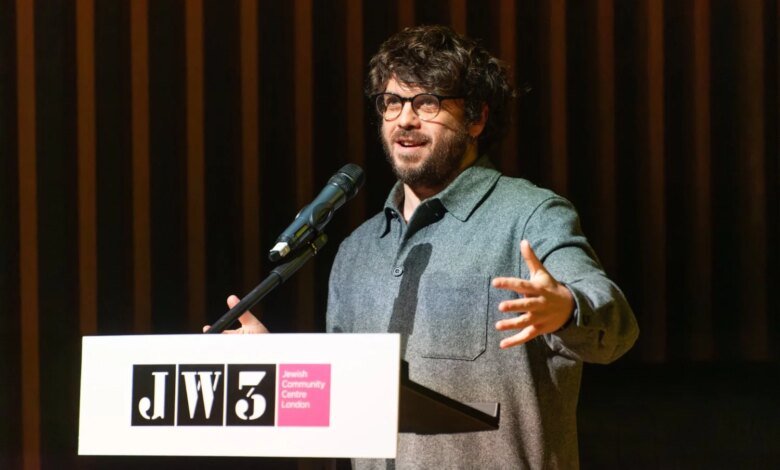

You’ve been working on Seder for quite a while. When did it start?
The show started in the pandemic, in 2020, but the project started some years before that. In 2017, I met with the publisher of the book, because the piece began its life as a poetry collection, and asked if he’d be up for working with me if I explored the connection between Judaism and heavy metal. I was already doing collaborative work with dancers and musicians, so I thought why not explore the potential of this collection to be a collaborative piece as well – because that’s what my [main] practice is. So, we all learnt to use Zoom and produced something. When we were going to tour it in 2023, it all kicked off [7 October]. The tour got cancelled [due to safety concerns], so we took that skeleton and redeveloped it over an entire year and a half to what you see today.
How different does Seder look now compared to pre-2023?
The previous piece was essentially the poetry collection, which worked to reposition Holocaust history in Jewish identity. My Jewish identity is very rooted in my grandparents’ house, their community practices – the way they did Judaism – and it’s abundant, joyful and welcoming. Yet at the same time there’s this inescapable Holocaust shadow. It’s present in everything that you’re doing, but it’s not spoken about and that’s not healthy.
Initially the piece was about decompartmentalising those stories, but when 7 October happened, we went into rehearsals and made something in response to that. It was difficult, because I was doing a lot of personal work, which is [touched on] in the piece, with regards to shame and reckoning with my connection to Israel as a safe space. I had to think: what do I want this story to do in the world? What’s going on is obviously horrific and somehow my story is tied up in it. So I went back to it, really tried to take agency of the story and consider what this dissonance is as a British Jew. The show has changed hugely, but the one thing it’s managed to hold onto is this idea that the binary doesn’t work. The myriad truths that we’re holding have changed. [One of] the only things that has stayed the same is my grandfather’s story.