Seeking a lift: Queens lawmaker urges MTA to equip more 7 train stations with elevators

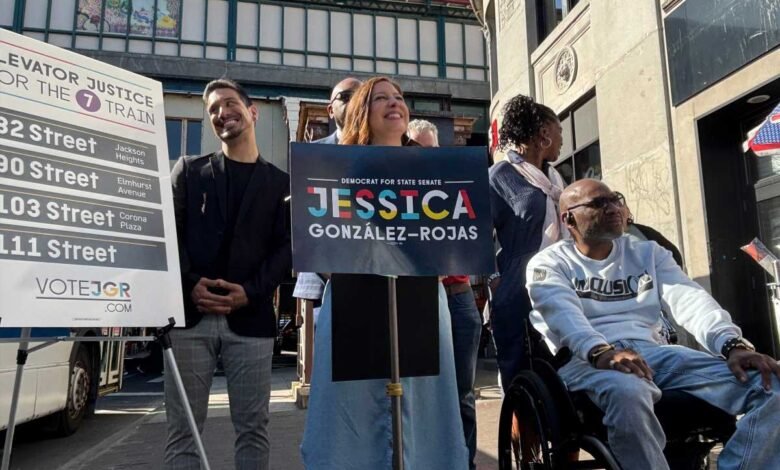

A Queens state lawmaker on Tuesday urged the MTA to make more 7 train stations running through the borough more accessible to all residents.
Assembly Member Jessica Gonzalez-Rojas (D-Queens), as part of her campaign to unseat state Sen. Jessica Ramos (D-Queens), called on the transit agency to install elevators at four 7 train stations that are currently inaccessible to riders who use wheelchairs or face other mobility challenges. She named 82 St-Jackson Heights, 90 St-Elmhurst Av, 103 St-Corona Plaza, and 111 St as the stations in need of elevators.
Specifically, Gonzalez-Rojas demanded the MTA prioritize adding lifts at 82 St, while making the accessibility upgrades to all four stations through its current five-year capital plan or the next one.
“These stations serve working families in Jackson Heights, Corona, Elmhurst, and East Elmhurst every single day,” the assembly member said. “Yet, decades after the ADA (Americans with Disabilities Act) was passed, accessibility law became law [sic], these stations remain out of reach for too many of our neighbors.”
The MTA has named half of the 60 stations it plans to add elevators to in its latest capital plan, which spans from last year through 2029. Of the four 7-line stations in need of elevators, only the 103rd Street stop is on the proposed upgrade list.
“They have committed to 60 stations to have accessibility upgrades, they’ve only outlined 30, so there’s room for more,” the Assembly member said.
Just six of the 7 train’s 18 stops in Queens are currently wheelchair accessible.
The agency did not provide a response by publication time.
Gonzalez-Rojas said the 82 St-Jackson Heights station should be prioritized due to its proximity to Elmhurst Hospital, although Jackson Hts-Roosevelt Av/74 St, which has elevators, is equidistant from the medical center.
Moreover, the lawmaker said the lack of elevators at those stations not only renders them inaccessible to disabled riders, but also makes them more difficult for seniors and parents with strollers to access.
Stephanie Rodriguez, an advocate with a young child who spoke during the event, said that while she can always count on a fellow New Yorker to help bring her stroller up the subway stairs, she should not have to.
“Sometimes I don’t even have to ask for help; New Yorkers, we show up for each other,” Rodriguez said. “But it’s time that our government shows up for us and does right.”
Gonzalez-Rojas said the issue is even more pressing due to a large concentration of those living along the 7 line being immigrant and working class.
“These neighborhoods are majority immigrant communities, they’re majority working class communities, they’re communities that rely on public transit more than almost anywhere else in New York City,” she said. “Yet we’ve been left behind.”
The closest accessible station to 82 St is Jackson Hts-Roosevelt Av/74 St, which is eight blocks away. Similarly, 90th St is eight blocks away from its closest station with elevators — Junction Blvd.
The accessible station at Junction Blvd is five blocks from 103 St, while the 111 Street station is nine blocks away.
“What we hear from the MTA is that it’ll happen over time, but it’s not a priority, because we have a subway station about 10 blocks away that has elevated access,” said City Council Member Shekar Krishnan, who represents Jackson Heights.
“Ten blocks away, that is unacceptable,” he continued. “Tell that to anyone who is a parent with a stroller. Tell that to anyone with disabilities to go 10 blocks further to be able to get to their train.”
The agency is currently in the process of adding elevators to other stops on the 7 line under the current capital plan, including 33 St-Rawson St and 46 St-Bliss St.