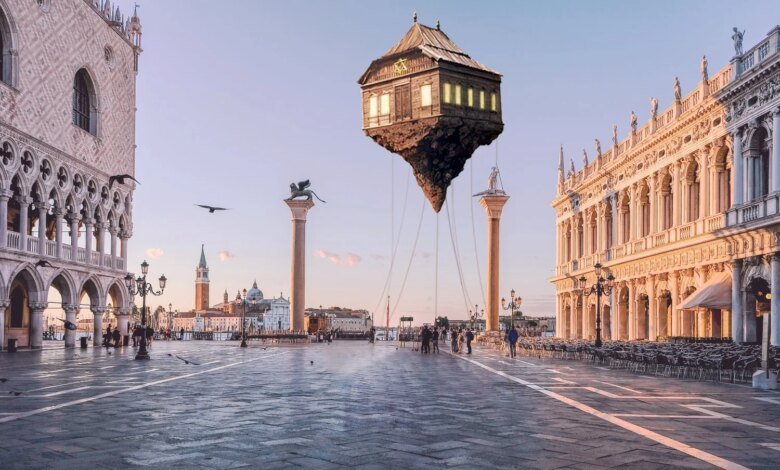
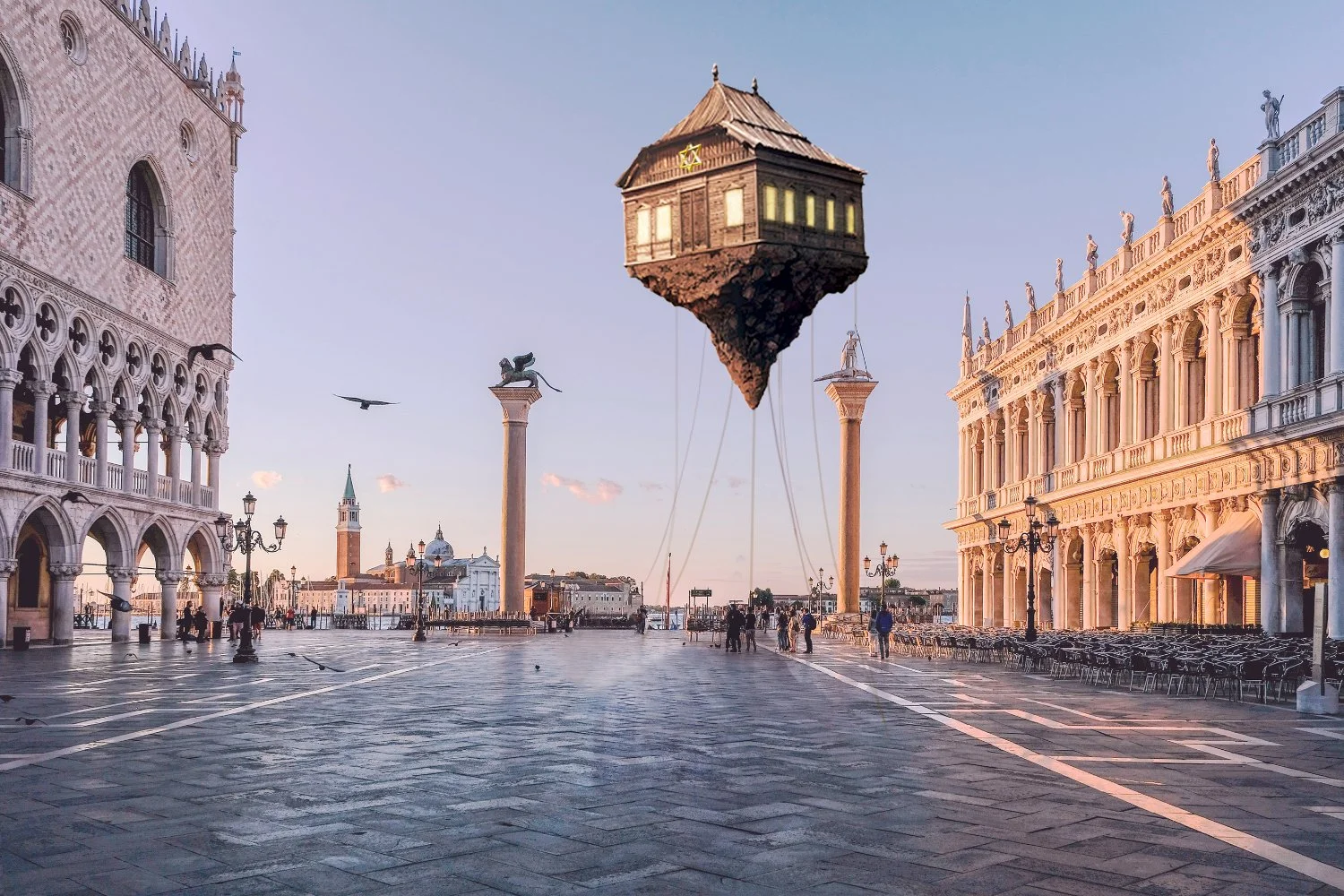
This May also sees the return to Venice of Anna Kamyshan, a Londonbased Ukrainian architect, who last year presented The Castle of Yiddishland, an AI-generated video of traditional shtetl shuls floating above different cities around the world, inspired by Magritte’s Castle of the Pyrenees. The video was part of last year’s Yiddishland Pavilion, but this year Kamyshan has a separate venture. She aims to bring that video to life via a balloon-like installation entitled Nabatele, a name amalgamated from the Slavic nabat (call for attention when under threat) and the Yiddish suffix -ele (to convey affection). On her Instagram Kamyshan explains: “The work recalls how Jews in Venice were once forbidden to build synagogues on the ground floor thus raising them above the city. In perpetual flight, they evoke a homeland without land.”
Yiddishland Pavilion was created as an answer to life without borders, with no single nation to claim as one’s own. “Our goal was to provide a critique of the Biennale, but also to create spaces where diasporic artists, with complex identities, could find a home,” says Fiks.
By Danielle Goldstein
Header image: Nabatele by Anna Kamyshan. A digital sketch with Al-generated elements. This proposal for the 61st Venice Art Biennal was first presented as a part of an Al-generated video at the Architecture of Hereness exhibition for the Yiddishland Pavilion at Ghetto Vecchio, Venice, 2025 © Anna Kamyshan
Yiddishland Pavilion runs Thursday 7-Saturday 30 May throughout Venice. yiddishlandpavilion.art
This article appears in the Spring 2026 issue of JR.