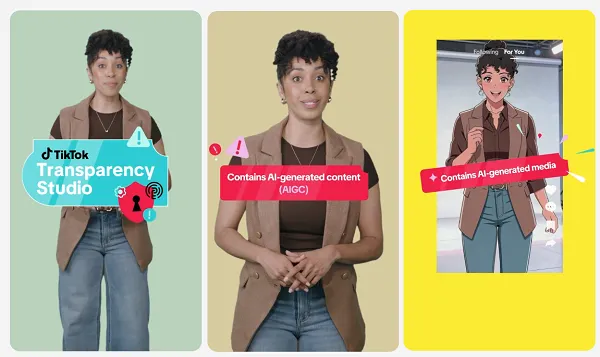
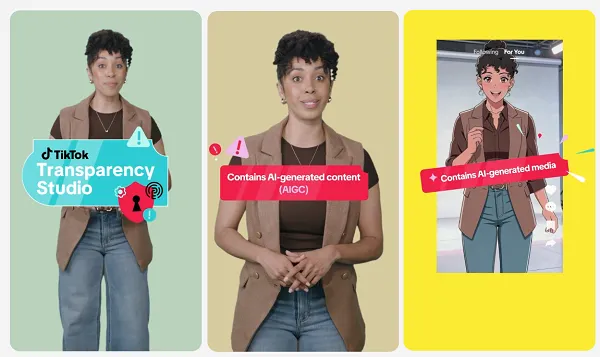
TikTok has announced an initiative to address the rise of artificial intelligence-generated content in the app, including an expanded educational program for users, and an improved detection systems designed to increase transparency.
First, TikTok launched a new AI literacy guide to help users identify in-app AI content.
As explained by TikTok: “We know from experts that education is critical to giving people control over their experiences with AI. That’s why we’ve worked with industry partners NAMLE & Henry Ajder to create a new guide that helps our community use AI tools responsibly.”
The guide includes video overviews and explainers designed to help TikTok users better understand how to identify AI-generated content.
TikTok is also planning to launch an in-app hub in the coming weeks. The hub will teach users practical skills for spotting AI-generated content when they search for AI-related terms.
TikTok also announced expanded funding for AI literacy initiatives, including NoFiltr and Raspberry Pi Foundation. These programs are intended to promote AI literacy through TikTok content.
The company is also expanding its own AI detection efforts in order to detect AI-generated spam and misinformation.
“We’ve long prohibited spam and used technology to find and remove it at scale, with more than 86 million fake accounts removed in the first three months of this year alone,” TikTok said. “But as this kind of content evolves, so must the ways in which we protect the integrity of our platform. In the coming weeks, we’ll be testing improvements to our detection systems for accounts dedicated to posting AI-generated spam on topics that could pose a risk to public trust or well-being. These include politics and current events, financial advice, and medical content.”
Finally, TikTok announced an expansion to its labeling partnerships, which is designed to flag more AI content in the app.
“To date, we’ve labeled over 3 billion videos as AIGC using a combination of Content Credentials, creator labeling tools and our invisible watermarking technology,” TikTok said.
The updates reflect the growing dilemma that social media platforms are facing regarding generative AI.
On one hand, social media apps are looking to implement creative AI options in order to lean into the latest tech trend and drive more engagement. On the other hand, users are quickly tiring of AI slop, which is being facilitated at scale because these tools are readily available to billions of social media users.
That’s not to say that AI is bad in this context. The tech has created plenty of engaging, viral video content and images. But as with all creative tools, a lot of experiments are not going to resonate.
Moreover, social media users are now being used as test audiences for an endless amount of AI experiments, which are beginning to crowd out the good content. And with platforms offering financial incentives for top-performing posts, and with no limit on how much content can be posted, there’s been a virtual tsunami of AI slop infecting every app.
That wave now threatens to dilute the value of social apps entirely, which could lead to a reduction in overall usage.
As such, the platforms have to implement counteractive measures to reduce the impact of their own AI tools. This has led to a confusing approach, in which AI is being simultaneously promoted as both good and bad.
Really, it’s neither because it’s all relative to each use case. Though right now, the negative uses seemingly outweigh the good.