MTA officials announced on Thursday that the agency is finally expanding its pilot program systemwide to designate space on city buses for caregivers to stand with unfolded strollers, following years of parent advocacy and testing.
New York City Transit President Demetrius Crichlow, during an Aug. 6 Lower Manhattan news conference, said the expansion comes after a “successful” years-long pilot and is supported by funding approved by the state legislature.
“Parents will be able to ride without needing to fold their strollers,” Crichlow said. “That’s a huge win for many people who have been asking for this for many years.”
The MTA kicked off the pilot in late 2022, beginning with seven routes and expanding to several more the next year.
It followed fierce activism by a group of mothers who long argued that the agency’s policy requiring that strollers be folded on buses was a “nightmare” to navigate. They said it was difficult to collapse their strollers while also boarding the bus and holding onto their children at the same time.
State Sen. Andrew Gounardes (D-Brooklyn), one of the lawmakers who pushed to fund the pilot, recounted his own experience struggling to board the bus while ensuring his child’s stroller was properly folded.
Gounardes said when he passed funding for the pilot, he was “pushing a stroller for my second child and had to navigate the buses with my oldest, who was not in a stroller, and my youngest, folding the stroller up and trying to not have him run away from me.”
The pilot also resulted from a review of the stroller ban by an MTA-convened working group — composed of parents, disability advocates, and transit workers.

Crichlow said the areas for stroller-pushers are separate from the ones set aside for wheelchair users, in response to concerns from disability advocates that the two would conflict.
“This program means that buses will have clearly marked places that separate from existing priority seating for those using them for wheelchairs and walking devices at separated accessibiliy locations,” Crichlow said.
Quemuel Arroyo, the MTA’s chief accessibility officer, said part of the reason why the program had been in the pilot stage for so long was that the working group had to ensure that the spaces for strollers did not take away from space designated for disabled riders.
“It took us exactly the time it needed to take us for us to ensure that we heard every voice, that everyone’s needs were met, and that we were able to provide something that was helpful to every rider,” Arroyo said. “Every rider’s needs were taken into account here.”
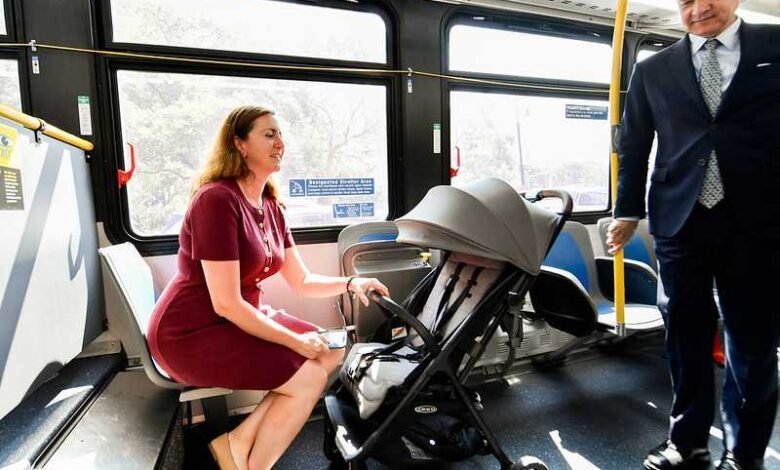
The space for those with strollers on buses is most commonly found across from the back doors, but can also be in other locations depending on the bus class, Crichlow said. On some bus models, the area is created by flipping up a pair of seats, similar to the wheelchair accessible space at the front of the vehicles, but on others, seats are removed to clear the spot.
“It’s just across from the rear door and you’ll see the two flip-up seats that are easily accessible and designated as such,” Crichlow said.
“Depending on the model [of bus], they have different configurations,” Arroyo said. “Some of them you have to flip up the seat, others, it’s already an open space. … Where two people used to sit, four can stand.”

Officials said that those with strollers still must board and pay their fares at the front of the bus before proceeding to the back.
Crichlow said that around 75% of the buses in the MTA’s nearly 6,000-bus fleet are already outfitted with space for those with strollers. He added that buses without the spaces are being retrofitted to include them and that the areas are now built into all new buses.
The NYC Transit boss said the system-wide expansion could be completed by early next year.