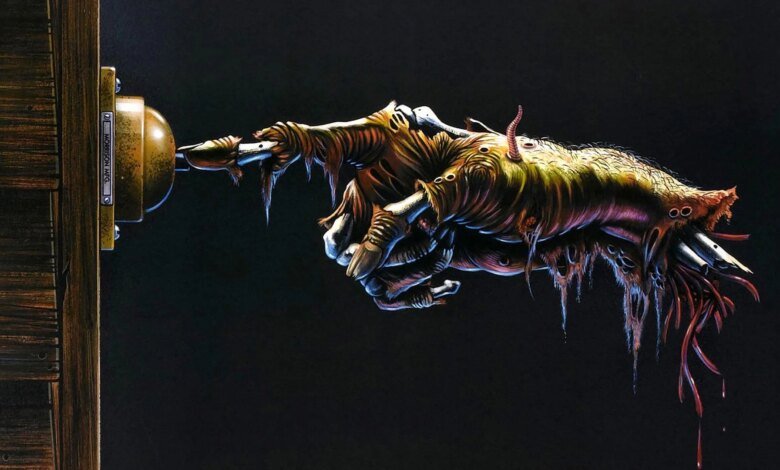

Some horror movies scare you. Some gross you out. Some make you laugh. Then there’s House, the wonderfully weird 1985 horror comedy that throws grief, Vietnam trauma, rubber monsters, alternate dimensions, slapstick, haunted closets, and a shotgun-wielding flying skull into the same movie and somehow makes it work.
I absolutely loved this movie as a kid. I rented it countless times, and it has since become one of those comfort horror films I keep coming back to.
Watching it as an adult, I can see its faults much more clearly. Some of the comedy is corny, certain effects show their age, and a few of its serious ideas don’t come together as well as they could. None of that has killed my affection for it, though!
I still love the tone and vibe of House. I love the way it plays with horror and psychological trauma without forgetting that watching a movie about monsters coming out of closets should also be a hell of a lot of fun.
Directed by Steve Miner, House follows horror novelist Roger Cobb, played by William Katt, a man whose life has basically collapsed. His young son has disappeared, his marriage is falling apart, and Cobb is still carrying the psychological scars of his service in Vietnam.
After the death of his aunt, he moves into her old Victorian home with plans to write an autobiographical book about the war. Naturally, moving alone into the creepy house where your aunt died turns out to be a terrible idea.
Cobb begins experiencing increasingly bizarre supernatural events and eventually discovers that the house may be connected to his son’s disappearance. More importantly, his son might still be alive.
That story could have produced a fairly conventional haunted house movie, but House has no interest in staying conventional.
Miner keeps changing the rules, bouncing between genuine sadness, monster movie thrills, physical comedy, psychological horror, fantasy, and outright cartoon insanity.
The movie has some of the ghoulish playfulness of George A. Romero’s Creepshow, while its anything-can-happen attitude points toward the kind of horror comedy Sam Raimi would later push much further in Army of Darkness. It’s closer to the Three Stooges-inspired madness of that film than the nastier, rougher energy of the first two Evil Dead movies.
That tonal juggling act is one reason House still feels different from so much horror made around the same time.
Katt is a big part of why it works. Best known during the era for playing the accident-prone hero of The Greatest American Hero, he makes Cobb likable even when the movie asks him to jump from tortured veteran to grieving father to monster-fighting slapstick hero within a few scenes.
There’s also a funny Stephen King quality to Cobb. He’s a successful horror writer living in an imposing old house and discovering that alternate realities aren’t limited to his fiction. Katt plays the insanity with enough sincerity that Cobb never completely becomes the straight man in a live-action cartoon.
Then George Wendt shows up. Best known as Norm from Cheers, Wendt plays Cobb’s neighbor Harold, who is simultaneously suspicious of him and thrilled to discover that a famous writer lives next door. Wendt brings an easy comic presence that helps some of the movie’s cornier material land. He’s the lovable guy who can walk into a ridiculous situation and immediately make it more entertaining.
One of my favorite scenes in House is the midnight attempt to catch the closet creature with Harold. It’s such a perfect example of the movie’s weird balancing act because it starts as a goofy monster hunt, turns into full-on creature horror, dives straight into Roger’s Vietnam trauma, then ends on a great visual gag.
Roger already knows the creature is real. It has attacked him before, and his attempt to capture proof of it on video has gone nowhere. He has also figured out that the thing appears at exactly midnight, so he brings Harold into the house to help catch it.
Of course, he doesn’t tell Harold the truth. Instead, Roger claims they’re dealing with a giant raccoon, which is already funny considering the equipment he hands him.
Harold is given a harpoon gun attached to a wire tether, which feels hilariously excessive for pest control. George Wendt plays Harold’s skepticism perfectly. He clearly knows something about this situation doesn’t add up, but he goes along with it anyway.
Then midnight hits. The closet monster suddenly lunges out, and Harold completely freezes in terror. At the same time, everything goes wrong for Roger. His foot becomes tangled in the harpoon rope, and he’s violently dragged backward into the black void inside the closet.
That’s where the scene takes one of those sharp turns that makes House so memorable. What looked like a comic monster-catching sequence suddenly becomes tied to Roger’s psychological scars.
Inside the closet portal, he experiences a surreal return to his Vietnam trauma. The movie takes this ridiculous physical situation and connects it directly to the guilt and memories that have been haunting him long before the supernatural stuff began.
Then Roger finally makes it back out. He comes flying through the portal into the bedroom, only to land in front of Harold, who has completely passed out after drinking a bunch of beers.
I loved this scene because it contains almost everything that makes House work for me. You get a great rubber monster, George Wendt being hilarious, an absurd harpoon-gun plan, a supernatural portal, Roger’s psychological horror, and a punchline involving Harold being totally useless by the time Roger returns.
The movie keeps changing gears without warning, but somehow the scene holds together. It’s scary, ridiculous, personal, and funny within the span of a few minutes.
That combination is exactly why House remains such a comfort horror movie for me. It can deal with some pretty heavy material, then turn around and remind you that you’re also watching a movie where a guy convinces Norm from Cheers to hunt a “raccoon” with a harpoon gun.
Richard Moll plays Cobb’s fellow Vietnam soldier Big Ben, who becomes central to the story’s darker side. Moll works well when Ben is tied directly to Cobb’s guilt and memories of the war, and his eventual transformation into a full monster takes the movie to a new level of bonkersness.
There’s even some horror royalty hidden among the stunt performers, with Kane Hodder contributing years before becoming synonymous with Jason Voorhees.
The music comes from Harry Manfredini, whose score occasionally carries familiar echoes of his work on Friday the 13th but also gives House its own playful personality. The music understands what kind of movie this is. Horror can turn into comedy at almost any moment, so the score has to be ready to make the jump with it.
That unpredictability is where House really earns its cult status. Miner was determined to keep viewers wondering what kind of movie they’re watching. Some jokes come down harder than they need to, but the film’s willingness to chase whatever strange idea comes next gives it the flavor of an old E.C. Comics horror story that has escaped from the page.
The Vietnam material is probably the shakier part of the movie. Those flashbacks establish an important piece of Cobb’s psychological torment. He couldn’t save a fellow soldier, and that failure has followed him home in a very literal form. It’s an interesting attempt to connect supernatural horror with guilt and trauma.
The execution doesn’t completely sell it. The supposed Vietnamese jungle sometimes looks suspiciously like somebody found an overgrown backyard or cleared out a section of a plant nursery for the afternoon.
More importantly, the emotional weight of those sequences doesn’t always fit comfortably with the crazier movie surrounding them. Yet I appreciate that House tries.
This could have been a simple story about a writer moving into a haunted mansion. Instead, the filmmakers gave Cobb emotional baggage tied to war, the loss of his child, the destruction of his marriage, and his inability to escape his own memories.
The monsters aren’t simply things lurking inside an old house. They’re tangled up with everything Cobb has failed to confront.
Then the movie reveals that his missing son didn’t exactly disappear. He fell through a portal in a swimming pool into another world.
That’s House. Just when you think you’ve figured out what it’s doing, somebody throws an interdimensional swimming pool at you.
Judged against mainstream American horror comedies of its own era, House was taking some pretty unusual swings. Even the slicker and more accomplished Fright Night, also released in 1985, feels relatively safe beside it.
This becomes especially interesting when you look at where American horror was headed during the mid-’80s. Slashers were everywhere, and filmmakers were constantly looking for new ways to increase body counts and gore. House goes somewhere else.
There isn’t much blood. Instead, we get rubber monsters, creature suits, matte paintings, elaborate makeup, practical effects, supernatural portals, and strange visual gags. It’s a monster playground rather than a slaughterhouse.
I loved that stuff as a kid, and I still do. The creatures are a huge part of the movie’s charm. They don’t need to look photorealistic. They’re tactile, strange, funny, and wildly creepy. You can practically feel the materials they’re made from, which somehow makes them more enjoyable rather than less convincing.
The film could have pushed its comic-book influence even further. Miner was clearly playing in territory associated with the William Gaines-published E.C. Comics such as Tales from the Crypt.
House has the grotesque creatures, morbid jokes, crazy reversals, and macabre punchlines, but it doesn’t fully embrace the living-comic-book visual language that made Creepshow so distinctive.
That’s one of those things I notice much more now than I ever did as a kid. Yet whenever House starts looking like it might fall apart, it usually comes up with another wonderfully insane idea.
One of my favorite examples involves Cobb climbing down a rope into complete darkness. It’s already a awesomely strange image, but the movie isn’t satisfied with simply sending him into the abyss.
He encounters a winged skull creature and the monster takes Cobb’s shotgun. Then it gives the shotgun an Annie Oakley-style twirl before firing it off. What other haunted house movie gives you that?!
It’s a little moment, but it represents exactly why House remains so much fun. The filmmakers continually add weird little flourishes that didn’t need to be there. Someone could have simply had the creature attack Cobb. Instead, they thought, “What if the flying skull did a gun trick?”
Yes. Absolutely. Put that in the movie! Hardcore horror fans looking for buckets of blood may wish Miner had pushed the gore further. I get that. Yet the restraint actually helped give House an identity of its own. Rather than competing with every slasher of the period, it mixes creature horror, psychological trauma, fantasy, and slapstick.
Not all of those ingredients blend perfectly. That’s part of the appeal. House is clunky and uneven. Some effects work better than others. The Vietnam material needed more convincing locations and stronger dramatic integration. The comedy occasionally pushes too hard.
I wouldn’t want to sand those rough edges away, though. There’s personality in this movie. There’s imagination. Most importantly, there’s showmanship. Miner and company keep asking what else they can throw at Cobb, and therefore the audience, before the whole thing collapses under its own insanity. Somehow, it doesn’t.
For me, that’s also why House II: The Second Story from 1987 makes such a natural companion piece. Both movies understand that a haunted house doesn’t have to operate according to the usual haunted house rules.
Doors can lead anywhere. Monsters can be funny. Horror can suddenly become adventure. Something terrifying can become ridiculous seconds later. That’s a big reason these movies have lasted as cult favorites.
House is also easily one of Miner’s strongest and most distinctive films, and it’s one of the more memorable movies to come out of Roger Corman’s New World Cinema orbit. It took material that could have become disposable genre entertainment and gave it a personality that’s still recognizable decades later.
Maybe nostalgia is part of why I’ll always defend it. Like I said, it’s become comfort horror for me, the kind of movie I can put on and immediately enjoy being back in its strange little world.
I appreciate the psychological elements more as an adult, particularly Cobb’s grief and guilt, while still getting the same kick out of all those monsters, portals, gags, and practical effects that grabbed me when I was younger. Most of all, House is fun!
There’s an entire generation of younger horror fans who haven’t seen it, and I hope more of them discover it. Anyone exploring underrated ’80s horror movies, practical effects horror, cult horror comedies, or strange haunted house movies owes House a look.
It isn’t perfect, but perfect would probably make it less interesting. Nearly everything memorable about House comes from its willingness to make an unexpected choice when an easier one was sitting right there.
That’s why, after all these years, I’m still happily walking back into that house.