How To Deal With Jealousy Revealed On 1,500-Year-Old Mosaic Found In The Ancient City Of Syedra, Türkiye

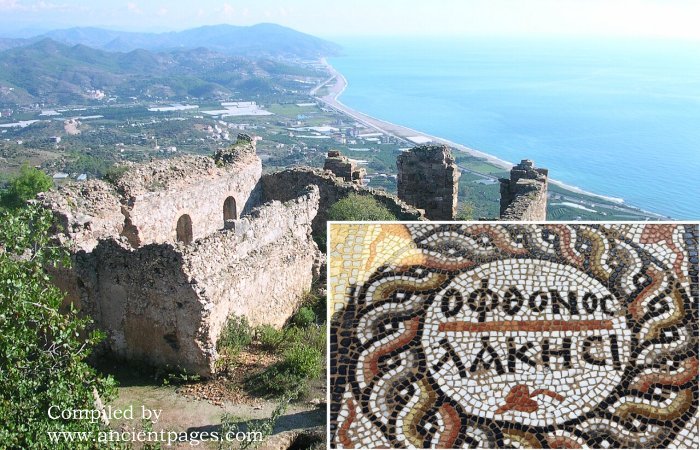
Jan Bartek – AncientPages.com – Jealousy is a timeless aspect of human nature. Throughout history, people have experienced jealousy, and this emotional trait has been recognized across generations. Evidence of this awareness appears in a 1,500-year-old mosaic discovered in the ancient city of Syedra, located on the southern coast of modern-day Türkiye, between the towns of Alanya and Gazipasa. The builders of the mosaic left a message for future generations on how to deal with jealous people.

Ancient ruins of Syedra. Credit: matzi01 – CC BY-SA 3.0
Archaeological excavations in Syedra, a settlement with a history spanning roughly 3,000 years, are being conducted under the leadership of Assoc. Prof. Dr. Ertug Ergürer from the Tourism Faculty of Alaaddin Keykubat University. These ongoing studies are expected to yield many significant and intriguing findings.
One notable discovery so far is a remarkably well-preserved mosaic uncovered at the central entrance of one of the city’s largest residences. According to Dr. Ergürer, the mosaic features geometric patterns and various floral motifs. Based on initial examinations, the team believes the mosaic dates to the 4th-6th centuries, as he explained to Anadolu Agency.
Let the Envious Burst!
Dr. Ergürer noted that what makes the approximately 15-square-meter mosaic special is the presence of two inscriptions on it, and continued as follows:
“In the central section of the mosaic, there is an inscription that means ‘enjoy it’ or ‘use it with good luck.’ At the entrance to the room, there is a second inscription within a circular border. This inscription has a somewhat metaphorical meaning. The first word in the inscription means ‘jealousy’ or ‘jealous,’ and the second word means ‘burst, explode.’

Ancient peoples’ advice on handling jealousy. Credit: Mustafa Kurt/AA
It’s an expression that corresponds to the modern-day phrase ‘let the jealous one burst.’ Encountering such an expression at the entrance of a structure built approximately 1500 years ago was a great surprise for us.”
Ergürer stated that they consider the building one of Syedra’s significant residential structures and that excavation and restoration efforts will continue in specific areas of the house.
He explained that the northern section of the three-story building includes the entrances to the second and third floors. The structure, which features numerous rooms and a central courtyard, was in use from the 2nd to the 7th century AD. Over this long period, ownership changed several times, new spaces were added, additional floors were constructed, and some areas were closed off. In later centuries, both the entrance and the upper part of the mosaic section were covered, a modification that ultimately helped preserve the mosaic to the present day.

Credit: Mustafa Kurt/AA
Ergürer also noted that both the mosaic and the building have been safeguarded through ongoing restoration and that cleaning and conservation work will continue.
See also: More Archaeology News
Selma Yagci, a conservator-restorer on the excavation team, stated that they began the restoration process after identifying the mosaic unearthed during the excavation.
Noting that the mosaic is in generally good condition, Yagci said, “There were some areas that required localized emergency intervention. Then we applied borders. We identified and gathered the scattered sections. After putting the pieces back in place, we performed joint filling. After this localized work, we completed the process by applying a surface protector.”
Source: Anadolu Agency
Written by Jan Bartek – AncientPages.com Staff Writer