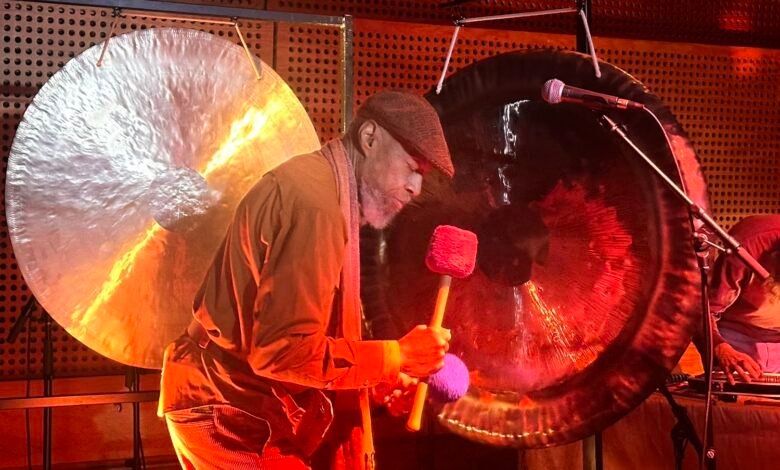
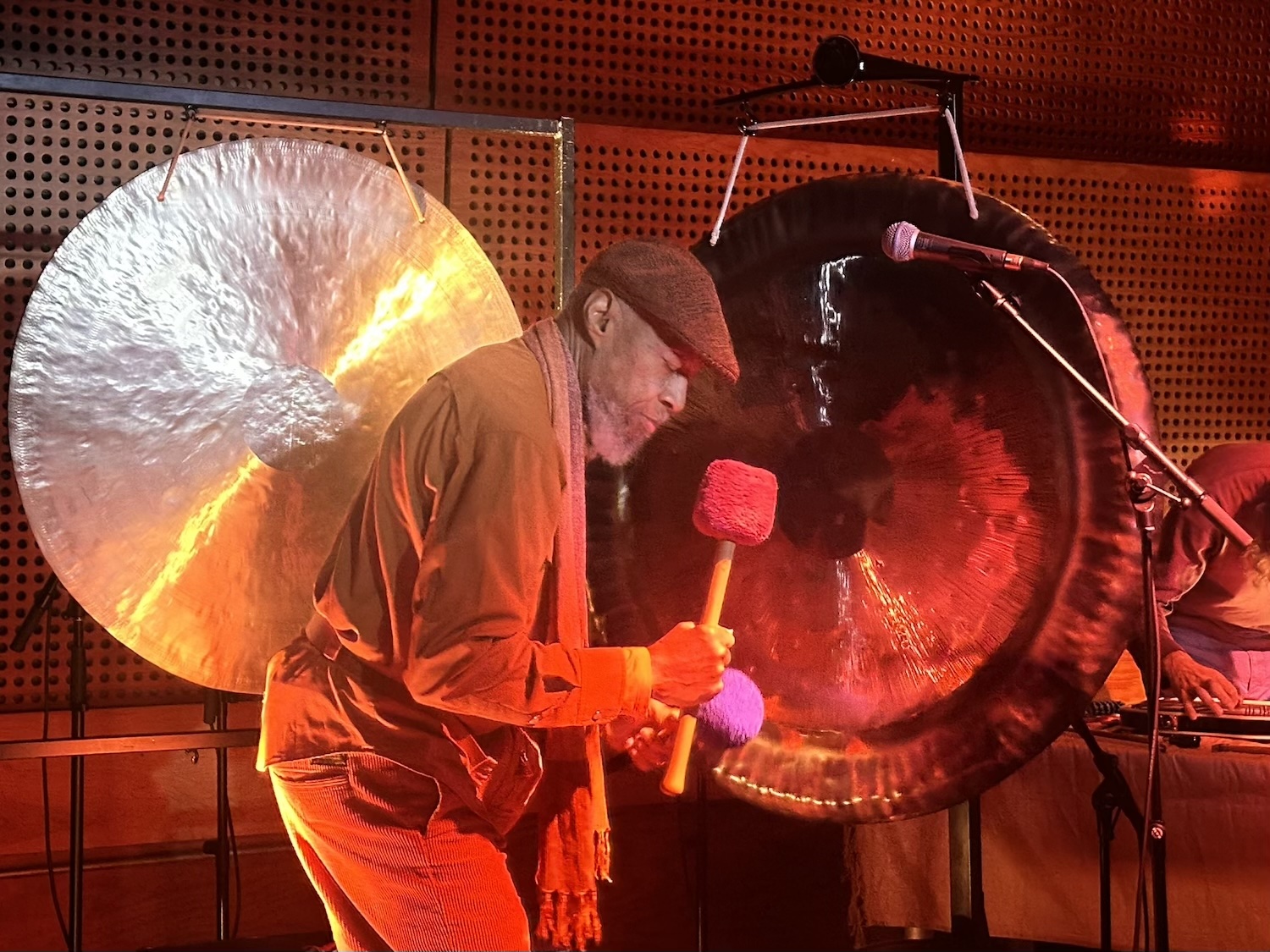
In the remote corner of Gowanus that Public Records’ Sound Room occupies, LARAAJI lurked peacefully stage left while musician and sound healing facilitator Samer Ghadry prepped the crowd. Squished into the north side of the room, we made bird calls, shook our bodies and voices from side to side, and imitated gongs (low) and autoharps (high). “It’s the end of the week!” Ghadry said. “You all do this at the end of the week, right?”
The music was slow and droning. Ghadry sang wordlessly and played his gongs while LARAAJI worked magic with an autoharp (a zither that allows the player to automatically mute non-chord tones with built-in bars), his instrument of choice for the past 50 years and the one that’s made him a mononymous experimental music icon of the 20th and 21st centuries. Warm-up aside, the performance was understated and reflective. Some in the crowd stood, some sat on the floor; everyone looked at once relaxed and locked into the glacial sounds the two men made: Ghadry struck his gongs methodically, letting the slow crashes resonate. LARAAJI bowed, plucked, tapped, and looped his autoharp, stringing its sounds through subtle effect chains with a synthesizer. Half an hour later, the duo stopped naturally. If any physical cue was given from one to the other, I missed it.
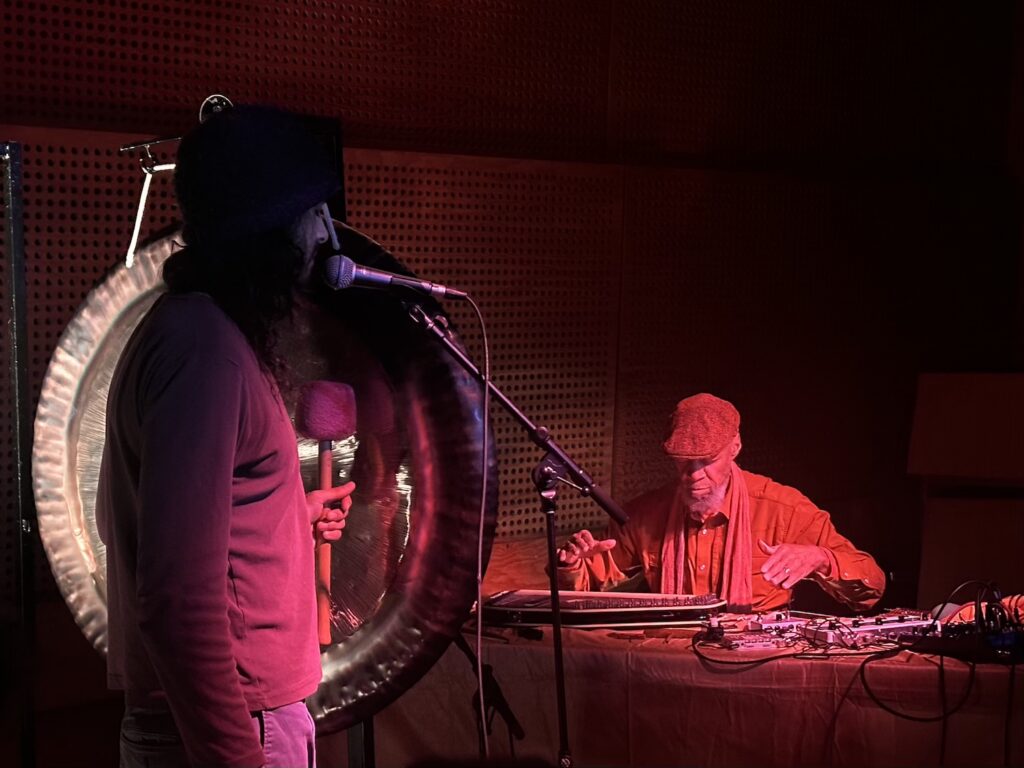
Photo by Raphael Helfand
LARAAJI got his first autoharp at a Queens pawn shop in 1974, during a short stint at his mother-in-law’s place in South Ozone Park. Strapped for funds, he entered the store with his $175 guitar, hoping to pawn it for cash, but was only offered $25. His eyes settled on the trapezoidal stringed object in the window, and, as the legend goes, a voice from the ether told him to swap his guitar for the unfamiliar instrument rather than the money.
He may have bartered his zither in Queens, but he learned to use it, misuse it, and push it past its prior limitations in Park Slope, where he moved shortly after its acquisition. It was a time of tremendous change in every area of his life—from family man to itinerant soul, from jazz fusionist to ambient music pioneer, from youthfully edgy comic to ageless apostle of the Sun. In parallel with his craft, Brooklyn is where LARAAJI both refined and expanded his spiritual practice, weaving an intricate web of Eastern philosophy, Western science, and personal flair.
It went down during the winter week he spent living on the subway, riding through rush-hour scrums in Manhattan and pre-dawn desolation in the outer boroughs. Emerging from the Grand Army Plaza 2/3 station one day, he sat on a bench near Prospect Park’s northwest entrance. “At that point in my life, I was very much alone,” he tells me more than 50 years later, in the music room of his fifth-floor Harlem walkup. “I wasn’t troubled by it, but I remember sitting on the park bench and feeling the presence of the Sun like I’d never felt it before—like a very warm, gentle friend.” For the first time, he appreciated the full magnitude of the Sun’s power.
LARAAJI’s Grand Army Plaza revelation and his move to Park Slope less than a year later weren’t consciously connected, he says, but the coincidence is too cosmic to ignore. It was in Brooklyn that he renounced his earthly wardrobe for the all-orange ensembles he’s worn exclusively ever since in homage to his new celestial mentor, and it was in Brooklyn that he prepared to cast off his birth name and receive a new one.
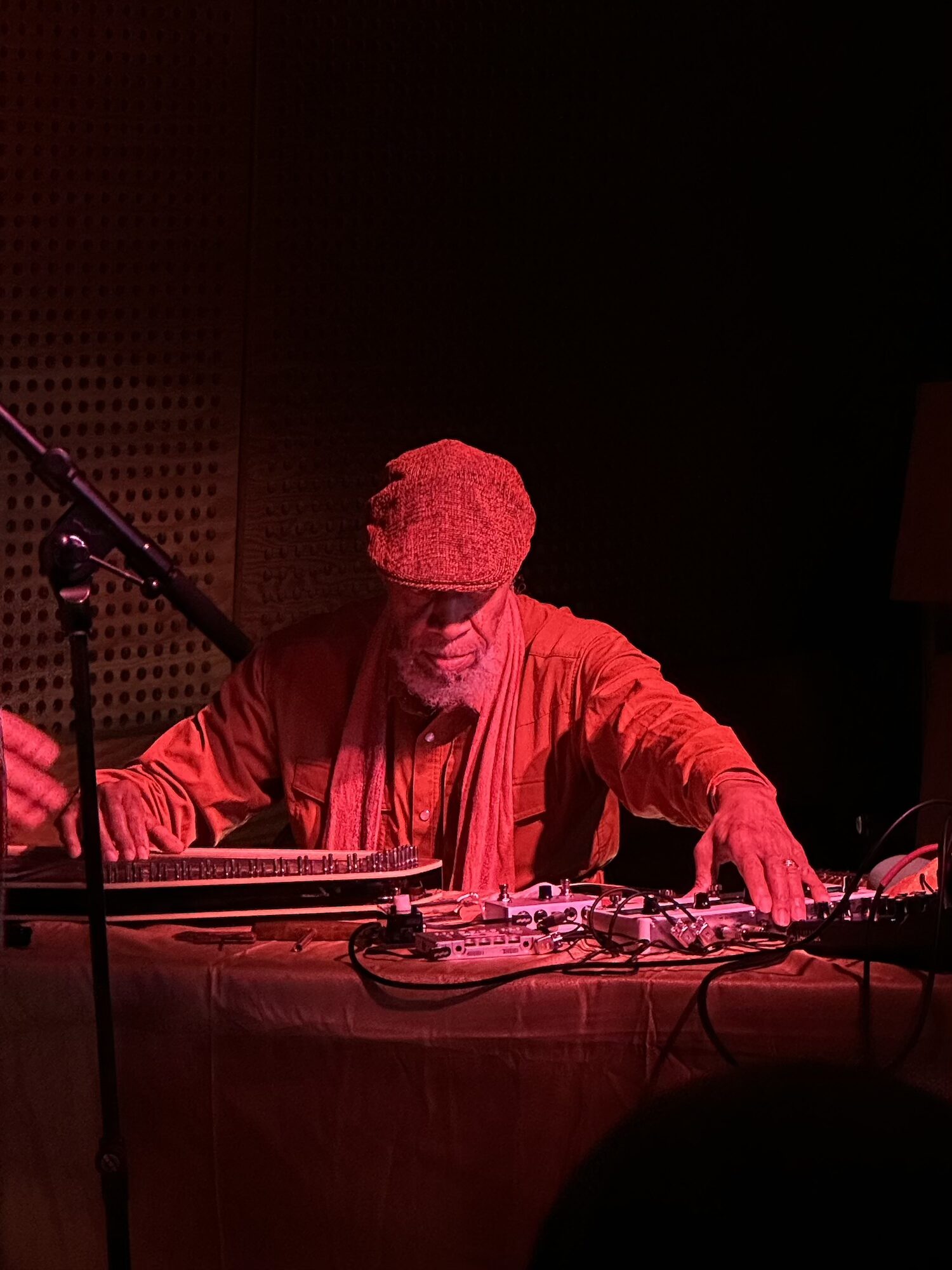
Photo by Raphael Helfand
Edward Larry Gordon was born in Philadelphia (“The body was born in Philly,” he clarifies) in 1943 and grew up in Perth Amboy, New Jersey, just across the Arthur Kill from Staten Island. When he first moved to New York in the mid ’60s to pursue a career in comedy after college, he landed in an elderly couple’s spare bedroom on St. Nicholas Avenue in Harlem. He spent most of his time downtown, though, performing at hootenannies in small rooms like the Village Vanguard and The Bitter End. He acted, too—in stage productions, TV commercials, and Robert Downey Sr.’s racially charged cult comedy classic Putney Swope. Unaware of exactly what he’d participated in, he was shocked and excited by the film’s boldness. But one day, at a free reading in a Harlem church, he heard a poem that made him reconsider his career. “Just as I sat down, this young, very vibrant Black brother was reading this poem that went, ‘Dadadadada and the n***as who did Putney Swope should be offed,’” he told In Sheep’s Clothing in 2024. “That was the straw that broke the camel’s back… That’s when I started researching meditation.”
LARAAJI had always been a musician first, and, as he began his spiritual journey, he started playing Rhodes piano in a jazz-rock band called Winds of Change. Growing up, he’d played piano, violin, and trombone, and sung in school and church choirs. In college, he’d studied music theory, composition, and piano performance. He’d shelved his musical dreams when his comedy career started picking up steam, but it quickly became his focus again after the Putney Swope incident. Meanwhile, he moved to the Bronx and got married.
By 1973, though, he realized his desire for a fluid existence full of musical and spiritual exploration was incompatible with the “very nuclear, committed family lifestyle” his wife wanted. A split ensued, followed by the brief experiment with subway sleeping. Eventually, his mother-in-law insisted he come stay with her and his wife in South Ozone Park. By the end of the year, though, LARAAJI had packed his few earthly possessions and headed west by southwest toward the tilted streets of Park Slope.
LARAAJI’s Brooklyn years marked the start of his music career in earnest. It was during this time that he tricked out his autoharp with an electric pickup, an innovation preceded only by the Lovin’ Spoonful’s John Sebastian. His other radically experimental advances in extended autoharp technique were (to public knowledge, at least) completely novel. Physically, he used mallets, bows, snare brushes, and chopsticks, among other unconventional implements, on the strings instead of strumming them. Spiritually, he played from intentional and “inner-aligned” states. “Whether it’s sensing the infinite unified field or visualizing angels or a marching band or the blood moving through the human system, I’m using my imagination,” he says. “I didn’t have sheet music for this.”
It was during these years, too, that he started playing his new instrument in public. Starting out, he’d find a sunny patch of grass by Prospect Park’s big lake, lay the zither on his lap, close his eyes, and let the music take him. As his confidence grew, he began performing in more intimate spaces on 7th Avenue, like the Gazebo restaurant and Second Story Bookstore.
Park Slope in the ’70s had a bohemian vibe, he tells me, quite distinct from the stroller-gridlocked, tech-employed, quarter-zipped miasma that chokes its streets today. What was a working-class neighborhood until the ’60s was now in the early-gentrification stage in which whole arts scenes flock to an area like birds of prey (his 1979 departure meant he missed the massive yuppie influx of the ’80s and ’90s and the 21st-century super-gentrification that brought the area to its current form).
According to LARAAJI, the Aquarius Coffee House on Lincoln Place and 7th Avenue epitomized that era at its apex. The café and after-hours performance space was owned by an ex-Marine, entrepreneur, and prolific pipe smoker named Warren Fox. “He noticed I was in this kind of floating lifestyle,” LARAAJI says. “And he said, ‘Hey, if you can help me out with the coffee house, I can give you room and board in a basement I’m not using.’” (That basement, on Union Street between 6th and 7th Avenues, was below the building that would go on to become the Park Slope Food Co-op.) He accepted.
The work-for-shelter exchange functioned well for about two years and proved crucial to LARAAJI’s life in music. “At nine,” he says, “Warren would close the door to official business, and till 11 it would be jam sessions, spontaneity.” These freeform nights allowed him to build his zither vocabulary alongside pianists, guitarists, flautists, poets, and singers.
Today, despite residing in an octogenarian body on 135th Street, LARAAJI is one of the Brooklyn experimental music scene’s most prolific collaborators. I’ve seen him perform at a drone festival in Hudson, the Park Slope of Upstate, with a dozen other legends of ambient music’s avant-garde, in a secret Greenpoint loft alongside Carlos Niño and Darius Jones, and on many other bills with vastly different (and vastly younger) artists.
Walking through Herbert Von King Park on a midsummer morning in 2023, I heard a familiar voice spilling from the park’s sunken amphitheater. “My legs are happy legs,” it sang. From afar, I saw a dancing blur of aqueous orange light. Moving closer, I watched as a scattered crowd of giggling Bed-Stuy millennials rose from the stone bleachers and wiggled their bodies like giant toddlers. It was beautiful.
What I was watching was a free lesson in laughter meditation, a field in which LARAAJI has become a leading light over the past few decades. The discipline demands that one laughs for 15 minutes before opening their eyes every morning, but LARAAJI’s workshops are less grueling. “I advise participants to get into the water body; don’t be just a stiff person laughing,” he says. Participants lie down, sit, stand, dance, and laugh in each other’s faces. “Notice where you tend to go with your body language, facial expression, breathing, and you can use these to jumpstart your laughter later on.”
“It’s improved my ability to appreciate laughter in public places, and it helped me to be mindful of supporting other people’s laughter when I found myself in laughing places,” he says. “It’s allowed me to bravely laugh sooner and fuller, like in a movie.”
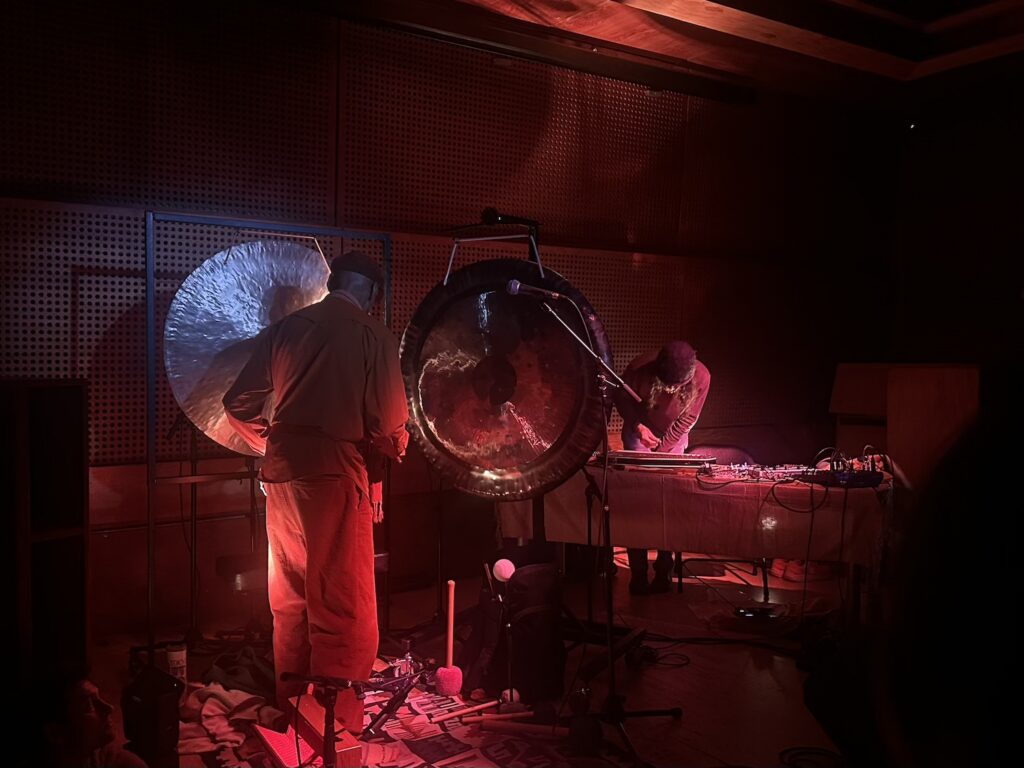
Photo by Raphael Helfand
It happened in the Village, but LARAAJI’s most crucial career development occurred during his half-decade in Brooklyn.
By 1978, he’d been busking on the northeast corner of Washington Square Park for several years. Though still far from financial security, he’d found a way to make decent money playing for tips and selling homemade cassettes for $10 a piece. “Sometimes I wondered if people were enjoying the music,” he says. “Some people might have thought I was handicapped because I was in lotus position on the ground with my eyes closed, so I looked like the kind of person who might be asking for money out of destitution.”
When he opened his eyes, though, he often looked out on a rapt audience, and on tour, he found his energy had spread well past city lines. “I’d be in Golden Gate Park just leisuring out,” he says, “and someone would come up to me and say, ‘Weren’t you the man playing in Washington Square Park?’ A lot of people saw me who I didn’t see.”
One such person was Brian Eno. Waking from his trance one fall evening in Washington Square Park, LARAAJI found a note in his zither case from the rockstar and super-producer turned experimental pop master, inviting him to his studio on Broadway and Broome. Two years later, they released the LARAAJI-created, Eno-produced Day of Radiance, the third album in Eno’s Ambient series and LARAAJI’s first studio LP.
“It very strongly validated me,” LARAAJI says. “It put me in connection with the name of a well-known artist and producer and fast-tracked my global recognition.” It made a material difference, too. “Not overwhelming, but more than I was getting playing on the sidewalks in New York,” he recalls. “It gave me a boost to invest in myself.”
Another sea change came in 1979, LARAAJI’s final year in Brooklyn, and the end of his life as Edward Larry Gordon. During a residency at a new-age Harlem bookstore called Tree of Life, two community members approached him with a new name they’d found for him through research. He was skeptical at first, but he’d been searching for a sun-related name ever since his epiphany under the arches of Grand Army five years earlier. They convened the following day at Central Park’s Bethesda Fountain, and the two men dubbed him “Laraji.” He was impressed. “It’s built around the Egyptian sun god Ra, and ‘ji’ is a term that I understand is given spontaneously as endearment,” he says. “Thus, ‘the divine sun, the beautiful sun.’” Adding a third “A” to give his new title a celestially significant three triangles when capitalized, LARAAJI was born.
But LARAAJI did not leave Brooklyn under happy circumstances. Helping Warren Fox prepare for a bohemian gathering one day, he received a psychic message to take his zither to Central Park immediately. “It was very strong, the same kind of voice that guided me into selecting the autoharp in the pawn shop,” he says. “Warren was confused about that, and I couldn’t explain to him what I was doing.” He went to the park anyway and performed for no one, except “these two people who came up to me afterwards and asked me if I was psychic because they were looking for a musician like myself to perform on a multi-cassette spiritual guidance program they were recording. So it made sense; I was being guided.”
When he returned to the loft, Fox flew into a rage, and things got physical, so LARAAJI grabbed his things again and left for the Upper East Side, where he sojourned for some time with a woman who “was open to befriending [him] with a place to stay.” From there, he moved to West 104th Street, and in 1998, he found the Harlem residence where he lives today.
LARAAJI’s Brooklyn years could be described as a discrete chapter in his earthly existence, though he prefers to see them as a time of “music-woodshedding-free-structured life,” he tells me. Discrete or not, though, those years were bounded by traditional family life on the left and free-floating mysticism on the right, by sleeping on the subway and ascending to the upper echelon of the worldwide experimental music scene, by quotidian life as Edward Larry Gordon and solar transcendence as LARAAJI.
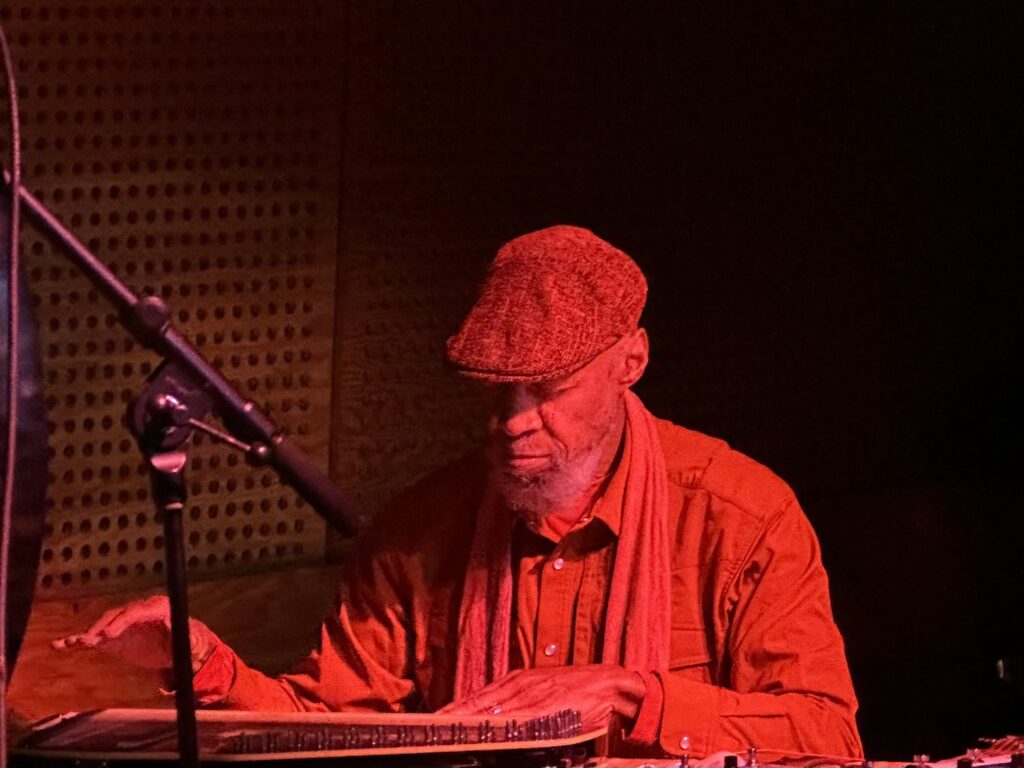
Photo by Raphael Helfand
Days after my late-January interview with LARAAJI, I fly to India, stopping first in Delhi and Jaipur. LARAAJI had planned an almost (geographically) identical itinerary after being invited to run a series of laughter meditation sessions in the country where the concept was born, but he was forced to cancel the trip due to a spike in Delhi’s suffocating high Air Quality Index.
On Valentine’s Day, I text him from the balmy backwaters of Kerala—India’s only Communist state—to clear up some factual inconsistencies and throw a few new questions his way. He responds within hours from New York’s frozen tundra to arrange a call.
“Having lived in New York for 60 years, what do you think makes a New Yorker?” I ask.
“Each New Yorker will be an individual,” he says. “A few dramatic incidents, maybe being near-mugged, able to handle the subway system, a very evolved emotional rapport with rats and roaches, enjoys the parks and the four seasons, knows where to find a good pizza, goes to museums…but especially the parks.” His favorites are Central and Riverside, but he acknowledges that Prospect Park’s design was an improvement on Central Park’s layout.
I ask if he considers himself a proud New Yorker.
“Proud?” He takes a moment. “I’m an appreciative New Yorker. I savor it.”
The post LARAAJI’s Days of Radiance in Park Slope appeared first on BKMAG.