The Riemann hypothesis claims that the locations of prime numbers along the infinite number line all adhere to a beautiful and orderly, but obscure formula. Yet 167 years after German mathematician Bernhard Riemann made this guess, and in spite of a million-dollar bounty, mathematicians still have no idea how to prove it.
Now a team in China has managed to encode that formula into a physical system and explore its workings using a quantum computer. The researchers’ work, an unedited version of which saw early publication last month in the journal Nature Communications, makes this abstract question about prime numbers more tangible than ever before.
“It provides a new perspective on the Riemann hypothesis,” says Shijie Wei of the Beijing Academy of Quantum Information Sciences, the study’s co-lead author. He hopes the work will prove “that quantum computing will serve as a powerful avenue for investigating major mathematical conjectures.”
On supporting science journalism
If you’re enjoying this article, consider supporting our award-winning journalism by subscribing. By purchasing a subscription you are helping to ensure the future of impactful stories about the discoveries and ideas shaping our world today.
The notion struck Wei a decade ago, when he saw a lecture about the exploration of a related mathematical formula, called the Möbius inversion, with a quantum computer. “Inspired by this idea, I thought that maybe the Riemann hypothesis can also connect to quantum systems,” he says.
At the center of the hypothesis is the Riemann zeta function, a gnarly equation involving a sum of infinitely many pieces. First, you plug in its input—a number with a real part and an imaginary part (the latter is “imaginary” because it involves something seemingly nonsensical: the square root of –1). Then, once you calculate that infinite sum, the result is a single number.
Riemann showed that the locations of the zeta function’s “zeros”—the different inputs that cause its infinite sum to exactly equal zero—encode the locations of all the prime numbers along the number line. Moreover, he hypothesized that these zeros happen only when the input’s real part is exactly 1⁄2. If true, this would reveal remarkable order hiding beneath the primes’ apparent chaos. But if you find any zero where the input’s real part isn’t 1⁄2 (regardless of the imaginary part’s value), you’ve disproved the conjecture—and should write to the Clay Mathematics Institute to receive your $1 million.
For more than a century, the problem rested squarely in the realm of number theory. But in 1972 mathematician Hugh Montgomery, then a Ph.D. student at the University of Cambridge, happened to meet the renowned physicist Freeman Dyson, and the two got to talking about the Riemann zeta function. They noticed a strange connection between its zeros and the inner workings of the atomic nucleus.
Ever since, some have wondered if the secrets to the primes might lie in the microscopic quantum world. Scientists have sought a quantum system whose energy always corresponds to an input that makes the zeta function’s output zero. But no one has found such a hypothetical system.
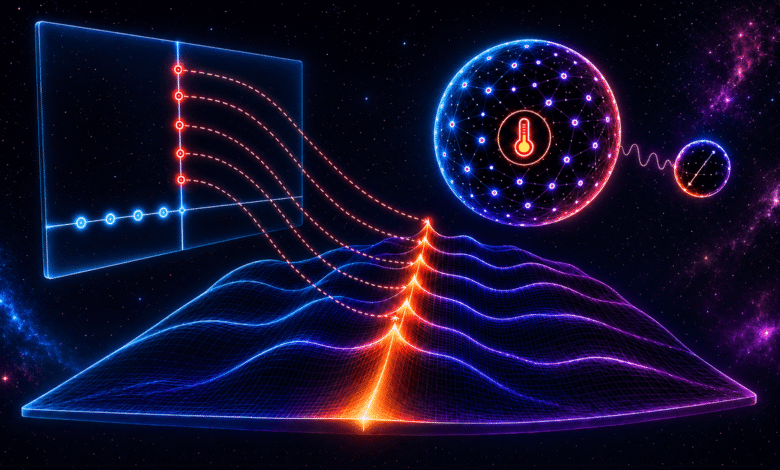
Wei and his colleagues have proposed a new physical path to the mysterious function. It’s a set of interacting atomic nuclei that evolves over time, sometimes undergoing a sharp, dramatic transformation called a “phase transition,” a physical change roughly akin to liquid water freezing to ice or boiling to steam.
The researchers showed that this unique quantum system exactly reflects the Riemann zeta function. At any given moment, the system’s temperature corresponds to the input’s real part, and the amount of time they’ve allowed it to evolve encodes the input’s imaginary part. The phase transition occurs only when both of these inputs, if fed to the Riemann zeta function, would make its output zero.
This finding offered a new way for Wei and his colleagues to hunt for unexpected zeros of the zeta function. They prepare the system at a temperature so that the input’s real part is something other than 1⁄2. Then they let the system evolve and wait for a phase transition. If one happens, that will mean that the zeta function has a zero with an input that’s not 1⁄2—disproving the Riemann hypothesis.
The team demonstrated that this quantum algorithm “scans” the zeta function for zeros faster than any of the “classical” computers mathematicians typically use. The researchers’ demonstration used a system of five interacting atoms—the quantum equivalent of computational bits, called “qubits.” They haven’t yet come across any zeros that mathematicians have missed, but the experiment “offers an analog physical lens rather than just digital calculation,” Wei says. If the team can grow the system to 100 qubits, then it will be able to check more zeros than any existing computer. The study brings Wei and his colleagues a step closer to Dyson and Montgomery’s dream: Riemann’s timeless question might find its answer in the physical world.
“It may well be,” says Guilu Long of the Beijing Academy of Quantum Information Sciences, the study’s senior author, “that the Riemann Hypothesis and dynamical quantum phase transitions represent two facets of one underlying truth.”
It’s Time to Stand Up for Science
If you enjoyed this article, I’d like to ask for your support. Scientific American has served as an advocate for science and industry for 180 years, and right now may be the most critical moment in that two-century history.
I’ve been a Scientific American subscriber since I was 12 years old, and it helped shape the way I look at the world. SciAm always educates and delights me, and inspires a sense of awe for our vast, beautiful universe. I hope it does that for you, too.
If you subscribe to Scientific American, you help ensure that our coverage is centered on meaningful research and discovery; that we have the resources to report on the decisions that threaten labs across the U.S.; and that we support both budding and working scientists at a time when the value of science itself too often goes unrecognized.
In return, you get essential news, captivating podcasts, brilliant infographics, can’t-miss newsletters, must-watch videos, challenging games, and the science world’s best writing and reporting. You can even gift someone a subscription.
There has never been a more important time for us to stand up and show why science matters. I hope you’ll support us in that mission.