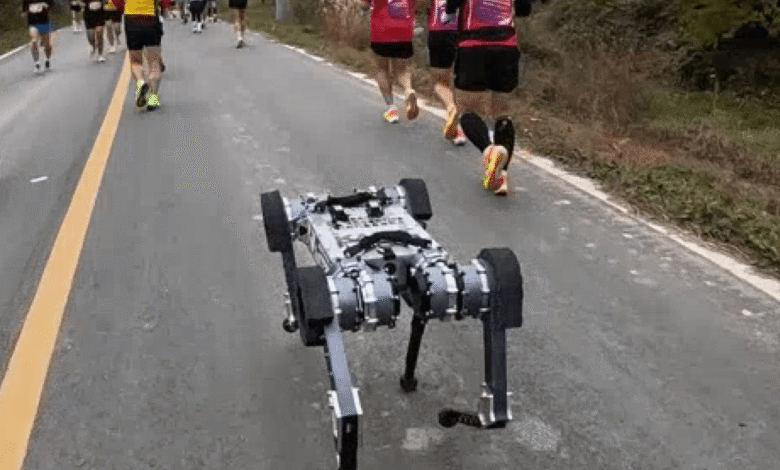
Hot on the heels of humanoid robots besting Usain Bolt’s record in the 100-meter sprint is a marathon-running dog bot.
The quadrupedal machine, named RAIBO2, ran the full 26.2-mile marathon course in a single battery charge, finishing in four hours, 19 minutes and 52 seconds—slightly ahead of the human average.
The feat shows how far researchers have come in making these bots energy-efficient. “What matters is energy consumed per unit of distance,” explains the study’s lead author Choongin Lee, a roboticist at the Korea Advanced Institute of Science and Technology (KAIST) in South Korea. To make their robot able to complete a marathon without needing a recharge, Lee and his team identified all the areas where walking robots waste energy.
On supporting science journalism
If you’re enjoying this article, consider supporting our award-winning journalism by subscribing. By purchasing a subscription you are helping to ensure the future of impactful stories about the discoveries and ideas shaping our world today.
About two thirds of a robot’s energy budget is lost as heat in the motors and their drive electronics, the researchers found. The rest goes into friction in the gears, feet that slip and the jolt of each footfall.
Lee’s team tackled each issue one by one: The researchers cut the weight of each leg, designed low-resistance motor boards and spent the freed-up mass budget on a bigger battery, combined with motors that produced the same torque for less current. RAIBO2’s walking style was trained through simulation with reinforcement learning, in which the control algorithm was rewarded for setting the robot’s feet down softly and for not allowing it to slip or overheat.
On top of that, RAIBO2 was designed to recuperate and recharge the battery on downhill stretches. The robot is described in a study that was published in Nature on Wednesday.
The result of all this tinkering is that the robot needs less energy to carry a kilogram over a distance of one meter than the average human runner. RAIBO2 travels roughly three times farther per charge than other quadrupedal robots, with a projected range of around 40 miles.
“I’m impressed with their ability to combine efficiency with speed and mobility in a quadruped,” says Sarah Bergbreiter, a mechanical engineer at Carnegie Mellon University, who was not involved in the study.
Katie Byl, an engineer at the University of California, Santa Barbara, who also was not involved in the work, points out that the humanoid robots that were recently seen racing in China needed several battery swaps from a support team jogging alongside. “It’s akin to a ‘mobile pit crew,’” she notes.
Still, Lee’s robot required human help during the marathon. “RAIBO2 is basically running blind,” Byl explains. The robot carried a camera but no software to interpret the road. A human operator had to steer it remotely.
Adding more autonomy will cost power, Lee says. To minimize the loss of energy-efficiency an added electronic brain would cause, Lee’s team is currently working on smaller onboard networks and sensors. “This way the robot can become more capable without a large increase in power consumption,” Lee says.
Subscribe to Support Independent Journalism
Great science journalism requires human expertise, time, effort and creativity. And it costs money. That’s why I and the journalists here at Scientific American hope you’ll join our community.
When you subscribe, you are supporting staff and freelance journalists who are passionate about telling science stories that are true, important and compelling. Our editors and reporters are often experts in their fields, which means they understand the nuances of big discoveries and can untangle the breakthroughs from the hype. With a subscription, you are also supporting rigorous fact-checking to ensure the words we publish are precise and accurate. And you’re supporting original illustrations, graphics and photos that bring you closer to an advanced laboratory, an ice sheet in Antarctica or a space mission in orbit. You’re helping us craft other types of high-quality journalism as well: Our newsletters are carefully written, edited and curated by staffers you have or will come to know and love. Our Science Quickly podcast is based on original reporting, collaboration with editors and scientists and exacting production.
Subscriptions keep this engine running so we can continue to deliver thoughtful, rigorous and independent science journalism to you. In an era of viral misinformation, this work is crucial. If you value what we do, I hope you’ll consider joining us as a subscriber