LinkedIn has shared some new notes on how brands can maximize their opportunities to be cited in artificial intelligence chatbot responses. The platform says that tapping into the credibility and authority of influencers can play a big part in seeing brands get referenced.
As explained by Robert Yanik, AI Search Marketing Lead for LinkedIn Ads: “AI models like ChatGPT, Gemini, and Copilot are built to reward credibility, and credibility, in their eyes, looks a lot like a real person with a demonstrated track record. LinkedIn ties every post to a verified identity, complete with employer history, skills, and a professional network.”
According to research cited by Yanik and conducted by Meltwater, AI chatbots are most likely to refer to LinkedIn posts generated by individual users who have more than 10,000 followers in the app.
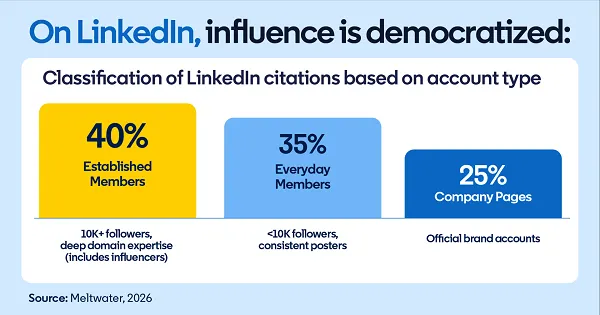
As shown in this visual overview, accounts with over 10k followers and company pages make up 65% of LinkedIn citations in AI chatbot responses. Users with under 10k followers account for only 35% of these mentions.
“C-suite and VP-level articles earn higher citation rates per article than non-executive content, which shows this isn’t about volume but about how AI models weigh authority,” Yanik explained. “LinkedIn profile metadata, including title, company, and industry, acts as a direct authority signal that AI models use to judge credibility.”
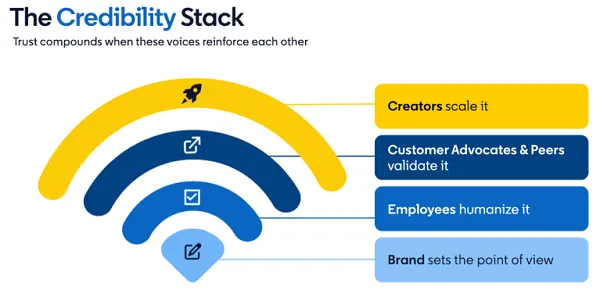
Based on this, in order to maximize opportunities to be cited in AI responses, Yanik said that brands should look to activate a range of individuals in addition to their company page posts in order to spread their messaging.
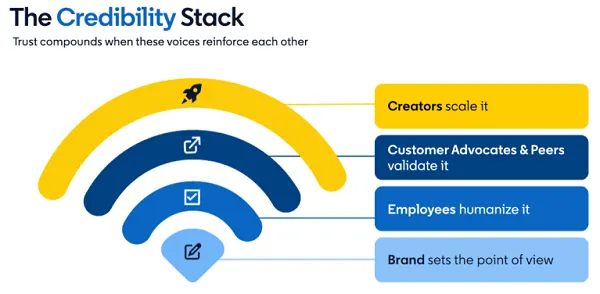
In order to put this into practice, Yanik said brands should identify three or four themes to own, then encourage “credible employees” to post consistently about those themes. He added that brands should also identify one or two creators “whose audience overlaps with your buyers and explore a partnership.”
So, essentially, the advice here is to post a lot more on LinkedIn, though Yanik’s guidance extrapolates this recommendation with presumed insight into how AI models choose different sources.
But Yanik doesn’t outline how each AI tool decides on what source to cite, so this report is based on correlation, and really, LinkedIn is reliant on the established domain authority of its platform. And as such, this advice is less about helping businesses understand AI citations, and more about driving more LinkedIn activity.
Over the past few months, LinkedIn has been increasingly keen to highlight how AI chatbots commonly cite LinkedIn posts and articles in their generated replies.
As search behaviors evolve, this presents a significant opportunity, because while referral traffic from search engines has steadily declined for many websites, businesses that are reliant on those referrals are now looking for ways to tap alternate traffic drivers, like AEO, or Answer Engine Optimization, or GEO, Generative Engine Optimization.
As such, maybe putting more focus on LinkedIn could be the answer.
LinkedIn has tried to capitalize on this by sharing various guides and advice notes on what AI chatbots are seeking from web content, and how brands can rank higher in AI chatbot results.
The core of all of this guidance, however, is that brands need to post on LinkedIn, a lot, in order to piggyback on LinkedIn’s domain authority as a means to boost their presence. LinkedIn is totally reliant on its established trust and authority in this respect, but it’s not doing anything specific to better align with AI tools. Nonetheless, the company has seized upon the opportunity to present itself as an authoritative advisor on AI citations because of these stats.
These latest insights underline this by reinforcing that the only real way to optimize for AI chatbots based on LinkedIn posting is to post a heap to LinkedIn, and to share a lot of content that resonates with LinkedIn users, in the hopes that, eventually, this will help to boost brand and individual authority in the app. All of LinkedIn’s other AEO notes, such as its guides on how to structure articles for AI chatbots, are irrelevant if the creator doesn’t have an established presence.
In summary, posting on LinkedIn can have a positive impact on AEO or GEO efforts, and could see brands get more mentions in AI chatbot responses. But it’s not as simple as structuring content in a certain way. The true signal here is established trust and presence, which are the indicators that AI chatbots can use to measure relevance and expertise. Platforms including LinkedIn and Reddit can provide such through user engagement data, including how many likes a post has, how many upvotes, and how many people follow the creator. Those signals can be integrated into a chatbot’s code on how to identify what’s likely to be an authoritative response to a query.
The other notes are largely irrelevant.