
ECONOMY
-

Has Broader Stock Market Participation Changed How Interest Rates Affect the Economy?
Juan M. Morelli Stock market participation in the U.S. has changed dramatically over the past four decades. In the mid-1980s, fewer than 30 percent of households held equity. By the early 2000s, more than half of U.S. households owned equity, either directly or through mutual funds, 401(k)s, and IRAs. As participation widened, the way stock market fluctuations passed through to…
Read More » -
Stripping STRIPs Trading Activity – Liberty Street Economics
Michael J. Fleming and Or Shachar In March 2020, the Financial Industry Regulatory Authority (FINRA) began reporting aggregate trading volume for securities issued by the U.S. Treasury Department. The public data do not, however, include information about the trading activity of Separate Trading of Registered Interest and Principal of Securities (STRIPS). STRIPS are created from existing Treasury securities and offer…
Read More » -

How Distressed Are Consumers? Reconciling Diverging Credit Card Delinquency Measures
Donghoon Lee, Daniel Mangrum, Joelle W. Scally, Tejas Sinha, and Wilbert van der Klaauw Total debt balances declined slightly by $13 billion in the second quarter of 2026, according to the latest Quarterly Report on Household Debt and Credit from the New York Fed’s Center for Microeconomic Data. Mortgage and student loan balances saw a small decline, while there were…
Read More » -

Does the Equity Term Structure Respond to Monetary Policy Shocks?
Henry Dyer and Tomas Jankauskas A long-standing body of research, inspired by Bernanke and Kuttner (2005), has documented the effects of Fed interest rate surprises on stock markets. While stock markets provide valuable information about the investor risk premium and dividend growth expectations, researchers have only recently developed more comprehensive tools to estimate the term structure of equity risk premia…
Read More » -

AI’s Impact on Labor and Hiring
Kartik B. Athreya Welcome to Street Level, my new series on Liberty Street Economics. As research director, I try to keep track of the wide range of work that the economists at the New York Fed produce. My goal for this series is to periodically offer some thematic discussion of that work, highlighting recent analysis by Research staff and adding…
Read More » -

Why Do Fewer Renters Expect to Move?
Christopher Gresh, Andrew F. Haughwout, Eungik Lee, and Wilbert van der Klaauw Americans are moving less than they used to. Moving rates have declined steadily for decades, falling from close to 20 percent annually in the mid-1980s to below 10 percent by 2019. This decline has persisted through business cycles and has been evident across all regions, and has affected…
Read More » -

Tracking the K-Shaped Economy: Who’s Driving Spending?
Rajashri Chakrabarti, Thu Pham, Beck Pierce, and Maxim L. Pinkovskiy Editors’ Note: The title of the second chart in this post has been corrected. May 1, 10:40 am. Aggregate real consumer spending has risen solidly since 2023. However, it is less clear how widely shared this improvement has been across all segments of society. This is important because systematic…
Read More » -

Stablecoins and (Non)Crypto Shocks: A 2026 Update
Kenechukwu Anadu, Pablo D. Azar, Sean Baker, Marco Cipriani, Thomas M. Eisenbach, Mattia Landoni, Gabriele La Spada, Marco Macchiavelli, and J. Christina Wang Stablecoins are digital assets whose value is pegged to that of a fiat currency, typically the U.S. dollar at a peg of $1.00 per token. In a previous blog post, we described the rapid growth of stablecoins…
Read More » -

Synthetic Stablecoins and Financial Stability
Pablo D. Azar and Jeff Garofano On October 10, 2025, the announcement of a potential additional 100 percent tariff on Chinese goods drove risk-off moves across equities, Treasuries, credit spreads, and digital assets. Digital asset prices fell sharply, trading volumes surged, and liquidity vanished from key exchanges. In this post, we show how the price shock in digital assets was transmitted…
Read More » -
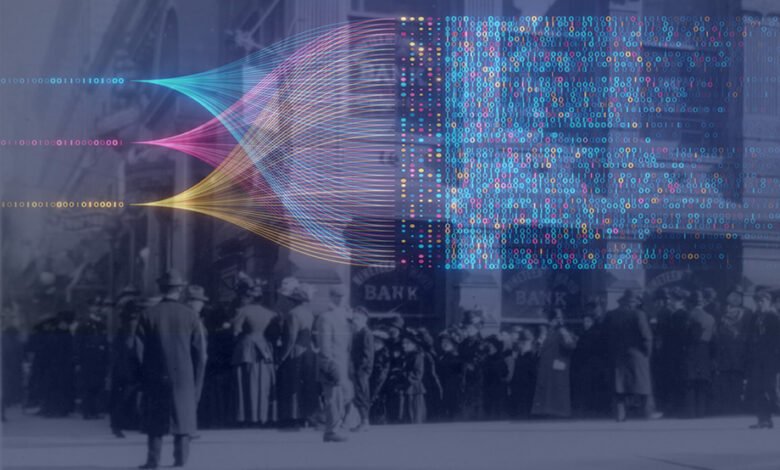
Using AI to Let History Speak About Bank Runs
Sergio Correia, Stephan Luck, and Emil Verner Banking crises are commonly associated with bank runs and banking panics, yet our empirical understanding of bank runs is constrained by a lack of bank-level data. In a new paper, we use large language models (LLMs) to extract information on bank runs from millions of digitized historical newspaper pages, creating the most comprehensive…
Read More »