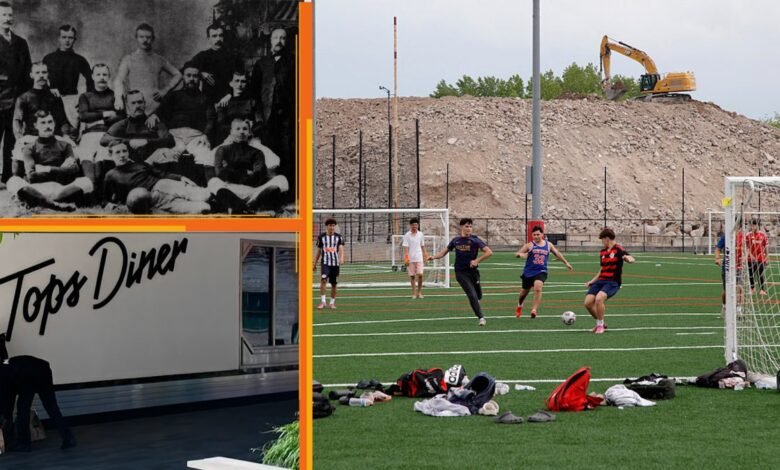
Did you know there is a region in northern New Jersey known as “the cradle of American soccer”? That’s because if you walk along the streets of Kearny, Harrison and East Newark, you are walking on sacred sport ground and history.
“New Jersey is known for the best diners in the world — and this is one of them,” Tom McCabe — a historian, professor and soccer expert — said while at Tops DIner in East Newark. “But underneath this foundation is really the start. The cradle of American soccer.”
McCabe, spent a day with NBC New York, to talk about the West Hudson region of New Jersey and its ties to the world sport, including the quaint town of Kearny, which has become widely known as a “Soccer Town, USA.”
Immigration and the sport
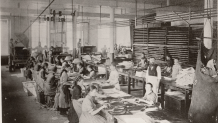
According to McCabe — who has taught college courses on the history of the sport and produced a documentary about the subject — the nickname for this region was given because it is considered the hotbed of soccer in the tri-state area ever since the sport was brought over by Scottish immigrants who worked in the nearby factories in the late 1800s before the soccer fever spread to the rest of the country.
While at Tops Diner, McCabe explained that the locale sits on what was at one time the soccer field of the Clark Thread Mill, a Scottish thread manufacturer that set up its U.S. headquarters across the street in the 1860s.

“They kept bringing over men and women and boys and girls to work in this factory from Scotland,” McCabe said, adding that they bring their traditions, their customs, their culture with them. And there’s no better bit of culture, in my estimation, than the ball, right? Culture that rolls and that’s football. That’s soccer. So from the very beginnings here on this soil, is the American soccer story.”
As Scottish immigrants came to the area in the 1860s and 1870s, the lot where the diner is on was the first soccer field for teams that sprung from the workers at the mill. And it was this site that saw championships from 1885 onward into the 1930s, McCabe said. In fact, the first international soccer match held outside of the United Kingdom on Nov. 28, 1885 took place at Clark Field in East Newark. In a match between the United States and Canada, he Canadians won 1–0 in front of over 2,000 spectators. Clark Field was located at the Clark Thread Co. complex. Today that site is the parking lot of the renowned Tops Diner.
“[This is a] really important, foundational neighborhood in American soccer. It’s in this part of Kearny, lower Kearny called Cooper’s Block,” McCabe said. “So you have national team players coming out of here, professional players. and then they spread around New Jersey and spread around the country very, very influential place.”
The birth of soccer
Through the ages, there have been many kicking ball games, from the Chinese cuju to the Italian Calccio to the Mesoamerican ball game. But modern soccer, as it is known today, with all its rules and regulations, didn’t really kick off until the 1800s. When alumni from a number of elite UK boarding schools and universities – like Eton, Oxford, Cambridge — came together and codify what becomes known as modern day soccer in a London tavern in 1863 by establishing a universal code of rules, McCabe said.
While the rugby advocate who thought the ball should be carried while running decided not to participate in these sessions, McCabe said, the kicking and dribbling advocates stayed and set up the rules in the 1860s. These rules were hashed out in 1870s, and by the time the game comes to the United States, these rules were set.
Eventually, recognizable soccer comes to the states through immigration when English, Scottish and Irish immigrants bring the game over. The Scottish, as the Kearny story and Harrison story tells us, are the true missionaries of the sport when they bring the pastime with them to work in the factories.
“This global game in reality is an early American game,” McCabe said.
The Kearny Scots American Club, an unofficial museum and ode to soccer history
As the years passed and Scottish immigrants made Kearny, Harrison and East Newark home, they set up social clubs to socialize and celebrate their culture, including their beloved pastime.
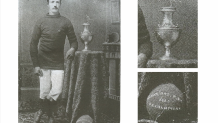
The Kearny Scots American Club has been in town since 1931. From here great teams sprung up. Teams that went on to win the American Football Association Cup in 1915 with a young Archie Stark and the League Championships.
Walking through the Scots American Social Club is truly like walking through a soccer museum. Photos, trophies, mementos of the game and its ties to the local community adorn every single nook and cranny of the bar.

“This club would be packed with Scottish immigrants, 40s, 50,60s. I believe John Harkes parents met here one night. so this great American soccer story, of John Harkes begins in the Scots Club. What’s also key is that the fathers from this club set up a youth club in the 1970s, Thistle Soccer Club, named after the Scottish national flower,” McCabe said. “And they set up a youth club for boys and girls. And this is where Tom Ramos, Tony Meola, John Harkes and so many others get their start. in organized soccer. So it was a powerhouse, in New Jersey.”
According to McCabe, it is this youth soccer program that provides a platform for Ramos, Meola and Harkes to get out of Kearny and the surrounding communities into the USMNT.
“Others would have gotten out and gone to college. So it’s really like soccer as this social mobility strategy, certainly in the 1970s and 1980s and still to today,” McCabe said.
Joe McGonigal, a lifelong Kearny resident and member of the Scots American Club, said that soccer has always been present in his life. But two memories stand out the most.
“In 1967, I was in eighth grade. here in town in Kearny when, my favorite, Glasgow Celtic soccer team, won the European Cup. So that was one. And the other one was when in high school, we won the parochial state championship in New Jersey,” he said of his time at St. Cecilia High School. “There are two [memories] right off the top of my head, but I must have 100 of them.”
“I also played for the Kearney Irish American at one time in the mid, 1970s, while my brother Michael played for the Scots American here. So, yes, we were against each other in the league on occasion.”
Hometown heroes
As McCabe recounted, Tab Ramos, Tony Meola and John Harkes, have become ingrained in the history of soccer and local success stories.
Tab Ramos, born in Uruguay and raised in Harrison, played professionally in Spain, Mexico and the USA representing the latter in three World Cups. He then went on to coach professionally and has been inducted into the Soccer Hall of Fame.
Tony Meola, who grew up in Kearny, went on to represent the United States in three World Cups, becoming a stellar goalkeeper.
John Harkes, also grew up in Kearny playing alongside future national teammates Meola and Ramos. Harkes went on to play in the English Football League and had stints in the MLS as well, forming part of the US Men’s National Team, playing in two World Cups.
The business of the game
Kearny Thistle United Executive Director, Mike Mara is also the owner of Soccer Post – a relatively new store dedicated to the game located on Kearny Avenue, in the town’s downtown business district. The love of the game lead to Mara completely deviating from his career on Wall Street and following his passion. Ultimately, opening up his business in 2022.
“[Soccer] has kind of changed my life. I was a Wall Street, started my career on Wall Street. And, you know, it was kind of felt like, is this really what I want to do?” Mara said. “And it was a period that was kind of, like, very career driven. But then when I started coaching my son…and, you know, kind of found my way into, into soccer post, which was a great, great transition, helps me leverage the network.
“There’s so many players and coaches that have played the game in town that are involved still at the local level, at a high school level or college level on a pro level. So I’m like, there’s got to be layer here. I could, you know, sell a couple jerseys and a pair of boots or two and, and have this energy and excitement around the game,” Mara continued.

And just like that, Soccer Post became, not only a stop to get gear, but, as Mara describes “a little bit of a community center.”
While the makeup of the surrounding communities have changed from Scottish to Portuguese and Spanish to, most recently, Latin American, the love of the game continues, Mara said.
“What’s great about Kearny is, we have the, you know, we still have, you know, quite a competitive youth landscape, but there’s also a big pickup community…and it’s kind of woven into our story with the success of you know, John, Tab and Tony and sort of the culture, around the pickup game and the creativity creates,” Mara said.
Local soccer landmarks
The competitive landscape. The youth teams and the spirit of pick-up games that both Mara and McCabe describe are a common sight in many towns and cities across the tri-state area, the country and the world. Kearny is no different. One of the main sites in town that has seen these games play out is a vast playing field in the Kearny marshland known as Gunnell Oval.
And just like Gunnell Oval, there is another site close by in neighboring Harrison that has witnessed greatness for decades. Although at first glance “it is “The Courts” is a rather unassuming location.
The Courts first started off as tennis courts, but in the 1970s after local kids got rid of the net to play soccer, time and time again, the town decided to convert the space into a pitch.
“All the best players would come here and you would put together your team and it was winner stays on. So it creates this competitive cauldron, right? This winner stays on. And you know what’s at stake. so John, Tab, Tony would have grown up playing in these games playing as boys of 12, 13, 14 against men, you know, just finishing work,” McCabe said.
Another site that has a strong grasp in local soccer history is St. Benedict’s Academy in neighboring Newark — a all-boys Catholic high school that took on Ramos and another soccer legend, Claudio Reyna.
Ramos went to grammar school right across the street from The Courts, at Holy Cross School.
“One of the cool things about this space is a young Tab Ramos moves to this country and he’s got no one to play with.Tab went to grammar school right behind us at Holy Cross Grammar School. So he’s here is a young boy of, you know, 12,13 and, they hold them back for a year because the language was an issue,” McCabe recounts. “Then Kearny and Harrison high schools wanted him to come and play for them, these two great powerhouses. But Saint Benedict’s Prep, a small Catholic school across the river in Newark, where I worked for many years. Kind of steals them away.”
St. Benedict’s Prep is a soccer powerhouse and it is this powerhouse that, according to McCabe, made a proposition that Ramos could not pass up on: “come play for the school’s soccer team and we won’t hold you back.”
“So Tab was reclassified, but he was promoted a year, not held back a year. And then at Benedict’s, he gets hooked into the national team, the youth national team, and he’s on his way, towards stardom. So you have those two Kearny High School stars [Meola and Harkes], and then Tab Ramos over at Saint Benedict’s,” McCabe said.
Through the years, St. Benedict’s Prep will have this tradition of winning many national championships. Gregg Berhalter, a coach of the national team, played there. And his classmate and friend was Claudio Reyna, the captain of the U.S. team.
“So these types of places really shape these types of players, right? These, gritty, tough players that the national team needs,” McCabe said.
Soccer today
Throughout this year’s World Cup, many teams have won over hearts with their enthusiasm for the game. And it is this effervescent enthusiasm and love for soccer that were the initial catalysts in bringing the game to the tri-state over a century ago.
A love that transcends time and space.
A love that continues today.
A love for the game that may have started in the green coasts of Scotland, but is now weaved into the tapestry of a diverse and ever-growing area and state. While the waves of immigrants have changed from mostly Scottish and Irish in the area to Portuguese, Spanish and most recently Latin American, the passion of the sport has always been present and consistent.
“Kearny gets called Soccer town USA, right? But there are these other towns around it. Soccer towns, USA: Harrison, New Jersey. East Newark. The Arlingtons. And, of course, across the Passaic River: Newark,” McCabe said. “They are here from the beginning, right? There is that trifecta. There’s immigration, there’s industry and there’s sport. So it’s this greater kind of, Newark area that really cradles the game, embraces it and keeps it alive for a long time.”
As McCabe winds down our tour through the “cradle of American soccer,” I wanted to know what does an expert like him think about why the sport resonates so strongly with people all around the world, more so than any other sport?
“I see soccer as Esperanto, right? A universal language, you can play with someone and not have the communication skills verbally, right? But you can communicate on the field…so there’s that, the physical aspect of it. And then anywhere you go in the world, you have a word or two, a player, a team, you know, you could be in Brazil and just say Pele. And then you’re immediately kind of welcomed into this, you know, global football family,” McCabe said.
“As I teach students the history of the game, that’s really kind of lesson number one. This game is a passport to the world.”