They say you can’t go home again, but James Gray keeps trying. Since his 1994 debut feature Little Odessa, the writer-director has spent the last 30-plus years mining the realities, relationships, and remnants of his Queens-bred youth and packaging them into vivid, semi-autobiographical films around the edges of New York City. Except for two notable and consecutive detours—first to the Amazon, in 2015’s The Lost City of Z, and then to space, in 2019’s Ad Astra—Gray has found narrative possibility and emotional resonance in retracing his middle-class Jewish upbringing, most notably in 2022’s explicitly autobiographical coming-of-age drama Armageddon Time.
Paper Tiger, which goes into wide release Friday, November 20, is set in 1986 and was originally conceived as a sequel to his previous film. Miles Teller plays Gray’s father Irwin, a struggling engineer convinced by his brother Gary (Adam Driver), a former cop and aspiring entrepreneur, to enter a shady business deal with Russian importers operating out of Gowanus. But an otherwise promising financial partnership backfires when Irwin drives his two sons down to the project in the middle of the night, putting them and his health-stricken wife, Hester (Scarlett Johanssen), at risk of retribution. Like the rest of his filmography, Paper Tiger delivers dynamic, standout performances, a striking visual palette, some of Gray’s best, most thrilling set pieces, and the grand structure of a classic Hollywood story, or a Greek myth.
Which is to say, Gray’s ninth film is one we don’t get to see very often. It’s made for adults, teems with subtext, and rejects obvious expository language. In total, his New York films (The Yards, We Own the Night, Two Lovers, The Immigrant, Little Odessa) might be loosely defined as crime dramas—some are propulsive and thrilling, others ache with domestic tension, all sharing rich, detailed, authentic portrayals of his native city and the blue-collar life within. But Gray can only see them as excavations and memories of growing up; folkloric reconstructions that observe American strivers, Russian-Jewish enclaves, and family men treading above the fragile ceiling of a violent underworld ready to corrupt and destroy at any false step.
On a recent Zoom call with Brooklyn Magazine, Gray checks in from a hotel in Paris, continuing a lengthy press tour that began when the movie premiered at Cannes in May. Now L.A.-based, he speaks in what could be described as a Queens-fried, eloquent, and erudite “cinephile-ese,” comparing (with rather impressive, practiced accents) his own experiences and philosophies to the characters and situations of the 60s and 70s films that he grew up with as a kid.
He put them to great use—leaning on lengthy, stimulating, and often hilarious anecdotes and asides—as he sort out his feelings for the city that raised him.
Editor’s Note: This interview has been edited and condensed for clarity.

Photo by Paras Griffin via Getty Images
You’ve recently been to the jungle and to space, but you’ve returned to New York City for your last two films. What is your relationship like with New York City now, so many years removed from living in it, especially compared to when you first began filming it in Little Odessa?
James Gray: Well, my relationship with the city now is interesting. I’ve sort of begun to rediscover it a little bit. But it’s a different place. It’s a much safer city, much cleaner. In many ways, more beautiful. I see a real vitality in young people when I go back. My son goes to college there now. And when I visit him, which is frequently, he just absolutely loves it. It’s like the best place for a young person that you can imagine. It wasn’t always the case. It was a much more hostile place when I was a kid. I mean, I loved it. I sort of embraced the danger of it and used to love going first to Studio 54, and later Danceteria and Xenon and Elle’s and places like that. So I did love that, and I loved the movie theaters, and I loved the danger. But I’m not sure that if I ever did get in real trouble physically going to a revival house, that I would have kept going. So, in some ways I’m being disingenuous. It didn’t happen to me. I sort of enjoyed being around it, you know?
I would say that the city is pretty great because it reflects a lot of what’s happening at the absolute edge of our world. I like to say that the United States is five years ahead of every country in the world. And I include the developed world. We have a #MeToo movement and the French will get it five years later. And so New York is at the absolute edge of the edge country. What you see is the cultural winds. And there are things that I don’t love: The overwhelming pressures and power of capitalism that is a real omnipresent force in New York City. Almost exaggeratedly so.
The constant conversation is about cost here.
Well, that’s right. And the reason for that is, the city has changed quite a lot. When I was growing up, I remember an exchange that my mother and father had, where my mother called up to my father and said, “Irwin, there’s a brownstone available on Park Avenue on 63rd. It’s $60,000. Would you like to take a look at it?” “No, there is no future in the city.” My father, by the way, was a reverse alchemist. He would turn gold into shit. But the point being that the city changed in perceived value. And now the question is: how do we get a middle class in there? I don’t know the answer to that. That’s something way above my pay grade.
So, there’s lots of things that go into the soup, but what you still can feel in New York is the layer of American history there. You still have it. Even if it takes looking at the Statue of Liberty in Ellis Island, you still have it. Just the other day I was with my son. We had gone to dinner, had a wonderful Italian meal. And we were walking on Washington Square. I was walking him home. And we passed 3 Washington Square North, which has a little plaque on it that says, “This is the home of Edward Hopper.” It’s that kind of thing, the layers of history that still are there, because of the pedestrian culture. Now, a lot of “For Rent” signs…

Courtesy of Neon
On that note, I know you couldn’t shoot the Gowanus Canal on location, but I imagine you wanted to originally.
Yeah, we wanted to [shoot there] very badly. And I thought, Oh, how could you do it anywhere else? It’s so focused on that. And then I went with the scouts and it was absurd. It looked nothing like it did. There’s a Lowes, a Whole Foods. It looks like Tokyo.
I remember you telling this story about recently showing your children your own childhood home in Queens and feeling this profound sense of melancholy about its very ephemeral nature—its moving sense of place and time. When you return to some of these places, like Gowanus, do you still feel a sense of melancholy?
For me, tremendous melancholy. But part of that may not be New York. Part of that may be just that I’m getting older. Such an important part of beauty, which is quite apart and distinct from “pretty,” is ephemerality. That it’s here today, gone tomorrow. As Proust would say, thin slices in the continuum.
Queens Boulevard looks nothing like it did. Fresh Meadows looks nothing like it did. And in the United States it’s more acute. I’m here in Paris. And Paris is quite preserved, actually. Now, that’s a beautiful thing because in New York you have like all this reinvention. Paris is beautiful because they haven’t touched it, but New York, they touch it a lot. Paris—it becomes like Disneyland for grown-ups. And even though it is magnificent, it’s stuck in the mud a little bit. It doesn’t really progress. Wonderful ideas of tradition, but it is a backwards-looking culture.
It’s not as utilitarian.
It’s not dynamic. Isn’t that the word? I mean, look, I love Paris. It’s like my favorite place ever. So this is not to badmouth Paris, but it’s not a dynamic city.
New York, which attempts constantly to destroy its history, is beautiful. Why? Because it’s dynamic. It reinvents itself all the time. It goes from being Italian, Little Italy, to Chinatown. You have the Jewish community that’s there, and now it’s a bunch of hipsters. Or the place that you used to go to eat French food now says Halal. It reinvents itself all the time in magical ways. That is beautiful. What’s not beautiful? The sense of history turned to dust.
So it’s not an easy thing that you ask. I think the acknowledgement of the melancholy is very important. We do an excellent job as a culture trying to deny it and to say that actually, it’s the domain of losers or sentimentalists. But it’s a very important part of life. It’s part of what acknowledges ephemerality, which as I say, it acknowledges beauty.
When you are writing these semi-autobiographical stories, how do you determine the points at which historical accuracy and your own personal memory cede to dramatization? And are you aware of the moments when your memory can cross between someone else’s memory, as though it has been co-opted without realizing it?
Well, that’s a great question. What I would say is that most of the time you are [dramatizing]. I’m not making a documentary so my first responsibility is to the moment—the authenticity of the moment; not the realism, not the facts, but what is authentic to the scene. That’s my obligation.
I’ll tell you a brief story along these lines. My parents got into this terrible fight where my mother wound up hitting my father. And he did not respond. It was sort of an emasculating moment for him, quite frankly. And she screamed at him, and you could see that her life’s frustrations came out. And I wrote a version of that scene, but I embellished it quite a bit. I thought it would be good for a movie—blah, blah, blah. And then, I got to rehearsal, and the actress kept saying, without knowing my own personal history on it, “You know, I don’t think that this is right.” And they would get rid of the thing I embellished it with. “I don’t think this is right.” And then, as they played the scene for me, and I shot it, it’s exactly the fight that my parents had. Exactly! To my recollection, disturbingly close. She plays it disturbingly like my mother did. My father had that exact thing happen to him.
And I just regarded that as a bit of a lesson, which is not that you shouldn’t embellish if you feel that you need to, but that the actors will recognize authenticity if and when they see it. So I’ve started to trust the process a little bit and trust my instincts. And to know that it’s not a documentary, but at the same time to be aware of the authenticity of the situation. And you would be shocked at how often it seems to adhere to what actually did happen, just by asking the actors what to do.
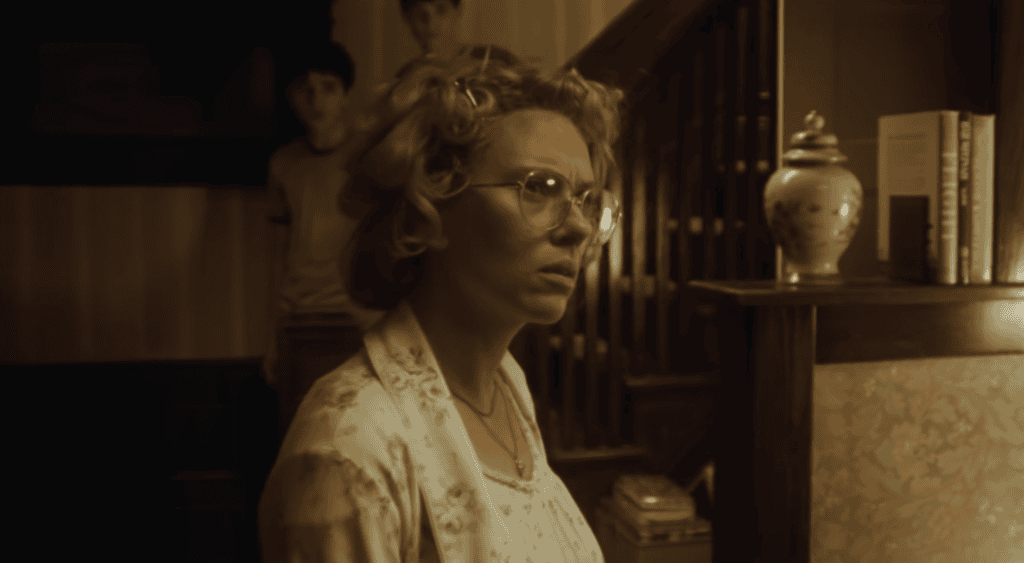
Courtesy of Neon
On the note of authenticity and actors, I know you faced a little backlash for casting non-Jewish actors in Jewish roles for Armageddon Time.
May I say one thing? You’re not wrong, but to me, nothing could be dumber.
Well, what is your philosophy on casting actors with ethnic or religious backgrounds different from the characters they’re playing?
I just cannot understand where this comes from. I suppose it comes from a very well-founded and ethically correct position, which is that there are not enough roles for women in general, for Black actors, for Latino actors, for disabled actors. All of that’s true. But let me put that in one bucket. That’s the system being screwed up and our economic system is racist and our political system has failed us. And all of that’s true. It’s all true. You can’t really contest that. On the other hand, there is the choice of the artist—him, her, or themselves. And I’m Jewish. If I think that Annie Hathaway can play my mother, then she can! And for someone else to say: “She’s not authentically Jewish.” Well, what they really mean is she’s not authentically Jewish by the stereotype.
But I will tell you, Scarlett Johansson is Jewish and is from New York. And I’ve still gotten people going, “That’s the top.” Or, “It’s not real.” Or, “She’s doing XYZ wrong.” The stupidest approach to viewing any work of art is always the most common one, which is to assault it first from the position of believability or what Hitchcock called, with great resentment by the way, “the plausibles.” That could never happen. Because that is the person who is not open to the idea of transcendence in a work and wants to view it as an explanation of facts. So, the actor is not playing a documentarian representation of the person. The actor is playing the part to bring expert sympathy and compassion and grand and noble visions of the person’s soul. So Anthony Hopkins has tremendous grandeur. I don’t care that he didn’t go to shul. I mean, it’s ridiculous. Do we need to have a person who has Alzheimer’s to play the next King Lear, who’s not going to remember his lines? And so that’s going to be really great, because it’s so authentic? I really think that people have to understand that it’s not the job of the artists and the artistic community to fix the catastrophes of the political system.

Courtesy of Neon
At this point in your career, a lot of your New York films have started to collapse into each other a bit. One example is the phragmites grass that envelops the climactic scene of Paper Tiger, just as it does with We Own the Night. It’s an invasive species, specifically in the outerborough areas. What attracts you to these grasses, this place, as a climactic location for violence?
Yeah, well, first of all, the thing about phragmites grass is that it’s very tall. When you actually stand in it, it’s marshland. It’s very unpleasant. We were covered with ticks every day. That grass itself is about seven or eight feet tall, and you lose your sense of direction very quickly. You can’t see more than two or three feet in front of your face. It’s very dense, so it’s quite frightening. In parts off the Belt Parkway—Jamaica Bay, in that area—they’re actually protected wetlands now.
The weird thing is, they’re partly beautiful, but they’re also weeds. So it’s like, beautiful weeds that have that contradiction. It’s a dumping ground for bodies. It always has been; and so is the Gowanus Canal, by the way. Have you ever read about Lake Mead in Las Vegas? Because of drought, the water line in Lake Mead has been going down quite significantly. And as it goes down, it keeps revealing these cadavers and cars with bodies in them; mafia hits over the decades.
The other thing about the weeds is it’s New York, but it doesn’t look like New York, but it does! If you know New York, it has both of those things. It’s sort of like the natural world encroaching upon the city. And so when I did that sequence, the violence is just outside the frame. In other words, it’s the same thing with the home invasion, where it’s just a shadow on the wall. And when the guys approach the car through the frosted glass window, you wouldn’t quite see who was gonna kill him. That the fear and the fright and the danger is beyond what we can imagine. It’s outside the frame. There is that, but further, it’s his return to the natural world. In metaphoric terms, [Gary] returns to the primordial ooze, becomes one with the earth again. And so I was trying to bring a cosmic notion into the film at the end. It was the transmigration of his soul.
If you need that in New York, where are you gonna go? You can go to Central Park. But in Central Park, everything is fake. I love Central Park. I think it’s incredible, but there’s not a tree or a rock that wasn’t planted there and designed. It’s magnificent. It’s one of the great municipal decisions in human history—maybe the greatest. But it is fake. The phragmites grass off the Belt Parkway—that’s the natural world of New York.

Courtesy of Neon
At the end of the movie, there’s this beautiful speech that Irwin gives to his sons, and it conveys a lot of what your story’s moral messaging has been. It reminded me of the ending of The Lost City of Z, which has another father-son moment at its conclusion. What compels you to send off your stories with these elemental interactions, and how difficult are they to write? It seems like they have to be very fine-tuned without also being extremely cliché.
It’s a wonderful question. I mean, it depends on your taste, I suppose. Whether it’s cliched or not. I always think that inside every cliche is an archetype. An archetype is what you want to get to. What is the difference, really? Archetype is something we’re familiar with, but it’s performed or executed with such specificity and sincerity that it transcends cliché. A cliché exists when there is no emotional commitment to it. So it’s a cardboard idea that’s been put up time and again to solve a story need.
But my thinking on that was that Miles Teller—and I have to say, I’m obviously biased—I think his performance there is incredible, because here’s what he’s doing: He’s got these two kids—they’re teenagers, so they don’t really give a shit what he’s saying, right? They just listen to him and go, “Yeah, dad, OK.” He is trying to be sincere with them. He’s also trying to maintain his position as a father. But he’s not gonna break down. But he kind of maybe would under other circumstances. But he’s not going to do it in front of them. He also wants to convey to them that he means it. So he has to play both of those things. And I think that this thing works for me because he performs it really well and you can see those layers in what he’s saying.
At the end of the day, you struggle through these things. You push, you try to find particularities and specifics of character and interesting ways to tell a story. And after all is said and done, you really only have one thing, which is love. And how is love converted? We often misrepresent love as meaning some kind of sentimental notion where it’s part of a romantic comedy or something starring Annie Hathaway, which can be wonderful! But for dramatic purposes, to love somebody else is very hard, and it’s filled with layers of resentment and past histories and awkwardness and a kind of chemical difference, and all of these things that get in the way. And we have to fight to preserve that sense of love. So you’re talking about fathers and sons, and you’re writing this thing, and you’re always trying to boil it down to the essence. One word, really, is sincerity. How do you get to something that is sincere between them? And if it is [sincere], you can kind of include all the bromides or clichés that you want, because it will have inside of it an honesty in conveying the most profound and important emotion that the human being can have.
In that same vein, I’ve always found your final shots—including in Paper Tiger—to be so captivating and beautifully composed. In your last few films, your protagonists tended to exit the frame into the distance, into the future, walking through a doorway or out into the world. I know you love open endings. What attracts you to that motif?
That’s a great question. I never thought about it. You’re obviously right.
I’m thinking about Paul Graf in Armageddon Time walking down the sidewalk…
You’re 100 percent right. He walks off.
Sienna Miller walks through the doorway into the jungle in The Lost City of Z.
In The Immigrant, both of them are walking off, metaphorically. You’re absolutely right. I used to do it where the character was sitting alone, and then it would end that way. But I guess the idea is that with good and ill, with struggle and with beauty, life will go on. It’s going to continue.
You have to keep walking, to a certain extent.
You have to keep going. It’s like, “I can’t go on. I must go on.” And that’s a very important idea because we live in a culture which has totally tried to suppress notions of pain. I get it. Why the hell would I want to have a terrible headache for four straight days? Take a pill. I like that. I take Advil, thank god. Advil’s made my life much better. So I get that. It makes sense. But you can’t get rid of it all. And even if you got rid of all physical pain, you still have this pain [gesturing to his head]. A society that is founded upon the removal of all pain is not going to be one that confronts the fact that, on a daily basis, we do an excellent job at pushing down this notion all the time. But at a certain point in your life, you cannot suppress it anymore. And I think it’s why, if I may go on a soapbox, the country seems kind of unhappy. It’s not a happy country in the United States. Why? Because Johnny down the block just got a Corvette, and I’m still driving a Honda Accord. And the culture has told me I can have that if I work harder, or if God favors me, right? Calvinist predestination. Or, even worse, that I shouldn’t feel bad. I should honor the fact that he has a Corvette. So my feelings are wrong.
Yes.
And it comes out in interesting ways—opiate addictions and a large swath of the country just being profoundly lost, adrift.
[James momentarily excuses himself to answer his hotel door and then returns.]
It was funny to think about the visual of you walking off out of frame at the end of this interview, much like the end of your movies.
The truth is that the answers cannot be glib, because it gets at the root of what you’re needing to express. So much of why we feel adrift—I’ll see my children; they have more to watch than ever. And they have the familiar refrain I had in 1978: “There’s nothing on.” And, really, what they mean is there’s nothing on with grandeur.
The post James Gray’s Eternal Return to New York appeared first on BKMAG.