
The disruptions have included an incident that prompted the Federal Aviation Administration to issue a four-hour ground stop, banking service interruptions and a ransomware attack two weeks ago that is still affecting the Queens Public Library system as of publication.
While some incidents stem from technical failures rather than malicious activity, cybersecurity experts say the growing interconnectedness of digital infrastructure, coupled with advances in artificial intelligence, presents new challenges for businesses and governments alike — but it’s not necessarily cause for panic.
Adam Wandt, an associate professor of public policy at John Jay College of Criminal Justice who also serves on the school’s digital forensics and cybersecurity graduate faculty, said the recent disruptions reflect a changing threat landscape.
He said three overlapping issues are contributing to an increase in the number and sophistication of cyberattacks and other incidents: hackers’ growing access to artificial intelligence tools, companies’ increasing reliance on AI without adequate human oversight and heightened cyber activity tied to international conflicts.
Wandt said companies have been too quick to integrate AI into their operations without ensuring that knowledgeable employees remain involved in reviewing and managing those systems. He pointed to failures during technology upgrades and migrations as potential examples of what can happen when organizations rely too heavily on automated processes.
“They’re taking humans out of the loop,” he said. “Not entirely, but enough so that things that humans used to do 100% are now reliant too much on AI to do, without the human expertise.”
He added that organizations need employees who understand how to defend their systems, rather than assuming that purchasing new technology will solve the problem.
“There are no tools corporate America could buy to fix this,” Wandt said. “There are only humans that corporate America could put in place to address this problem.”
He also warned that smaller vendors can create vulnerabilities throughout the technology supply chain, particularly when they lack the resources and security capabilities of larger companies.
“The problem with our supply chain is there are so many smaller vendors, so many corporations that don’t have Microsoft capabilities or Google capabilities, and it’s going to be a painful struggle for a while for everyone to catch up and realign,” Wandt said.
Wandt also warned that a newly released artificial intelligence framework called “Artex,” which he said had been adopted by hackers in recent weeks, allows less-experienced threat actors to use sophisticated hacking techniques with little technical knowledge, potentially lowering the barrier to launching cyberattacks.
Tarek Saadawi, a professor at the City College of New York and co-founder of its cybersecurity master’s degree program, acknowledged the uncertainty surrounding recent incidents, noting that some could be cyberattacks while others may result from infrastructure updates or other technical problems.
“That’s where the confusion is happening. But there is definitely a concern,” Saadawi said. “And clearly, cybersecurity has to be embedded in everything we do nowadays.”
He described the current cybersecurity landscape as a race between attackers and defenders, with artificial intelligence increasingly being used by both sides.
“We are defenders of the system, and I see too much emphasis on the hackers using AI tools,” Saadawi said. “But also we are applying a lot of our know-how in building AI-based defense systems.”
Saadawi, who previously served on the New York City Cyber Command Task Force, said government agencies at the federal, state and city levels are working to monitor threats. He also pointed to partnerships among government, universities and private companies as an important part of those efforts.
“I think there should be more funding, more research, more effort to keep up with what is going on, and that should be pushed further,” Saadawi said.
For New York City, the stakes extend beyond protecting personal information. A significant disruption could affect transportation, communications, utilities and other services residents depend on.
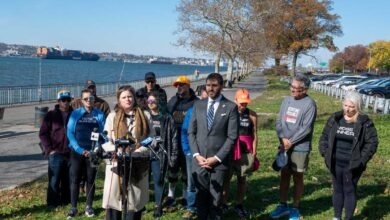
Mayor Zohran Mamdani addressed the issue Nov. 17, saying during a press conference that the city had assigned responsibilities across agencies following the 25th anniversary commemoration of the Sept. 11 attacks to ensure preparedness for large-scale disruptions.
The mayor added that the city had been communicating with state and federal partners, particularly the Port Authority of New York and New Jersey, to determine what assistance could be provided during recent disruptions.
Gov. Kathy Hochul has also sought to reassure New Yorkers, describing the recent outages as “deeply unsettling” but expressing confidence in the state’s cybersecurity response capabilities.
Hochul said the state has conducted exercises to prepare for various emergency scenarios and has worked to strengthen vulnerable infrastructure, including transportation, energy, water and sewer systems.
Con Edison and National Grid not immediately respond to requests for comment on preparation for technology outages.
Within the city government, legislation introduced by Council Member Chi Ossé could add another layer of preparedness. Intro. 1119, currently in committee, would require the city’s Office of Technology and Innovation Cyber Command and New York City Emergency Management to develop or update an emergency response plan addressing artificial intelligence-related threats to city infrastructure, operations and public health.
The proposal would also require annual reviews of the plan and progress reports to the mayor and City Council speaker.
Despite people’s concerns, both professors cautioned against panic.
Saadawi said New Yorkers should remain alert and informed without resorting to extreme preparations.
“We should be vigilant, but we shouldn’t reach the point of panic,” Saadawi said.
Wandt similarly emphasized that the country has the ability to respond to disruptions, even as organizations work to improve their defenses.
“There really is no cause for massive concern,” he said. “But there is cause for vigilance.”
Rather than treating every outage as a sign of an impending technological meltdown, Wandt said, businesses need to invest in qualified cybersecurity personnel and improve their ability to identify and respond to threats.
For residents, the recent disruptions serve as a reminder of just how much of daily life depends on systems that can, at times, fail.