Mamdani admin considers charging for more parking spots, but not as a moneymaker: DOT Commissioner Flynn

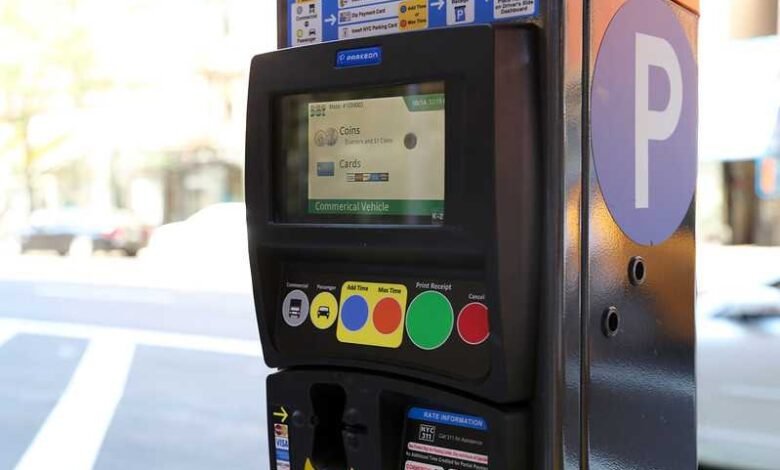
Expanding metered street parking and introducing dynamic pricing at the curb are “very much something” Mayor Zohran Mamdani’s administration is “looking at,” but it should be driven by policy and not a desire to raise revenue, Department of Transportation Commissioner Mike Flynn said on Thursday.
Flynn made the comments during an Oct. 8 New York Law School event, when he was asked to shed more light on First Deputy Mayor Dean Fuleihan’s remarks earlier this year that charging drivers for more of the city’s abundant free parking spaces was under consideration within the administration. At the time, Fuleihan framed the proposal as a way to help the city fill a sizable budget gap, which it has since closed — although outyear deficits remain.
When asked to give an update on Fuleihan’s remarks on Thursday, Flynn said that DOT’s recently created Office of Curb Management is weighing an expansion of metered parking as one of several tools for better regulating the city’s curb space.
“Pricing is just one tool, right? There’s a whole toolbox. That’s why we created this team,” Flynn said. “If there’s places where better pricing of the curb would really help the curb work better for everybody, then that should be on the table.”

Flynn said the current system, under which close to all (97%) of the city’s nearly 3 million street parking spaces are free, is not functioning well for anyone.
That’s because, in Flynn’s view, free parking allows drivers to leave their vehicles in spaces for long periods of time without getting charged. As a result, it becomes more difficult for other drivers to find open spots, delivery workers to make drop-offs, restaurant owners to build outdoor dining setups, the city to place containerized trash bins, and disabled New Yorkers to make it to their Access-a-Ride paratransit vans.
“The system as it currently works doesn’t work that great,” Flynn said. “If you’re someone who needs a car for a particular trip, for whatever reason, like you should be able to find a parking spot without having to circle for a half hour, right? If you’re a business that needs to get a delivery, you should be able to get your delivery without them having to double park…If you need an Access-a-Ride, you should be able to connect to it.”
But Flynn emphasized that he would not want such an expansion to be guided by the need to bring more revenue into the city’s coffers. He said that is because while charging for parking might work in some parts fo the city, there are other more car-dependent areas where it could create a financial burden for residents.
“We know that the city is a very diverse place,” Flynn said. “There’s neighborhoods that are more car dependent. There’s neighborhoods that are very dense and transit-friendly. You can’t do a one-size-fits-all approach. So it’s very much something we’re looking at. But it’s a big thing to unpack.”
Ending free parking should be about ‘efficiency,’ experts say
Sam Schwartz — the transportation guru who once led the city’s Department of Traffic, a forerunner to the DOT — said that while there could be a lot more revenue in expanding metered parking, he thinks Flynn is taking the “right approach.”
“There are a lot of people that are talking about monetizing the streets of New York, and numbers have been thrown out, anywhere from a billion to $12 billion could be reaped by charging people for parking,” Schwartz told amNewYork. “[But] curb management should be about what’s best for the city, and not just about revenue.”
Prior to Mamdani naming him as DOT commissioner, Flynn worked for Schwartz at his firm Sam Schwartz City Solutions for several years.
Sara Lind, executive director of the advocacy group Open Plans, echoed Schwartz’s sentiment that while metered parking generates revenue, that should not be the primary reason for expanding it.
“It’s an efficiency tool,” Lind said. “It’s a way to keep our curbs moving and keep producing availability for people to park. We are figuring out how to continually manage the demand for a competitive public space. And revenue is raised, but that’s the side effect, not the purpose.”
Fuleihan’s comments earlier this year came not long after the think tank, The Center for an Urban Future, released a policy paper arguing that the city should meter more of its parking spaces as a revenue raiser. The group also recommended other changes such as introducing dynamic pricing — a model that adjusts meter rates depending on the time of day— and creating a residential permitting system.
The group projected that the city could raise an additional $1.21 billion in revenue annually by metering 25% more of its parking spaces.